Trump: "U.S. Navy to Escort Oil Tankers"
Late Session Losses Narrow on Wall Street
Most Sectors Decline Across the Board
Tech Stocks, Which Had Supported Indices, End Lower
Safe-Haven Assets Gold and Dollar Rise
![[New York Stock Exchange] "Falling on Oil Prices, Rebounding on Trump"](https://cphoto.asiae.co.kr/listimglink/1/2025011506280389199_1736890083.jpg)
On March 3 (local time), all three major indices of the New York Stock Exchange closed lower as international oil prices surged due to airstrikes by the United States and Israel on Iran, increasing inflationary pressure.
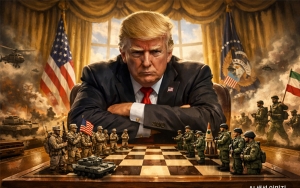
Earlier in the day, the three major indices plunged by 1% to 2% at the start of trading following reports that Iran's Islamic Revolutionary Guard Corps had closed the Strait of Hormuz. However, the losses narrowed after noon as President Donald Trump made remarks about 'escort for oil tankers'.
On this day at the New York Stock Exchange (NYSE), the Dow Jones Industrial Average closed at 48,501.27, down 403.51 points (0.83%) from the previous trading day. The S&P 500 index, which focuses on large-cap stocks, fell by 64.99 points (0.94%) to 6,816.63, and the tech-heavy Nasdaq index closed at 22,516.691, down 232.167 points (1.02%) compared to the previous session.
At the start of trading, the New York Stock Exchange saw a sharp decline due to concerns that the war between the United States, Israel, and Iran could be prolonged. The closure of the Strait of Hormuz by the Iranian Revolutionary Guard Corps after the airstrikes fueled expectations that the rise in international oil prices would continue, heightening worries about inflation.
Jeffrey O'Connor, Head of US Equities Structure at Liquidnet, pointed out in an interview with CNBC, "Historically, the US market has been able to overlook geopolitical shocks, but the closure of the Strait of Hormuz is never a trivial matter."
About 20% of the world's oil consumption is supplied through the Strait of Hormuz. The closure of the strait, if it leads to a continued rise in oil prices, will inevitably affect future inflation and US Treasury yields, and could also alter the path of interest rate cuts.
![[New York Stock Exchange] "Falling on Oil Prices, Rebounding on Trump"](https://cphoto.asiae.co.kr/listimglink/1/2025012308584010173_1737590320.png)
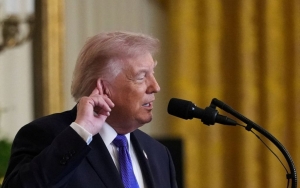
Subsequently, when President Trump posted on the social media platform Truth Social that "if necessary, the US Navy will begin escorting oil tankers through the Strait of Hormuz as soon as possible," market concerns were eased.
Fawad Razaqzada of Forex.com commented, "The market right now is reacting to every headline," and added, "Much will depend on whether tensions with Iran ease, or whether this marks the beginning of a prolonged disruption to global supply chains."
As a result, oil and airline stocks declined. Exxon Mobil fell 1.61%, Chevron dropped 0.37%, Delta Air Lines declined 0.03%, American Airlines lost 0.64%, and United Airlines was down 0.65%.
Technology stocks, which had been supporting the downside of the indices, also fell across the board as expectations for interest rate cuts due to rising inflation diminished. Nvidia closed down 1.50%, Apple fell 0.42%, Amazon dropped 0.06%, Alphabet Class A was down 1.22%, Broadcom declined 1.75%, and Tesla ended the session down 2.85%.
![[New York Stock Exchange] "Falling on Oil Prices, Rebounding on Trump"](https://cphoto.asiae.co.kr/listimglink/1/2025021302054530239_1739379946.jpg)
However, some believe that it is too early to call this a bear market. Nancy Tengler of Laffer Tengler Investments said, "It may take time for the situation to stabilize, and it could take several weeks," adding that she does not view this as the beginning of a bear market.
Ed Clissold and Tan Nguyen of Ned Davis Research also told Bloomberg that unless there is a prolonged disruption in oil supply, it is unlikely that the Iran war alone would end the cyclical bull market.
Meanwhile, on the New York Mercantile Exchange, West Texas Intermediate (WTI) crude for April delivery closed at $74.56 per barrel, up $3.33 (4.67%) from the previous session. On the London ICE Futures Exchange, Brent crude for May delivery settled at $81.40 per barrel, up $3.66 (4.71%).
Amid a preference for safe-haven assets, the US dollar strengthened. As of 4:30 p.m. Eastern Time (6:30 a.m. Korea time), the ICE US Dollar Index, which measures the dollar's value against the currencies of five major countries, stood at 99.04, up 0.67% from the previous session. On the other hand, gold futures for April delivery on the New York Mercantile Exchange traded at $5,089.4 per ounce, down 4.2% from the previous session.
© The Asia Business Daily(www.asiae.co.kr). All rights reserved.