Administrative Status Equivalent to Seoul and Up to KRW 20 Trillion in Annual Fiscal Support
Mega-Regional Economic Zone Launched with 3.2 Million Residents and KRW 159 Trillion GRDP
Citizens' Briefing Held Ahead of July 1 Launch: "Toward a City of Full Employment"
Gwangju and Jeonnam will be unified for the first time in 40 years since Gwangju was separated in 1986. With the passage of the "Special Act on the Establishment of the Jeonnam-Gwangju Unified Special City" by the National Assembly, a unified special city with a population of 3.2 million will be launched on July 1.
On March 4, Gwangju Metropolitan City and Jeollanam-do held the "Gwangju-Jeonnam Administrative Integration Citizens' Briefing" at the main auditorium of Korea Energy Engineering University in Naju, where they shared the process of passing the special act and their future vision. The briefing was attended by Gwangju Mayor Kang Gijung, Jeonnam Governor Kim Youngrok, the chairpersons of the city and provincial councils, members of the Pan-Citizens Council, and about 700 citizens from both regions.
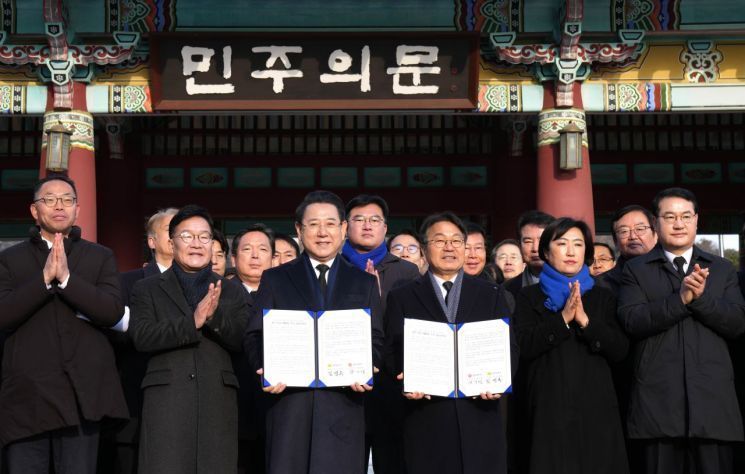 Jeollanam-do and Gwangju City, welcoming the Year of the Byeong-O, declared on January 2 at the National May 18th Democratic Cemetery, in front of the May spirits symbolizing South Korea’s democratization, to immediately promote the grand unification of both the city and the province to open a new chapter of great revival for Gwangju and Jeonnam. Yonhap News
The event included a special act briefing and programs for citizen participation. In the "Changes Expected by Citizens" QR code poll, job creation, corporate investment attraction, and promoting youth settlement were selected as major tasks. In the hope message presentations by 10 citizen representatives, fostering high-tech industries such as artificial intelligence (AI) and semiconductors, balanced regional development, and revitalizing local commercial districts were highlighted.
The Jeonnam-Gwangju Unification Special Act passed the National Assembly plenary session 59 days after Mayor Kang and Governor Kim issued the "Jeonnam-Gwangju Grand Integration Joint Declaration" at the Gate of Democracy of the National May 18th Democratic Cemetery on January 2. This is the first administrative integration in 40 years since Gwangju's separation.
During this process, the two regional governments stated that they had gathered feedback through public hearings touring the cities, counties, and districts of Gwangju and Jeonnam, five joint meetings between local lawmakers and the mayors/governors, and explanatory sessions at the local councils. They explained that public opinion among citizens was approximately 70% in favor of the integration.
The special act grants the unified special city an administrative status equivalent to that of Seoul Special City, expanding its autonomy, fiscal authority, and organizational rights. The government led by Lee Jaemyung proposed incentives, including up to KRW 20 trillion in financial support over four years (KRW 5 trillion per year) and preferential treatment for the relocation of a second round of public institutions.
The unified special city will launch with a population of 3.2 million and a gross regional domestic product (GRDP) of KRW 159 trillion. The plan is to create a mega-regional economic zone by combining Gwangju's strengths in artificial intelligence and high-tech industries with Jeonnam's infrastructure in renewable energy, agriculture, fisheries, and aerospace. There are also plans to improve access to administrative, medical, and cultural services by expanding the metropolitan transportation network and integrating living zones.
Gwangju City and Jeonnam Province stated, "Going forward, we will improve the special act's exceptional clauses to further develop the model for local autonomy and decentralization."
© The Asia Business Daily(www.asiae.co.kr). All rights reserved.