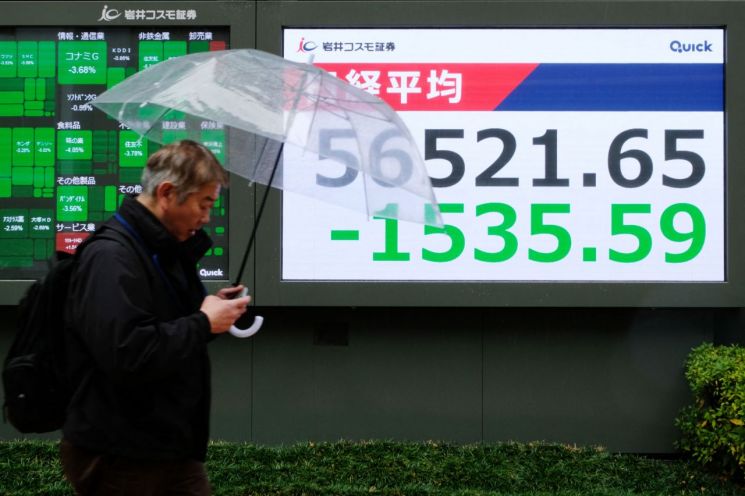
 On the 3rd, a pedestrian is passing in front of the Nikkei Index display board. Photo by AFP Yonhap News
Amidst negative developments originating from the Middle East, major Asian stock markets all showed a downward trend, with Japan’s leading stock index, the Nikkei 225 Average (Nikkei Index), falling for the second consecutive day on March 3.
On this day, the Nikkei Index closed at 56,297.05, down 3.06% from the previous session. According to Nihon Keizai Shimbun (Nikkei), at one point during the session, it dropped by more than 1,900 points compared to the previous day, marking the largest decline so far this year.
According to Nikkei, more than 90% of the stocks listed on the Tokyo Stock Exchange Prime Market fell on this day. The media explained that continued tensions between the United States and Israel on one side and Iran on the other prompted investors to seek risk aversion.
On March 2 (local time), the Dow Jones Industrial Average closed at 48,904.78, down 0.15% from the previous trading day, showing relative resilience in the U.S. stock market. However, the Japanese stock market did not follow this trend. Nikkei explained that, unlike the United States-a crude oil exporter-Japan’s economic structure is highly dependent on Middle Eastern oil, which appears to have contributed to the difference.
The yen weakened on this day. As of 4:06 p.m., the exchange rate was moving at around 157.21 yen per U.S. dollar.
© The Asia Business Daily(www.asiae.co.kr). All rights reserved.