It has been revealed that prosecutors have been actively utilizing private generative AI-based case law search services in their work. The prosecution is expected to introduce its own AI model into the next-generation Criminal Justice Information System (hereinafter referred to as KICS) by 2027, thereby establishing an AI system centered on its internal network.
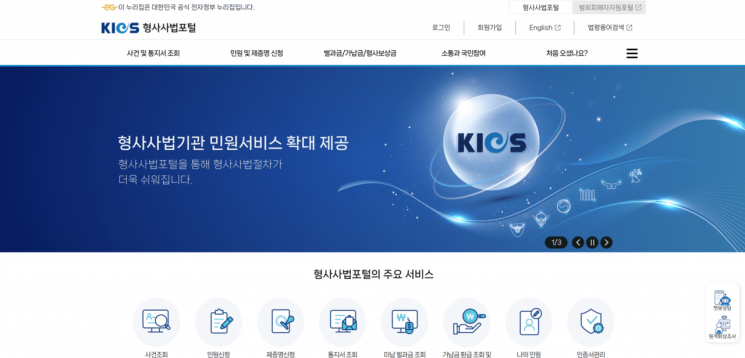 Prosecutors have been actively utilizing private generative AI-based case law search services in their work. Screenshot from the website
According to a Supreme Prosecutors’ Office official on February 25, as reported by The Law Times, “A formal contract was signed with LBox in August 2025, and we have been using generative AI case law search services and other related features. These services are actively being used for legal review, searching for case precedents and references on similar cases, and analyzing the standards for determining guilt or innocence in case law.” The prosecution had previously entered into trial service agreements with Superlawyer and LBox in January 2025 and conducted a pilot operation. The official explained, “Based on the feedback collected during the pilot operation in the first half of 2025, as well as a comprehensive review of the benefits of the CaseNote DB service and the contract terms, we ultimately signed a formal contract with LBox AI.” He added, “Since the formal agreement, the number of prosecutors and investigators utilizing LBox AI in their work has been steadily increasing. Many within the prosecution have evaluated it as being of substantial help for legal reviews and searching for similar precedents.”
An LBox representative stated, “LBox AI has minimized the hallucination phenomenon-typically a weakness of general AI-through its vast data and unique AI technology. This appears to have earned positive reviews from prosecutors and investigators in the field.”
However, it was also noted that some remain cautious in their work due to ongoing issues such as AI hallucinations. Regarding the existence of usage guidelines, the Supreme Prosecutors’ Office said, “Currently, the AI features used in the prosecution’s KICS are limited to (early-stage) search functions, and all personal information, including case numbers, is fully anonymized so that only text information is provided. There is therefore no separate internal user guideline for the service.” The ‘Similar Case Investigation Document Recommendation Service,’ which uses the initial AI technology ‘FastText,’ allows users to enter specific criminal facts and then searches completed cases to provide information on similar cases, including judgments, prosecutors’ decisions, and records, ranked by similarity.
They also stated, “When using the LBox AI service, we comply with the security guidelines for generative AI services presented by the Ministry of the Interior and Safety and the National Intelligence Service.”
The prosecution had already adopted and operated the ‘Similar Case Investigation Document Recommendation Service’ within KICS; while the early AI technology focused on similarity-based searches is effective for large-scale data retrieval, it has limitations, such as restricted contextual understanding and a lack of text summarization or generation capabilities.
Nayoung Shin, The Law Times Reporter
※This article is based on content supplied by Law Times.
© The Asia Business Daily(www.asiae.co.kr). All rights reserved.