Revision of the Child Allowance Act and Expansion of the Jeonnam Student Allowance: "The Beginning of K-Welfare"
Jeonnam Office of Education Launches Promotional Campaign at Samsan Middle School
Kim Daejung, Superintendent of Jeonnam Provincial Office of Education, declared the opening of a new era of K-welfare centered on "basics and balance" that goes beyond selectivity and universality, in light of the revision of the Child Allowance Act and the expansion of the Jeonnam Student Education Allowance. He defined this as a survival strategy to overcome the national crises of population extinction and the concentration of population in the capital region.
On March 2, through his Facebook page, Superintendent Kim emphasized, "The population decline in our country is so severe that Elon Musk warned of 'national extinction,'" and added, "The government, under the principle of popular sovereignty, has elevated regionally-led growth through the 'Five Poles, Three Specials' policy as a national survival strategy to overcome the unipolar system centered on the capital area."
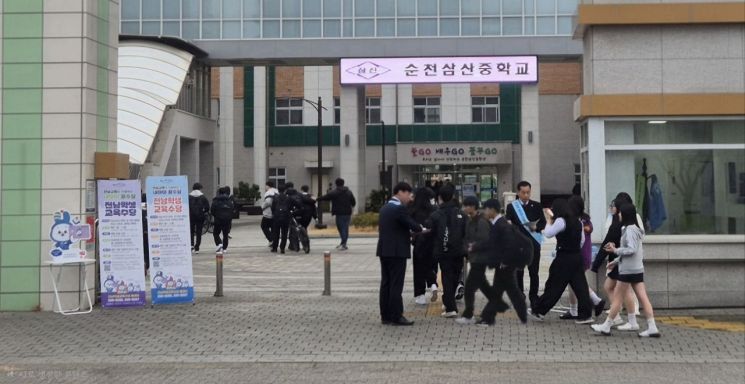 Jeonnam Provincial Office of Education visited Samsan Middle School to conduct the "Jeonnam Student Education Allowance On-site Campaign." Provided by Jeonnam Provincial Office of Education
He explained that the recent revision of the Child Allowance Act and the passage of the Jeonnam-Gwangju Special Integration Act were measures taken in this context. In particular, the revised Child Allowance Act, which passed the National Assembly on March 1, expanded the eligibility for the allowance from the current age of under 8 to under 13 and introduced differentiated support for non-capital regions and areas experiencing population decline.
Superintendent Kim described welfare in a capitalist system as a social safety net and a minimum means of wealth redistribution to mitigate inequality. He said, "This revision puts an end to unproductive debates between conservatives and progressives and provides a practical solution tailored to the Korean reality." He further explained, "Differentiated support for non-capital regions and population decline areas was a response to President Lee Jaemyung's request, and it is a design for balanced development rather than mechanical equality."
The 'Jeonnam Student Education Allowance,' which the Jeonnam Provincial Office of Education is prioritizing, is aligned with this approach. Starting this year, the office has expanded the payment of the allowance to include first and second-year middle school students (50,000 won per month), in addition to elementary school students. This is part of proactive educational administration aimed at narrowing the education gap outside the public education system and making Jeonnam a region that attracts children.
Superintendent Kim stressed, "The right to education guaranteed by the Constitution must be equally protected, whether on an island in Sinan or in Gangnam, Seoul," and added, "The Jeonnam Student Education Allowance will serve as a breakwater to reduce the education gap with the capital region and prevent regional extinction." On-site activities to ensure the policy's establishment are also accelerating. On March 3, the Jeonnam Provincial Office of Education visited Samsan Middle School to conduct the "Jeonnam Student Education Allowance On-site Campaign."
On this day, officials from the Office of Education distributed application guides to first and second-year middle school students who will benefit from 2026 and explained the eligibility and important details in terms that students could easily understand. In particular, they emphasized that students who transfer from other cities or provinces, or those who have not previously applied, must follow a separate application process.
Starting with this campaign, the Office of Education plans to operate a variety of programs, such as the "Visiting Symbiotic Economy Class" and a contest for creative uses of the allowance. Additionally, the office will actively promote policy changes in connection with regional parent-teacher associations.
Superintendent Kim Daejung stated, "The passage of the Jeonnam-Gwangju Special Integration Act has laid the foundation for educational integration," and expressed his ambition, saying, "We will rectify the imbalance tilted toward the capital region and create a 'K-Education Special City' led by Jeonnam and Gwangju."
© The Asia Business Daily(www.asiae.co.kr). All rights reserved.