Grok Accurately Predicted February 28
Other AIs Suggested Early March
Controversy Over Actual Deployment of 'Claude' in Military Operations
The United States and Israel launched a surprise airstrike on Iran on the 28th of last month (local time), removing Supreme Leader Ayatollah Seyyed Ali Khamenei. It has become a hot topic online as it was revealed that Elon Musk's artificial intelligence (AI) "Grok" accurately predicted the date of the airstrike. At the same time, it was also revealed that the US military actually used Anthropic’s AI model "Claude" in a real military operation, further fueling the debate over the military application of AI.
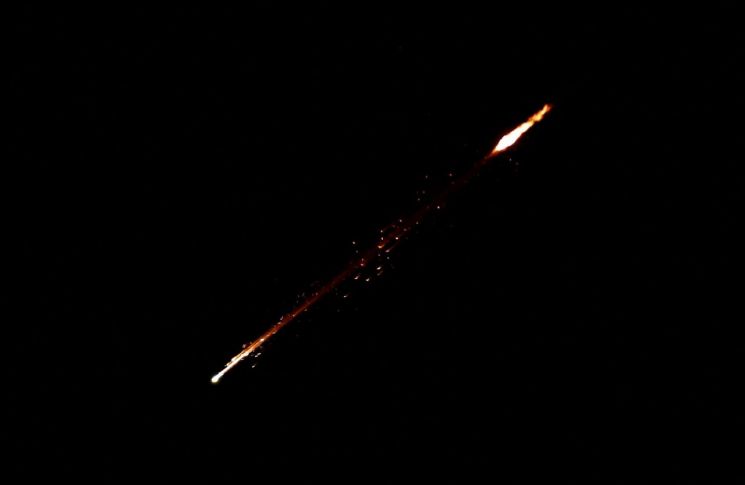 The United States and Israel launched a sudden airstrike on Iran on the 28th of last month (local time), aiming to eliminate Supreme Leader Ayatollah Seyed Ali Khamenei. Meanwhile, Elon Musk's artificial intelligence (AI) "Grok" accurately predicted the date of the airstrike, sparking a sensation online. Photo by Yonhap News Agency
 On the 28th (local time), smoke rises over Tehran, Iran, following an Israeli attack. Photo by AP Yonhap News
According to the Jerusalem Post on the 2nd (local time), the media outlet conducted an experiment on the 25th of last month with four major AI platforms, presenting them with a hypothetical US-Iran conflict scenario and asking them to select a date for an airstrike. By repeatedly prompting the models that initially avoided giving an answer, the experimenters compelled them to specify a date. As a result, only Grok from xAI, founded by Elon Musk, pinpointed February 28th exactly. In contrast, Anthropic’s Claude suggested March 7th-8th, Google’s Gemini indicated March 4th-6th as possible airstrike dates, and OpenAI’s ChatGPT, after first mentioning March 1st, later revised its prediction to March 3rd in response to additional questioning.
Grok's prediction spread rapidly on social media immediately after the airstrike. Analysts have pointed out that the influence was amplified because Grok is closely linked with X (formerly Twitter), which is owned by Musk. The media outlet noted, "The more users demand certainty, the more AI tends to provide specific answers even in uncertain situations." Experts believe that this case does not indicate supernatural predictive abilities, but rather that Grok likely identified the most probable date based on the heightened tensions in the region.
In the meantime, another controversy related to AI has emerged. The Wall Street Journal (WSJ) reported on the 1st (local time), citing government officials, that the US military used Anthropic’s AI model Claude during the recent airstrike on Iran. According to the report, US Central Command employed Claude for intelligence assessment, target identification, and battlefield simulations.
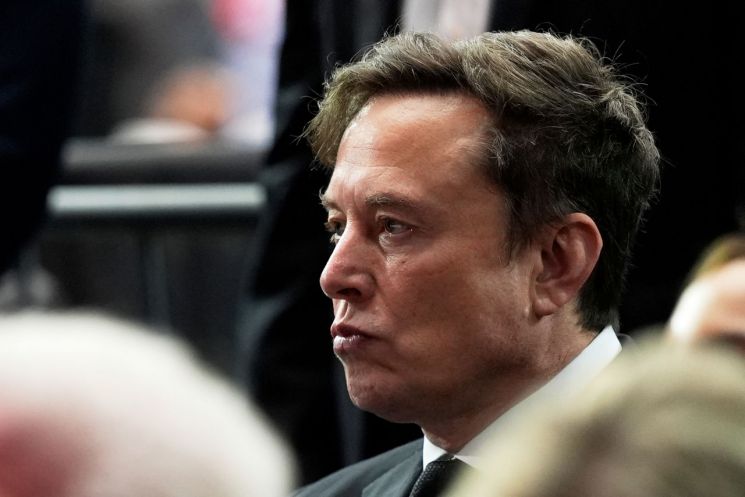 Grock's prediction quickly spread through social media immediately after the airstrike. In particular, it is analyzed that the fact Grock is closely linked to X (formerly Twitter), owned by Musk, increased its impact. Photo by AP Yonhap News
Previously, President Donald Trump criticized Anthropic as a "radical left-wing company" and hinted at a policy to ban its use within federal agencies. However, it was in fact deployed in military operations. The US Department of Defense is seeking to expand the scope of AI’s military applications, but Anthropic is known to adhere to the principle of not providing technology for large-scale surveillance or the development of fully autonomous lethal weapons.
The Trump administration is considering switching to other AI models such as OpenAI and Grok in the future, but some observers note that it will not be easy to replace the already established public AI systems in a short period of time. Industry forecasts suggest that a complete transition could take at least six months. This situation not only raises excessive expectations regarding AI’s predictive abilities, but also brings to light the issues of ethics and control in military applications. As AI becomes increasingly established as a tool for information analysis and decision-making support, attention is being paid to whether institutions and regulations can keep pace with the speed of technological advancement.
© The Asia Business Daily(www.asiae.co.kr). All rights reserved.