Adoption of a 'Swap' Structure Combining Local Government Bonds and Public Finance
Plan to Return Investment Profits as 'Lifetime Income'
"The integrated special city of Jeonnam and Gwangju will no longer limit itself to simply providing land or offering tax breaks. The city government and its citizens will become direct investors themselves."
Min Hyungbae, a candidate for the Democratic Party's mayoral primary for the integrated special city of Jeonnam and Gwangju, held a press conference on the afternoon of March 3 at the Gwangju City Council briefing room, where he presented the "Investor Jeonnam Gwangju Model" as a new strategy for attracting businesses to the integrated special city. The concept is for the integrated city to participate as a strategic investor, acquire equity stakes in companies, and return those profits to citizens as part of their "lifetime income."
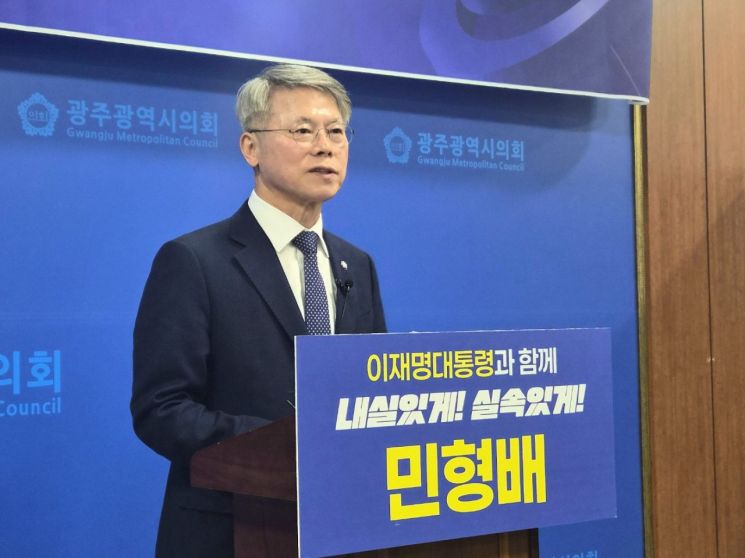 Min Hyungbae, the Democratic Party of Korea candidate for the mayoral primary election of the Jeonnam-Gwangju Integrated Metropolitan City, held a press conference on the afternoon of the 3rd at the briefing room of Gwangju City Council and announced the "Investor Jeonnam-Gwangju Model." Photo by Song Bohyun
Min stated, "I welcome Hyundai coming to Jeonbuk," adding, "We will take it a step further by attracting investment not only from domestic companies such as Samsung Electronics and SK Hynix, but also from global companies like Microsoft, AWS, and OpenAI." He explained, "We are currently having in-depth discussions with various domestic and international companies about a new investment model, and we are sharing feasible plans."
Min characterized the traditional approach to attracting companies as "the old-fashioned method of providing land and tax breaks," and said, "We will move beyond the subcontractor-style industrialization of the past, where cities were left with only buildings and jobs as companies moved on." Instead, he announced that the integrated special city would take the lead in using its own funds to address land compensation and infrastructure development.
To this end, he proposed introducing a structured finance model that links local government bonds, public finance, Korea Development Bank, and pension funds, and designing a blended finance structure that combines central government fiscal and policy financing. He explained that the so-called "swap" method would be used, in which the integrated city secures company shares equivalent to its investment costs, creating a structure where both the city and its citizens become investors.
He also announced plans to establish, if necessary, an "Ultra-Advanced Strategic Industry Investment Corporation" (tentative name) under the integrated special city, or to create a Special Purpose Company (SPC) to secure equity stakes. He described this as a model in which the city government and citizens contribute capital and share investment returns with companies.
Min stated, "We will open a path to new growth and ultra-advanced industrialization, where the city government and citizens provide capital together, share the fate of companies, and jointly benefit from investment returns," describing this as the concept of "Jeonnam Gwangju as Investor."
He also announced plans to combine this with a "Citizen Shared Capital Fund," enabling public and citizen capital to jointly participate as investors in global ultra-advanced corporate investment projects. From the perspective of companies, this would help distribute initial investment risks, while the integrated special city would become a partner that secures equity and dividends.
Min emphasized that, if this model is established, the integrated special city can escape the past failures of losing out in the competition to host ultra-advanced global companies, stating, "We will become investors who co-design new industries and companies together with the private sector."
He also outlined a plan to not only generate jobs and increase tax revenue through expanded investment, but to secure equity returns and structure these as "lifetime income." The plan includes providing scholarships and housing capital for young people, retraining and career transition support for middle-aged residents, and stable retirement income for the elderly.
Min said, "With short-term cash support measures repeated every year, it is difficult to guarantee the future of the integrated special city," and emphasized, "The entire integrated city must become a long-term investor and a dividend-sharing community." He added that the city would participate as an investor in projects undertaken with corporations such as data centers, power plants, and semiconductor fabs, and establish a virtuous cycle in which the resulting benefits are returned to citizens.
He stated, "In the AI era, the employment structure could be rapidly reorganized," stressing, "Beyond wage income, dividend and asset income should be shared by the local community." He added, "We will become a city that manages capital, not one dependent on subsidies, and we will be an equal strategic partner with companies."
Min also noted, "This initiative has undergone policy review and simulation, and we have been consulting with financial and industry experts," adding, "Soon, we will present a more refined blueprint in the form of the 'Jeonnam Gwangju Declaration (Manifesto).' "
© The Asia Business Daily(www.asiae.co.kr). All rights reserved.