Potential Applications in Security Screening, Including Explosive Detection
 (From left) Professor Woo-Seok Bang, Department of Physics and Optical Science at GIST, Hyungil Kim, integrated master's and doctoral course student.
On March 3, the Gwangju Institute of Science and Technology (GIST) announced that a research team led by Professor Woo-Seok Bang of the Department of Physics and Optical Science has developed an ultra-intense (high-flux) neutron source with stable energy characteristics by utilizing electrons accelerated with a high-power laser. Based on this technology, the team demonstrated its potential applications in security screening, such as explosive detection.
"High-flux" is a physics term referring to a state where the density of particles emitted or passing through per unit time and unit area is extremely high. When used in radiography or non-destructive testing, it serves as a key indicator for dramatically improving both imaging clarity and inspection speed.
Neutrons can easily penetrate thick metals that are difficult for X-rays to pass through, and they can also be used to distinguish organic elements such as hydrogen (H), carbon (C), and nitrogen (N) inside materials. This makes them an attractive next-generation precision security screening technology. In particular, a "laser-based neutron source" can generate neutrons without the need for large-scale facilities like particle accelerators or reactors, making equipment miniaturization and on-site application more feasible. However, until now, there have been technical limitations to simultaneously achieving both a sufficient neutron yield and a stable energy distribution necessary for precise inspection.
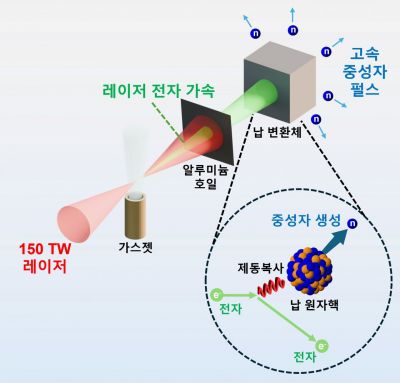
To overcome these technical limitations, the team conducted both laser-based neutron generation experiments and computer simulations, systematically verifying neutron yield and energy characteristics by comparing the results. The neutrons produced by rapidly accelerating electrons with a high-power laser and then colliding them into a lead converter were observed to be emitted in various energy states over an extremely short time period. This property is highly advantageous for neutron transmission imaging and precise material analysis. Through these results, the team confirmed that a university laboratory-scale setup can produce a high-yield neutron source and also secured the neutron characteristics and stable operational conditions required for security screening technology utilizing neutrons.
Using GIST's 150TW high-power laser, the research team succeeded in generating about 30 million neutrons per laser pulse by irradiating a high-energy electron beam onto a lead converter. This figure is among the world's highest for laboratory-scale laser-based neutron sources, underscoring the significance of achieving such a high neutron yield with compact equipment. In addition, through simulations, the team demonstrated that by optimizing the thickness and material of the converter, it would be possible to generate up to 160 million neutrons per pulse-over five times the current amount. This achievement further enhances the prospects for field applications of neutron-based imaging and detection technologies in the future.
The study also found that the neutron energy distribution remained highly stable regardless of changes in the energy of the laser-accelerated electron beam or converter conditions. This is an important result, as it demonstrates significant improvement in the energy fluctuation issue that had previously been pointed out as a limitation of laser-based neutron sources. Building on this property, the team specifically demonstrated through simulation that the generated neutrons could be used for explosive identification. This achievement confirms that it is possible to simultaneously achieve world-class neutron yield and stable energy characteristics even with laboratory-scale laser equipment, laying the foundation for practical applications such as airport security screening and industrial non-destructive testing.
Professor Woo-Seok Bang stated, "This research addresses concerns regarding the instability of laser-based neutron sources and demonstrates that the technology can be extended from laboratory studies to practical applications in imaging and detection fields."
Meanwhile, these results are also noteworthy in relation to neutron research at the fusion (artificial sun) research facility, which was recently selected as a construction site in Naju, Jeollanam-do. During the process of verifying detection and measurement technologies for the precise measurement of neutrons generated by the artificial sun, the laser-based neutron source developed in this study is expected to serve as an effective test platform.
This research, supervised by Professor Woo-Seok Bang and with Hyungil Kim, an Integrated Master's and Doctoral Program student, as the first author, was supported by the National Research Foundation of Korea’s Mid-career Researcher Program. The results were published on February 26 in 'Cell Reports Physical Science,' an international journal in the fields of materials, physics, and energy and a sister journal to the world-renowned journal Cell.
© The Asia Business Daily(www.asiae.co.kr). All rights reserved.