Industrial Development Roadmap Expected at National People's Congress
Humanoid Technology Showcased at Lunar New Year Gala
Core Components of Embodied Intelligence Standardized and Specified
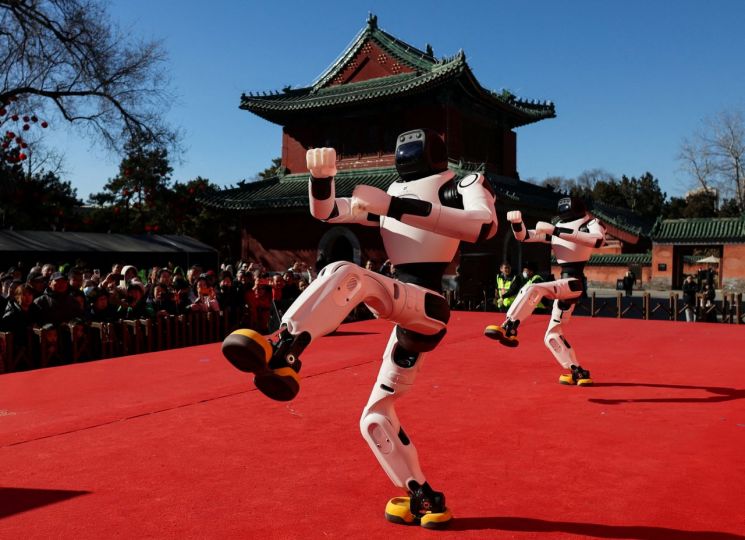 On February 18th, during the Chinese New Year Festival in Beijing, humanoid robots were dancing at a gala show. Photo by Reuters Yonhap News.
As part of its ongoing power struggle with the United States, China-which has continually emphasized "technological self-reliance"-has reportedly selected three core sectors for its next five-year industrial policy: artificial intelligence (AI), humanoids, and space.
According to Reuters on March 2 (local time), China's top leadership plans to unveil this industrial roadmap at the opening ceremony of the National People's Congress (NPC), scheduled for this week as part of the 15th Five-Year Plan (2026-2030).
These three sectors are nearly identical to the future growth engines first mentioned at last year's NPC. In last year's government work report, Chinese Premier Li Qiang referred to AI, embodied intelligence, and smart robots. Embodied intelligence refers to technology in which AI is combined with physical robots or humanoids, allowing interaction with real-world environments.
One particularly notable area is the humanoid robot industry. Humanoid robots were among the fastest-growing sectors in China last year. During the Chinese New Year holiday last month, China showcased domestically produced humanoid robots performing dances and martial arts at the CCTV gala show to demonstrate its achievements. According to the Ministry of Industry and Information Technology, more than 140 Chinese manufacturers released over 330 models in 2025 alone.
Additionally, on March 1, the Chinese government established and announced the country’s first national standard system to regulate the humanoid robot industry, as reported by Xinhua News Agency. Notably, standards have been developed for brain-like and intelligent computing, specifying the core requirements for the "cerebrum and cerebellum" of embodied intelligence. There is a particular focus on managing the entire data lifecycle, as well as the full process of model training and deployment.
However, in a January report, the US research firm Rhodium Group assessed that China’s emerging industries are unlikely to generate enough investment to sustain 5% economic growth over the next several years. The firm pointed out that the Chinese government is therefore likely to continue relying on exports to support its economy. It also predicted that, as was the case with electric vehicles, the government could intervene to "weed out" companies, given the proliferation of firms with similar technological capabilities.
The space sector is another area in which the Chinese government has devoted significant research efforts. As of 2024, China's space industry is reported to include more than 600 companies, driven by state-owned enterprises and government-backed private startups. Private space company LandSpace conducted a full-scale test of an orbital-class reusable launch vehicle in December 2023, and announced plans to attempt the recovery of its reusable rocket, Zhuque-3, again this year. Chinese private space firm Interstellar Glory recently began recruiting space tourists, with plans to send them to suborbital space in 2028.
© The Asia Business Daily(www.asiae.co.kr). All rights reserved.