Bank of Korea Holds Briefing on Provisional Third Quarter National Income Figures
With South Korea's economic growth rate for the third quarter of this year revised upward to 1.3%, the likelihood of achieving an annual growth rate above 1% has increased. The Bank of Korea stated that, mathematically, even if the economy contracts by 0.4% quarter-on-quarter in the fourth quarter, it is still possible to achieve 1.0% annual growth this year. In other words, even if growth stagnates at 'zero growth,' the annual rate can still exceed 1%. Construction investment, which was the primary reason for the upward revision in the third quarter growth rate, is not expected to be a drag on growth going forward.
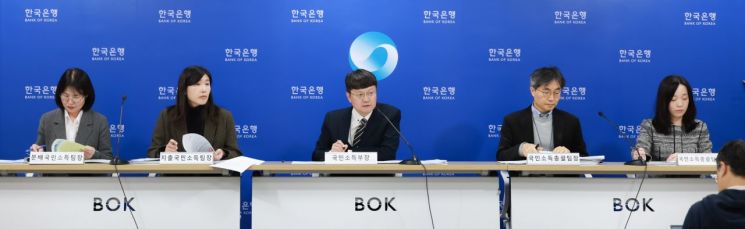 On the morning of the 3rd, the "2025 Q3 National Income (Provisional) Press Briefing" was held at the Bank of Korea in Jung-gu, Seoul. (From left) Sungja Kim, Head of Distribution Income Team; Hyunyoung Lee, Head of Expenditure National Income Team; Hwayong Kim, Director of National Income Department; Changhyun Park, Head of National Income General Team; Sunim Kim, Deputy Head of National Income General Team. Provided by the Bank of Korea
Hwayong Kim, Director of the National Income Department at the Bank of Korea's Economic Statistics Department 2, made this announcement at the "2025 Q3 National Income (Provisional)" briefing held on December 3.
Director Kim said, "Quarter-on-quarter GDP for the third quarter was 1.33%. Mathematically, if the fourth quarter growth rate is between -0.4% and -0.1%, the annual growth rate can reach 1.0%. If it is higher than that, annual growth could reach 1.1%."
Regarding the outlook for fourth quarter growth, he stated, "Looking at the October industrial activity trends, there was a temporary adjustment in manufacturing and investment due to the base effect from the holiday, but recent private consumption and export performance have shown a positive trend. This is expected to continue in the fourth quarter. However, due to the base effect of high growth in the second and third quarters, the quarter-on-quarter growth rate in the fourth quarter may be lower. The November forecast of 0.2% could be revised."
In the provisional third quarter growth figures, construction investment was significantly revised upward from -0.1% in the October preliminary estimate to 0.6%. Director Kim explained, "Despite some construction suspensions caused by safety incidents at certain construction companies during the third quarter, non-residential buildings, particularly semiconductor production plants, performed well. This also reflects additional government investment in social overhead capital (SOC)."
Regarding the substantial upward revision of investment in intellectual property products from 0.2% to 1.2%, he stated, "This was due to higher-than-expected investment in artificial intelligence (AI) services in the financial sector, the establishment of smart factories by companies, and software related to enhanced security." He also cited the increase in working days as the Chuseok holiday shifted from September last year to October this year, as well as the distribution of livelihood consumption coupons in September, as reasons for the upward revision.
With construction investment rebounding for the first time in six quarters, it is not expected to act as a drag on growth going forward. Director Kim said, "Even in the fourth quarter and beyond, the impact of semiconductor plant construction and increased government SOC investment will somewhat alleviate the sluggishness in construction investment. While construction investment dragged down growth by 1.5% through the third quarter this year, it is unlikely to be a significant drag on growth going forward."
Real gross national income (GNI), which reflects the real purchasing power of Korean citizens, increased by 0.8% quarter-on-quarter but lagged behind real GDP growth (1.3%). Director Kim explained, "Compared to the same period last year, GNI is up 2.5%, and for the cumulative three quarters, it is up 1.8%, outpacing GDP. Although there was a slight decline in the third quarter, overall, GNI continues its upward trend."
Regarding the household net savings rate rising by 0.1 percentage point quarter-on-quarter to 8.9%, he said, "Household income increased, mainly due to higher employee compensation, that is, wages, but consumption did not keep pace with the increase in income. While consumption did rise significantly due to the first round of consumption coupons in July and the second round in September, the second round was distributed at the end of September, so its use was postponed to the fourth quarter. As a result, consumption did not match the rate of income growth."
© The Asia Business Daily(www.asiae.co.kr). All rights reserved.