Government: "Follow-up Discussions to Be Held at FTA Joint Committee"
Challenges Expected in Sensitive Sectors

South Korea and the United States will begin negotiations on non-tariff issues later this month, following their agreement to reduce tariffs. The non-tariff negotiations will cover a wide range of regulations that determine actual market access for goods, including agricultural quarantine, data transfer, digital platform regulations, and product certification procedures. As these areas are more complex than tariff negotiations, more challenging adjustments are expected. Since the United States has frequently pointed to many of Korea's regulatory systems as de facto non-tariff barriers, the negotiations are expected to be particularly difficult.
On December 3, an official from the Ministry of Trade, Industry and Energy said, "As stated in the factsheet, additional discussions to promote mutual trade with the United States Trade Representative (USTR) will take place through the Korea-U.S. Free Trade Agreement (FTA) Joint Committee later this month," adding, "We are currently coordinating a specific negotiation schedule to discuss non-tariff barrier issues." The official continued, "Since both countries agreed to start follow-up discussions after the conclusion of the tariff negotiations, working-level channels will be activated according to the schedule," and added, "We will take a phased approach, taking into account domestic circumstances and the sensitivity of each industry."
The primary issue in these negotiations is expected to be agricultural quarantine and sanitary safety standards. The United States has consistently raised concerns that Korea's quarantine approval procedures are lengthy and lack predictability. As a result, shortening quarantine periods, simplifying procedures, and clarifying risk-based assessment standards are likely to be among the United States' main demands. However, since agriculture is a highly sensitive sector in domestic politics, the government has made it clear that easing standards will be difficult. Instead, the government is reportedly considering ways to improve administrative efficiency and transparency as a priority response.
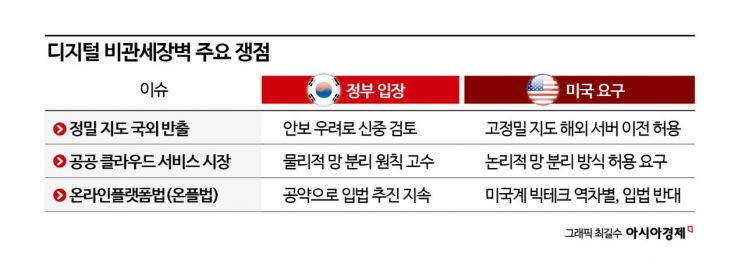
Regulation of digital platforms and the issue of data sovereignty are also major topics. The United States has repeatedly raised concerns about Korea's network usage fee policy, restrictions on overseas data transfers, and regulations on exporting mapping data. In particular, global platform companies have argued that network usage fees put foreign companies at a disadvantage, and this is likely to become a trade agenda item. However, data sovereignty and personal information protection systems are areas where Korea cannot easily make concessions, especially regarding the overseas transfer of high-risk data such as location information, which the government effectively considers a red line. Therefore, the government's negotiation strategy is to focus on strengthening procedural transparency and reviewing the competitive structure, rather than relaxing regulations.
Technical regulations such as product certification and standards are also considered important negotiation items. The United States is expected to call for institutional improvements such as expanding mutual recognition of certifications, increasing the sharing of test reports, and enhancing cooperation between certification bodies. Since there is relatively more room for adjustment in this area compared to other issues, the government is considering a certain level of procedural improvement as a negotiation card. However, the government has made it clear that it cannot accept a relaxation of product safety standards.
Pharmaceuticals and generics are also likely to become negotiation topics. The Korea-U.S. factsheet included an agreement to mutually exempt tariffs on certain strategic items, including generic pharmaceuticals. As a result, generic pharmaceuticals may become eligible for duty-free export, as the existing tariffs, particularly those under Section 232, could be reduced or eliminated. However, the factsheet specifies that this tariff exemption will not take effect immediately, but only after a non-tariff measure implementation plan is agreed upon by the Korea-U.S. FTA Joint Committee. In other words, the current tariff relief for generic pharmaceuticals is a "conditional promise based on future agreement" rather than "confirmed duty-free status" at this point. Which pharmaceuticals will be included in the exemption, as well as the procedures and timing, will depend on the outcome of future Joint Committee discussions.
In this way, the non-tariff negotiations are not simply about relaxing regulations, but are closely tied to domestic public interests such as agricultural protection, consumer safety, data sovereignty, and industrial competitiveness, which limits the scope for compromise. In particular, agriculture and data are areas where public backlash is likely, making it difficult for the government to make concessions. On the other hand, the United States is likely to demand not only tariff reductions but also substantial improvements in market access, so it is expected to take considerable time to bridge the gap between the two countries.
The Korean government has adopted a basic strategy of making limited concessions focused on procedural improvements in these negotiations. The approach is to reduce administrative delays and increase procedural predictability in quarantine and certification processes, thereby partially addressing U.S. concerns. The government aims to maintain core regulatory systems while improving inefficiencies in actual operations to find a balance. However, if the United States makes strong demands such as allowing data transfers or easing agricultural quarantine, Korea is expected to draw a firm line based on public interest and safety standards.
An official from the Ministry of Trade, Industry and Energy stated that after the start of negotiations this month, the two countries may reach visible agreements on some issues in the first half of next year through working-level meetings by sector. However, for sensitive areas, long-term negotiations or a phased approach will be unavoidable. The official added, "We will enhance transparency in the negotiation process by collecting opinions from stakeholders such as the agricultural sector, platform industry, and consumer organizations."
© The Asia Business Daily(www.asiae.co.kr). All rights reserved.