Court Cites "Room for Dispute Over Charges and Legal Interpretation"
Arrest Warrants for Key Figures Repeatedly Dismissed
Special Prosecutor's Momentum Expected to Weaken
Despite Protests That "Decision Cannot Be Accepted,"
Further Aggressive
The special prosecutor's team led by Cho Eunseok, investigating the rebellion case, filed an arrest warrant for Assemblyman Chu Kyungho as a last-ditch effort with just 10 days remaining before the end of their investigation. However, the court dismissed the warrant. As the special prosecutor's team failed to secure the detention of a sitting lawmaker, whom they considered a 'key link' in the rebellion investigation, it is now being assessed that the investigation, which has lasted nearly six months, is effectively entering its final phase.
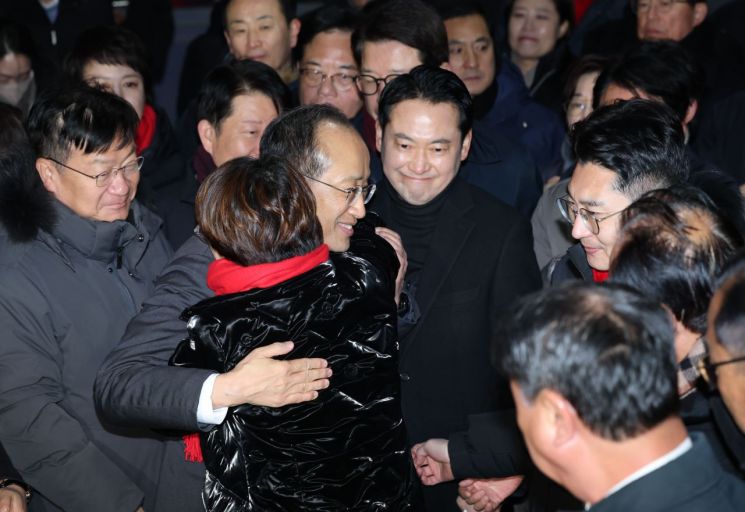 On the 3rd, Rep. Chu Kyung-ho of the People Power Party, who was accused of obstructing lawmakers' participation in the vote to lift martial law during the December 12-3 emergency martial law period, was released after the arrest warrant was dismissed and is leaving the Seoul Detention Center in Uiwang, Gyeonggi Province. Photo by Yonhap News
On the morning of the 3rd, Lee Jeongjae, the presiding judge in charge of warrants at the Seoul Central District Court, dismissed the arrest warrant for Assemblyman Chu, who was accused of engaging in key duties related to the rebellion. Judge Lee stated, "There is room for dispute regarding the charges and legal principles, so it is appropriate to conduct a thorough and careful trial before making a judgment and imposing punishment." Assemblyman Chu, who had been waiting for the result at the Seoul Detention Center, was released around 5:20 a.m. and exchanged greetings with party leadership, fellow lawmakers, and supporters.
Previously, the special prosecutor's team had applied for an arrest warrant for Assemblyman Chu on charges of engaging in key duties related to the rebellion. After the declaration of martial law, Assemblyman Chu convened an emergency general meeting of lawmakers and changed the location three times: from the National Assembly to the party headquarters, back to the National Assembly, and then again to the party headquarters. As a result, the resolution demanding the lifting of martial law was passed while 90 out of 108 People Power Party lawmakers did not participate.
The special prosecutor's team suspects that on December 3 of last year, at around 11:22 p.m., Assemblyman Chu received a phone call from former President Yoon Suk-yeol requesting cooperation with the emergency martial law, and subsequently attempted to prevent People Power Party lawmakers from participating in the vote to lift martial law.
Assemblyman Chu has denied all charges. During the hearing, he reportedly argued, "I was not aware of the illegality of the martial law declaration, and the special prosecutor has unreasonably applied for an arrest warrant based solely on circumstantial evidence."
After reviewing arguments from both sides, the court sided with Assemblyman Chu by dismissing the warrant. While there are circumstantial facts such as phone records, text notifications, and the rate of non-participation in the vote on the day martial law was declared, the court found that there was insufficient 'decisive evidence' to directly link these to the charges.
The special prosecutor's team immediately expressed strong opposition, stating, "We respect the court's decision, but cannot accept it." Special Prosecutor Park Jiyeong said at a briefing that morning, "If the court deems that pretrial detention is not necessary in such an important matter, it is questionable for whom detention would ever be appropriate. If pretrial detention is not granted simply because there is room for dispute, there is a fear that the same conduct could recur among lawmakers if similar circumstances arise."
With the dismissal of this warrant, the special prosecutor's team is expected to lose momentum in the final stage of the investigation. So far, the team has applied for arrest warrants for six individuals in connection with the rebellion allegations: former President Yoon Suk-yeol, former Prime Minister Han Duck-soo, former Minister of the Interior and Safety Lee Sangmin, former Minister of Justice Park Sungjae, former National Intelligence Service Director Cho Taeyong, and Assemblyman Chu. Among these, the court has recognized the necessity of detention for only three: former President Yoon, former Minister Lee, and former Director Cho. With arrest warrants for key figures being repeatedly dismissed, the goal of speeding up efforts to hold higher-level officials accountable is inevitably facing setbacks.
With the special prosecutor's investigation period set to end on the 14th, just over ten days remain. It is expected that the team will focus on determining whether to indict those involved based on the evidence collected so far, rather than making further aggressive attempts to secure additional detentions.
© The Asia Business Daily(www.asiae.co.kr). All rights reserved.