Mayor Min Geun Lee: "We Will Build a City Where All Generations Are Happy"
Ansan City in Gyeonggi Province has received "Age-Friendly City" certification from the World Health Organization (WHO).
On the 26th, Ansan City announced that it held a plaque ceremony at Ansan City Hall to commemorate its certification as part of the WHO Global Network for Age-friendly Cities and Communities.
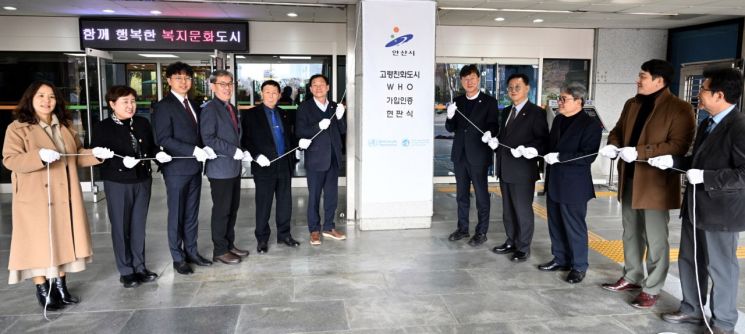 Min Geun Lee, Mayor of Ansan (fifth from the right), and other Ansan city officials held a certification plaque ceremony for the "Age-Friendly City" in the city hall lobby on the 26th. Provided by Ansan City
The international network for age-friendly cities aims to improve urban environments and services so that older adults can enjoy healthy and vibrant lives, thereby providing better opportunities for quality living.
To join the network, a city must meet standards in eight key areas: external environment and facilities, transportation convenience, residential stability, leisure and social activities, respect and social inclusion, social participation and employment, communication and information, and health and community care.
This certification is seen as the result of the city's ongoing age-friendly policies, which began with the enactment of the "Ordinance on Creating an Age-Friendly City" in 2020.
According to the city, the WHO highly evaluated Ansan for its systematic expansion of welfare infrastructure for seniors, enhancement of foundational facilities to improve quality of life, and community care policies where neighbors support one another.
The certification is valid for three years. During this period, the city plans to focus on policies that promote intergenerational solidarity, safety, and improved quality of life, aiming to build a sustainable urban model that harmonizes social participation and care.
In particular, the city has now achieved age-friendly city certification following its child-friendly city certification in 2022 and designation as a women-friendly city in 2023. This is seen as a step closer to realizing its vision of becoming "a city where children, women, and seniors are all happy together."
Meanwhile, according to resident registration population statistics from the Ministry of the Interior and Safety, as of October, 21% of South Korea's population is aged 65 or older, meaning the country has already become a super-aged society. In Ansan, the proportion of residents aged 65 or older is 16.5%, which is lower than the national average, but the city expects to enter the super-aged society category by 2029.
To meet the growing demand for welfare services, the city has established a "Mid- to Long-Term Plan for Expanding Senior Welfare Facilities" and is systematically expanding its welfare infrastructure. Currently, a complex senior welfare center is being built in Choji-dong, Danwon-gu, with plans to open in 2027, and the Guryong Senior Center and Senior Dining Hall are scheduled for completion by the end of this year.
The city has also introduced, for the first time in the country, the "Senior Care Safe Housing Model," allowing seniors in need of care to receive welfare, health, housing, and leisure services while remaining in their own communities. This year, the city established the "Ansan Housing Welfare Center" to strengthen on-site, outreach services.
Various policies are also being implemented to guarantee mobility rights for seniors. A notable example is the introduction of the demand-responsive transit service "Ttok Bus" in 2023.
In addition, next year the city will establish a dedicated job placement agency and provide customized employment opportunities for 6,317 seniors.
Mayor Min Geun Lee stated, "With certifications as a women-friendly, child-friendly, and now age-friendly city, Ansan has established itself as a city where all generations respect and care for each other. We will continue to implement policies that improve the quality of life for our citizens, making Ansan a safe and happy city for all generations."
© The Asia Business Daily(www.asiae.co.kr). All rights reserved.