President Lai Ching-te: "The Republic of China is not subordinate to the People's Republic of China"
Facing both China's growing military pressure amid the cross-strait crisis and the United States' demand for increased defense spending, Taiwan President Lai Ching-te announced on November 26 that the government will move to boost its defense budget, including an additional allocation equivalent to 58 trillion won.
During an emergency National Security Council meeting that morning, President Lai stated, "The authorities in Beijing have set a goal to achieve 'armed unification with Taiwan' by 2027, accelerating military preparations for an invasion of Taiwan while continuing drills and gray-zone incursions around the island. In addition to military means, they are intensifying legal warfare, psychological warfare, and public opinion warfare in an attempt to erase Taiwan's sovereignty on the global stage," he asserted.
He also repeatedly stressed that Taiwan is a sovereign nation, not subordinate to China. President Lai said, "'Democratic Taiwan' is a sovereign and independent country. Our citizens and international friends refer to our nation as the Republic of China, Taiwan, or the Republic of China (Taiwan). The Republic of China and the People's Republic of China (China) are not subordinate to each other, and Taiwan's sovereignty cannot be infringed or annexed. This is the status quo we are determined to uphold."
He added that national security agencies and related ministries will form a permanent project team to strengthen social cohesion in Taiwan, conduct public opinion campaigns among allied nations, and prevent Chinese interference in Taiwan's policies and elections.
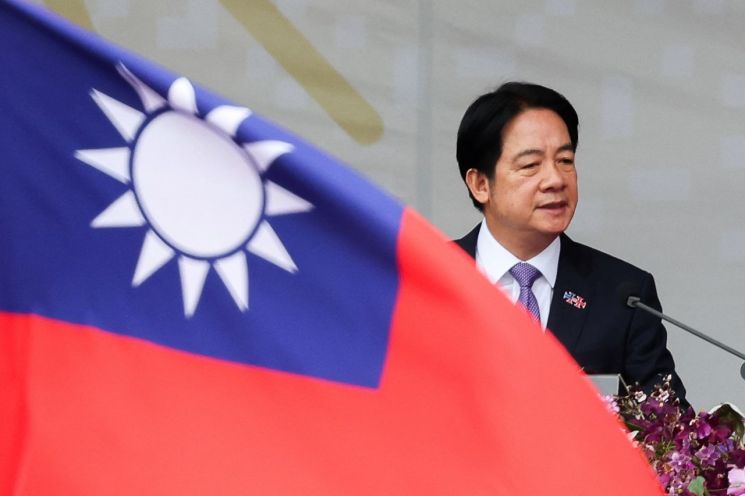
President Lai also unveiled plans to strengthen national defense in response to heightened war risks. He said that by 2027, Taiwan's joint military forces will establish a high level of combat readiness to deter threats from China, and that by 2033, Taiwan will build a comprehensive deterrence and defense capability.
He reaffirmed the goal of raising next year's defense budget to at least 3% of gross domestic product (GDP), in line with NATO standards, and to reach 5% of GDP by 2030.
Notably, President Lai explained that over the next eight years (2026-2033), a special defense budget of 1.25 trillion Taiwan dollars (approximately 39.86 billion US dollars) will be allocated to develop a 'Taiwanese Iron Dome' (T-Dome) with multi-layered defense, advanced detection, and effective interception capabilities, as well as to introduce cutting-edge technologies and artificial intelligence (AI), and to establish a precision-strike defense operation system.
On the same day, President Lai directly expressed his commitment to increasing defense expenditures through a leading US media outlet. Regarding the special 40 billion US dollar defense budget in particular, he emphasized, "This groundbreaking package will not only support major new weapons purchases from the United States, but will also significantly enhance Taiwan's asymmetric capabilities."
Raymond Greene, Director of the American Institute in Taiwan (AIT), which functions as the de facto US embassy in Taiwan, issued a statement welcoming Taiwan's '40 billion dollar special defense budget,' saying, "The United States supports Taiwan's rapid acquisition of key asymmetric capabilities needed to strengthen deterrence."
China, on the other hand, expressed opposition. During a briefing, Chinese Foreign Ministry spokesperson Mao Ning responded to questions about President Lai's defense budget announcement and Greene's remarks by stating, "China's position of opposing official and military exchanges between the United States and Taiwan remains unchanged," and added, "The Democratic Progressive Party authorities in Taiwan cannot succeed in rejecting unification by force and seeking independence."
© The Asia Business Daily(www.asiae.co.kr). All rights reserved.