655 Bankruptcies Among Large Companies This Year
Industrials and Consumer Discretionary Sectors Hit Hard
Greater Exposure for Investment Banks and Financial Institutions
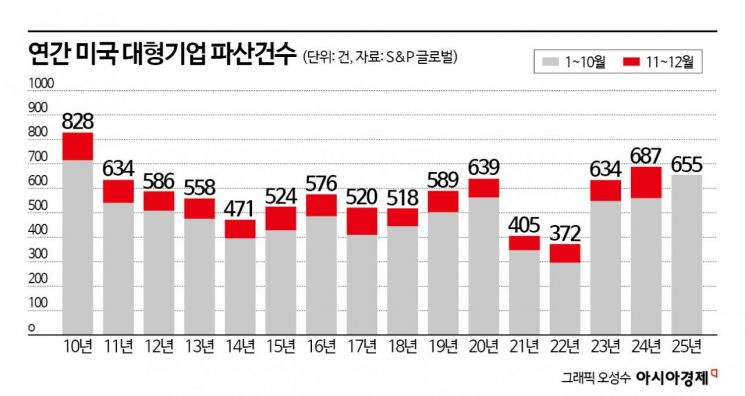
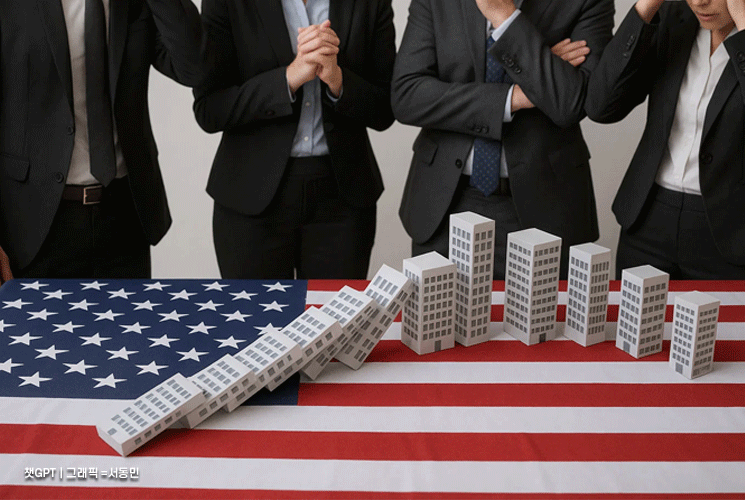
This year, the number of bankruptcies among large U.S. companies is expected to reach its highest level in 15 years, since 2010. Wall Street has grown increasingly wary following the consecutive bankruptcies of subprime auto lender Tricolor and auto parts manufacturer First Brands.
According to data released on November 13 (local time) by global credit rating agency S&P Global, the number of bankruptcies among large U.S. companies from January to October this year reached 655. This figure is already close to the annual total for 2024 (687 cases), and it is expected that the year-end tally will surpass last year's level. Large companies include both listed and unlisted firms with assets or liabilities above a certain threshold.
The upward trend in bankruptcies has continued since 2022, but the sense of crisis has intensified this year. In October, there were 68 bankruptcy filings, a slight increase from 66 in the previous month. In August, there were 76 cases, marking the highest monthly figure since 2020.
Last month, the only company to file for bankruptcy with debts exceeding 1 billion dollars was Office Properties Income Trust (OPI), a real estate investment trust (REIT) company. OPI entered bankruptcy protection proceedings while working with creditors to develop a financial restructuring plan.
By industry, industrials accounted for the largest number of bankruptcies among companies this year, with 98 cases, followed by consumer discretionary (80 cases) and healthcare (45 cases). The industrial sector is particularly vulnerable to supply chain disruptions, while consumer discretionary includes automobiles, coffee, apparel, and other products that experience significant demand fluctuations depending on economic conditions.
Reuters pointed out, "Even before the full impact of President Donald Trump's tariff policies is felt, U.S. companies are already complaining about rising costs," adding, "This is an additional burden for ordinary households already facing inflation and job insecurity."
There are also growing concerns that risks could spill over into the financial sector, including investment banks (IBs) with high exposure through loans and payment guarantees. In fact, JPMorgan Chase set aside 170 million dollars in provisions due to the bankruptcy of Tricolor, a subprime auto lender and seller. First Brands, an auto parts manufacturer producing oil filters and wipers, was embroiled in a 'fraud' controversy after more than 10 billion dollars in hidden debt was revealed. First Brands, which filed for bankruptcy protection in September, was deeply intertwined with major Wall Street financial institutions, causing significant shock to the bond market.
Jamie Dimon, CEO of JPMorgan Chase and known as the 'King of Wall Street,' referred to the First Brands case during a conference call last month, saying, "When something like this happens, my antenna immediately goes up. If you see one cockroach, there could be more nearby. Everyone needs to stay alert."
© The Asia Business Daily(www.asiae.co.kr). All rights reserved.