Three Major Changes in the Fourth Launch: Multiple Satellites, Nighttime Operation, and Transition to Private Sector Leadership
The Korean-type launch vehicle "Nuri," developed with domestic technology, is set to challenge another new milestone.
The Korea Aerospace Research Institute (KARI) will proceed with the fourth launch of the Nuri rocket at around 1:00 a.m. (between 12:54 a.m. and 1:14 a.m.) on November 27, 2025, at the Naro Space Center in Goheung, Jeollanam-do. The objective of this mission is to precisely deploy the third Next-Generation Medium Satellite and 12 CubeSats into a sun-synchronous orbit (SSO) at an altitude of approximately 600 kilometers.
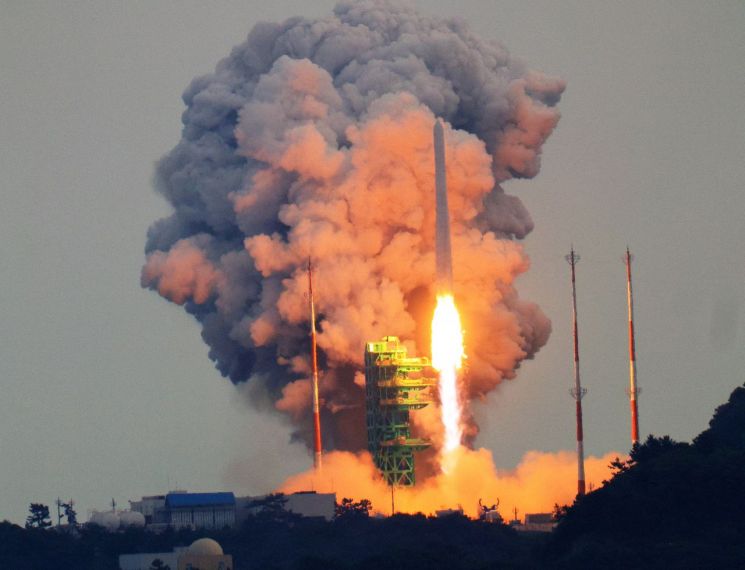 On May 25, 2023, the Nuri rocket (3rd launch) is being launched at Naro Space Center in Goheung-gun, Jeollanam-do. Photo by Yonhap News
This launch is considered a milestone that tests three changes simultaneously, moving beyond the "repeated launches" stage: ▲nighttime operation ▲multiple payloads ▲transition to private sector leadership.
Han Youngmin, Director of the Space Launch Vehicle Research Institute at KARI, stated at the Korea Science Journalists Association Media Academy on November 11, "The fourth launch of Nuri will maintain the same basic system as the third launch, but the payload configuration, separation technology, and the extent of private sector participation will be significantly different. Through this launch, we will verify both technical reliability and the foundation for industrialization."
1 a.m. Launch: Timing for the 'Aurora Satellite'
The reason for scheduling the Nuri launch in the early morning is due to the mission requirements of the main payload.
The third Next-Generation Medium Satellite must enter an orbit with a local time of ascending node (LTAN) at 12:40 p.m., where the relative positions of the Sun and Earth are fixed, in order to observe Earth's magnetic field and auroras.
To achieve this, the launch time needs to be adjusted to midnight or early morning hours. In addition, to avoid the close passage of the International Space Station (ISS) between 1:10 a.m. and 1:12 a.m., the optimal launch window is around 12:54 a.m.
Director Han explained, "Because of the satellite's observation time requirements, an early morning launch is unavoidable. If weather and upper-level winds permit, we plan to attempt ignition at the beginning of the launch window."
KARI has conducted multiple nighttime rehearsals that simulate the actual launch environment. "Technically, there is little difference between day and night launches, but personnel fatigue is a variable, so we have subdivided procedures and strengthened inspection steps," he said.
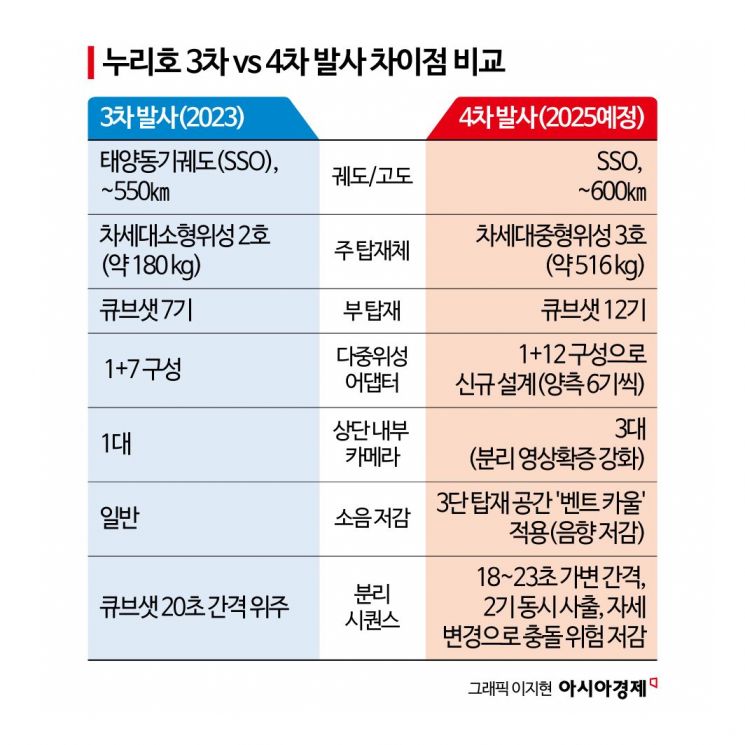
Core System Unchanged, More Sophisticated Separation and Verification Technology
The fourth Nuri launch maintains the basic structure based on a three-stage liquid engine, but the payload configuration and separation/verification methods have evolved.
During the third launch, the rocket carried the second Next-Generation Small Satellite (about 180 kg) and seven CubeSats. This time, it will simultaneously carry one medium-class main payload (the third Next-Generation Medium Satellite, about 516 kg) and 12 CubeSats.
Accordingly, KARI designed a new multi-adapter that can accommodate six CubeSats on each side. To increase the reliability of separation confirmation, the number of onboard cameras in the upper stage was increased from one to three, and a sound attenuation device called a "vent cowl" was introduced to reduce acoustic shock during separation.
The separation sequence has also been adjusted from the previous fixed 20-second intervals to variable intervals of 18 to 23 seconds, and a new method for simultaneous separation of two satellites has been applied. Nuri will make fine attitude adjustments to minimize the possibility of CubeSat collisions.
Director Han noted, "During the third launch, we had an instance where the separation video of one CubeSat was not confirmed. This time, we adjusted the camera angles and increased the number of devices to ensure the separation process can be fully verified."
The First Gateway to Industrialization with Private Sector Participation
This fourth launch is also significant as it marks the beginning of the private sector-led launch era.
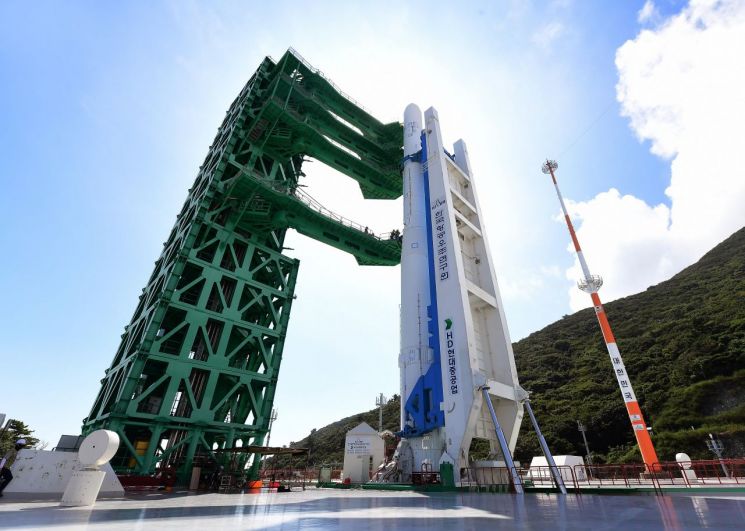 On September 16, the Nuri rocket stood upright on the launch pad at Naro Space Center in Goheung County, Jeollanam-do, for the final test ahead of its fourth launch. Photo by Yonhap News
Starting from the fourth launch, Hanwha Aerospace will serve as the system integrator, overseeing manufacturing and assembly, and will directly participate in the operation of the Launch Control Center (NCC) and Mission Control Center (MDC). The number of private sector personnel involved has increased from 21 during the third launch to 32 for this mission. KARI is responsible for overall project management and flight operations, while the Korea Aerospace Administration handles launch authorization, management, and supervision.
Director Han emphasized, "From the seventh launch onward, the private sector will handle all manufacturing, assembly, and operations, while the government will focus on supervision and safety management. The repeated launches of Nuri go beyond simple technical verification; they are opening up the industrial ecosystem."
Weather, Collision, and Environment... Triple Safety Net in Place
The most critical variables on launch day are weather, space collision risk, and the space environment. If the average ground wind speed exceeds 15 m/s or gusts surpass 21 m/s, the launch will be postponed. Eight hours before launch, a radiosonde is released to measure upper-level winds, and the final checks on load and control conditions are conducted.
Additionally, the risk of collision with crewed objects such as the ISS is assessed, and the CubeSat separation intervals and attitudes are adjusted to avoid mutual collisions. If there is severe space weather disturbance, such as solar flare activity, communication systems may be affected; however, early morning launches are relatively less impacted by solar particle storms.
Nuri will deploy the main payload into orbit about 8 to 9 minutes after liftoff. The first stage will fall into the sea southeast of Jeju Island to the Okinawa region, the fairing will fall east of the Philippines, and the second stage will fall into waters near the Philippines.
If any abnormal deviation occurs during flight, the Flight Termination System (FTS) will immediately activate and issue a destruct command. After all separations are complete, the rocket will perform a "happy (downward) maneuver" to decelerate, shorten the reentry period, and minimize the creation of space debris.
Since its successful launch in 2022, Nuri has been accumulating reliability data through its fourth, fifth, and sixth consecutive launches. The fourth launch is not just a simple repetition, but a complex mission that simultaneously involves technology verification and transfer to the private sector.
Director Han stated, "Just as SpaceX increased reliability through repeated launches, we also need to accumulate data through steady launches. The goal is for the private sector to take over the technology secured by the government and create commercial launch services."
© The Asia Business Daily(www.asiae.co.kr). All rights reserved.