Sharp Decline in Construction Orders Drives Down Demand
Shipments Expected to Remain at 36 Million Tons Next Year
Amid a severe slump in the construction industry, domestic cement shipments in South Korea this year have hit their lowest level in 34 years. The situation is further exacerbated by negative factors such as the national greenhouse gas reduction target (NDC) and the Safe Trucking Freight Rates System, making it difficult to expect a clear recovery momentum in the near future.
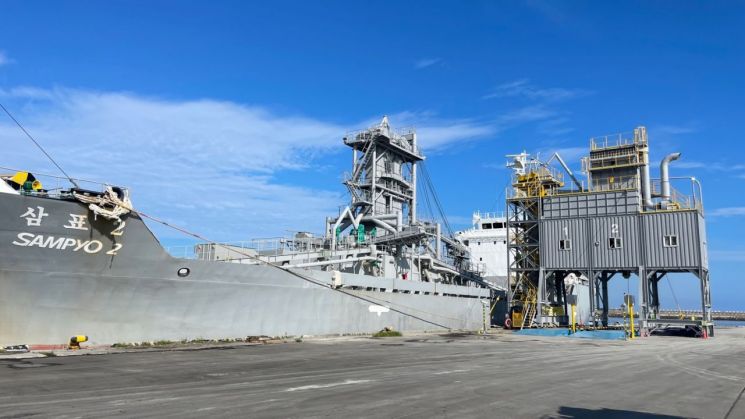
On November 11, the Korea Cement Association announced that this year’s domestic cement shipments by the country’s seven major cement producers-including Sampyo Cement, Ssangyong C&E, and Hanil Cement-are expected to reach only 36.5 million tons, a 16.5% decrease compared to the same period last year. Unless there is a clear catalyst for a rebound, projections indicate that shipments could fall further to 36 million tons next year.
Domestic cement shipments had dropped to 44.61 million tons during the International Monetary Fund (IMF) financial crisis, then recovered to 56.71 million tons by 2017. However, as the construction downturn has persisted, shipments have plummeted by about 20 million tons in just eight years. An association official emphasized, “In the early 1990s, the industry’s production capacity was only 42.1 million tons, and at that time, domestic cement demand surged due to new town development projects on the outskirts of the Seoul metropolitan area. Now, although production capacity has increased to 61 million tons, domestic demand has plunged, so considering current operating rates, the difference is far greater than the raw numbers suggest.”
The main cause of the sharp decline in domestic demand is the steep drop (18.9% decrease) in construction orders, a key leading indicator. In addition, coincident indicators such as building starts and construction progress also fell by 12.8% and 18.1%, respectively, compared to the same period last year (January to July). The budget for state-led social overhead capital (SOC) projects has also been on a downward trend for several years.
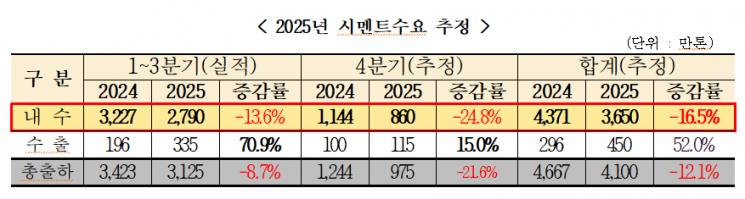
Industry observers believe that it will be difficult to expect a recovery in demand next year as well, due to continued sluggish construction starts and chronic funding issues in the construction sector, such as project financing (PF) risks and rising loan delinquency rates. However, the association analyzed that the decline is likely to be less severe than this year, thanks to the government’s strong commitment to boosting the construction industry by expanding housing supply over the next five years.
On top of weak demand, the introduction of the Safe Trucking Freight Rates System and requirements to reduce greenhouse gas emissions are compounding the industry’s difficulties. The Safe Trucking Freight Rates System has been implemented temporarily for three years since 2020, resulting in about a 40% increase in transportation costs for bulk cement trailers (BCTs). As a result, the industry has borne an additional cost of about 120 billion won over three years, while shippers’ freight burdens have also risen significantly.
An association official stated, “With weak cement demand persisting, the bigger issue for BCT drivers is not the short-term increase in freight rates, but the reduction in available work. There is a growing call for the government to swiftly implement measures to improve the business environment for the cement industry and stimulate demand.” He added, “While cement demand continues to decline, additional regulations that weaken industrial competitiveness are also being introduced one after another.”
© The Asia Business Daily(www.asiae.co.kr). All rights reserved.