Key Findings of OECD Education Indicators 2025
Public Education Expenditure per Student: $19,805
University Education Spending Falls Short of OECD Average
The amount of public education expenditure per student in South Korea was found to be $19,805, exceeding the average of the Organisation for Economic Co-operation and Development (OECD). However, for university education alone, it was lower than the OECD average.
On September 9, the Ministry of Education and the Korean Educational Development Institute analyzed and announced the main results of the "OECD Education Indicators 2025," which were compiled by the OECD after surveying 38 member countries and 11 non-member countries.
According to the survey, in 2022, South Korea's public education expenditure per student was $19,805, a 24.9% increase compared to the previous year. This figure is higher than the OECD average of $15,023. Public education expenditure refers to all spending by the government and private sector on public education, excluding the costs paid by parents for private education.
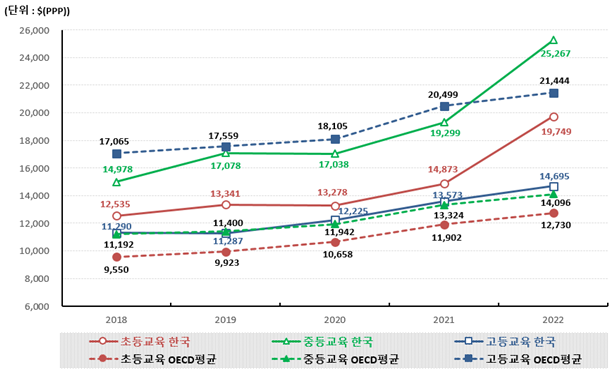 OECD Education Indicators: Trends in Public Education Expenditure per Student (2018-2022). Ministry of Education
By educational stage, the expenditure was $19,749 for elementary school and $25,267 for secondary school, both exceeding the OECD average. In contrast, for university (higher education), the figure was $14,695, which is only 68% of the OECD average of $21,444.
The indicator for the ratio of public education expenditure to Gross Domestic Product (GDP) also revealed insufficient investment in universities. In 2022, the ratio of public education expenditure to GDP for all education stages from elementary to high school in South Korea was 5.6%, an increase of 0.4 percentage points over the year. This is higher than the OECD average of 4.7%. However, government funding for higher education was 0.6%, falling short of the OECD average of 0.9%.
Although the number of students per class in schools is decreasing, it remains higher than the OECD average. In 2023, the number of students per class was 21.6 in elementary schools and 25.7 in middle schools, while the OECD averages were 20.6 and 23.0, respectively. The number of students per teacher was 15.3 in elementary schools, 12.8 in middle schools, and 10.5 in high schools, with elementary and middle schools each seeing a decrease of 0.4 and 0.3 students, respectively, compared to the previous year. The student-to-teacher ratios in middle and high schools were lower than the OECD average.
The starting salary for teachers was $37,773, lower than the OECD average of $44,465. In contrast, the statutory salaries for teachers with 15 years of experience and those at the highest salary step were $65,765 and $104,786, respectively, both higher than the OECD average.
The rate of higher education attainment among adults in South Korea was 56.2%, higher than the OECD average. In particular, the higher education attainment rate among young adults aged 25 to 64 was 70.6%, ranking first among OECD countries.
However, the employment rate by educational stage was lower than the OECD average. The employment rate was 72.5% for high school graduates, 78.6% for junior college graduates, and 79.9% for university graduates, all lower than the OECD averages of 77.6% for high school graduates, 82.5% for junior college graduates, and 85.9% for university graduates.
Additionally, in 2023, the wage gap by educational stage among South Korean adults increased compared to the previous year. When the wage of high school graduates is set at 100, the wage for junior college graduates was 109.9%, for university graduates 132.5%, and for those with a master's or doctoral degree 176.3%. In 2022, the figures were 109.2% for junior college graduates, 132.5% for university graduates, and 176.0% for those with a master's or doctoral degree.
The results of this survey will be posted on the OECD website in September. The Ministry of Education and the Korean Educational Development Institute plan to publish a translated version of the OECD Education Indicators 2025 in December and release it on the Education Statistics Service website.
© The Asia Business Daily(www.asiae.co.kr). All rights reserved.