Exynos Fully Integrated in Galaxy Z Flip7
System LSI Accelerates Performance Improvement
Samsung Display and Samsung Electro-Mechanics Also Supply Components
Samsung Electronics is bringing together the strengths of its affiliates to use its latest flagship foldable smartphones, the Galaxy Z Fold7 and Flip7, as a springboard for a rebound in performance. Key components from major electronics affiliates, including advanced semiconductor technology, display panels, and substrates, have been integrated into these smartphones. As a result, there is growing consensus that the success of the new Galaxy products will be a crucial factor in determining whether Samsung Electronics can recover its performance in the second half of the year.
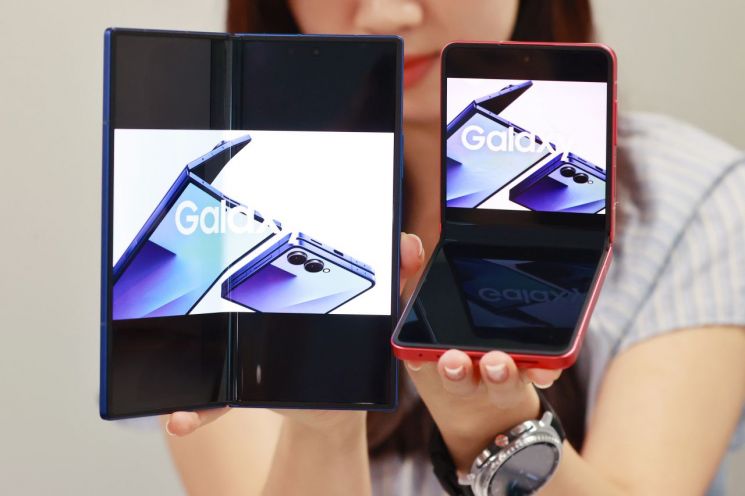 On the 10th, at the Samsung Electronics press room in Jung-gu, Seoul, an official introduced the new foldable smartphones Galaxy Z Fold7 and Flip7 during the Samsung Electronics Galaxy new product media briefing. Photo by Yonhap News
According to industry sources on July 13, Samsung Electronics held the 'Galaxy Unpacked 2025' event in New York, United States, on July 9 (local time), unveiling the Galaxy Z Fold7 and Flip7 to the global market.
In particular, the Galaxy Z Flip7, which for the first time is equipped exclusively with the company’s latest mobile application processor (AP, the brain of a smartphone), the Exynos 2500, attracted significant attention.
The Exynos 2500 was designed by the System LSI division of the Device Solutions (DS) unit, which is responsible for semiconductors, and manufactured by Samsung Foundry using the cutting-edge 3-nanometer (nm, 1nm = one-billionth of a meter) gate-all-around (GAA) process.
The budget model, Galaxy Z Flip7 FE, which was also unveiled at this event, features the 4-nanometer Exynos 2400.
During the Galaxy Unpacked press conference, Roh Tae-moon, acting head (President) of the Device eXperience (DX) division at Samsung Electronics, said, "It was confirmed that Exynos has achieved appropriate and sufficient performance and quality, so we decided to apply it to the Galaxy Flip," adding, "Given the positive initial response to the new products, we naturally expect sales to surpass last year’s figures, and that is our goal."
In addition, the Galaxy Z Fold7 is the first foldable to feature a 200-megapixel image sensor, while the Z Flip7 and Z Flip7 FE are each equipped with 50-megapixel image sensors. Samsung’s semiconductor technologies, such as display driver ICs (DDI), power management integrated circuits (PMIC), and fifth-generation (5G) modem chips, have also been fully integrated.
For these reasons, there are observations that robust sales of the new foldable products are more important than ever for improving the performance of the DS division. If the products are successful in the market, the performance of System LSI, which is responsible for core components such as APs and image sensors, could improve rapidly. Revenue from the Exynos 2500 has already started to be reflected from the end of the second quarter (initial shipments) and is expected to peak in the third quarter. Furthermore, this is likely to impact the development of next-generation Exynos chips and the expansion of models equipped with Exynos in the future.
Exynos has previously faced issues with yield (the proportion of usable finished products) as well as performance controversies such as overheating and battery drain. Whether the Galaxy Z Flip7 can dispel these market concerns is a key point. This could also lead to improved reliability for the Exynos 2600, which is scheduled to begin mass production using a 2-nanometer process at the end of this year. The Exynos 2600 is highly likely to be installed in the Galaxy S26 series, which will be released early next year.
Especially since the S series has a larger shipment volume than the Z series, if the Exynos 2600 is adopted, Samsung Foundry could achieve mass production of 2-nanometer chips following the 3-nanometer process. On July 11, Park Yongin, President of the System LSI Business at the DS division, responded to questions about second-half performance prospects at COEX in Gangnam-gu, saying, "We are steadily preparing the Exynos 2600 following the Exynos 2500," and added, "There will be good results."
Major affiliates are also increasing their expectations for second-half performance by supplying key components to the Galaxy foldable phones. Samsung Display supplied OLED panels for the front and main displays of the Galaxy Z Fold7 and Flip7. Samsung Electro-Mechanics supplied silicon capacitors for the Exynos 2500 and also provided camera modules, semiconductor substrates (BGA), and multilayer ceramic capacitors (MLCC) for the new products.
© The Asia Business Daily(www.asiae.co.kr). All rights reserved.