Rush of Hybrid Capital Securities Issuance by Domestic Financial Institutions
Capital Adequacy Management Could Become Difficult in the Event of Financial Shocks
Need to Encourage Capital Strengthening Centered on Common Equity
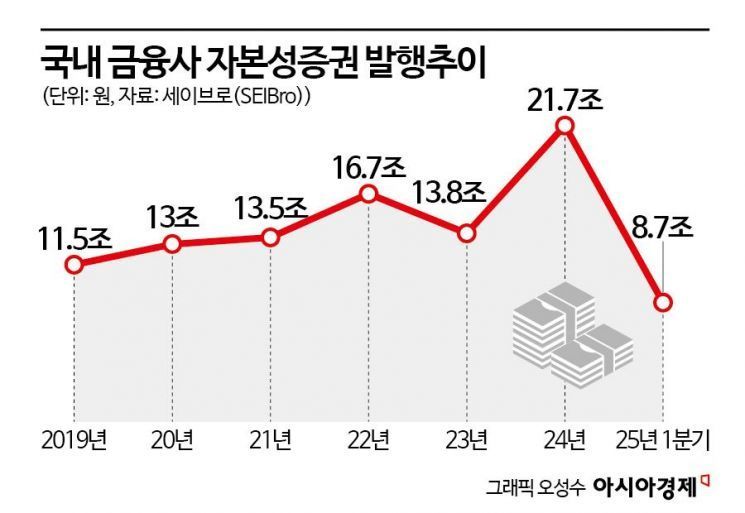
It has recently been found that domestic financial institutions have significantly increased the issuance of capital securities, such as hybrid capital securities and subordinated bonds, in order to strengthen their capital base. There are concerns that if the volatility of capital securities in the financial market increases and redemption is not properly carried out, it could negatively affect the capital adequacy and liquidity management of financial institutions, highlighting the need for supplementary measures.
According to the Korea Securities Depository and Korea Ratings (KR), as of May 2, 2025, the total issuance of capital securities by domestic financial companies in the previous year reached 21.7 trillion won, a surge of 57% compared to the year before. The trend has continued this year, with the issuance of capital securities by financial companies amounting to 8.7 trillion won in the first quarter alone.
Capital securities are divided into hybrid capital securities, which are issued as perpetual bonds, and subordinated bonds, which require mandatory interest payments and have a maturity of at least five years. Recently, the issuance of hybrid capital securities has been increasing significantly. As of last year, the proportion of hybrid capital securities in the total equity of 69 domestic financial companies averaged 20.2%, a substantial increase from 6.6% at the end of 2019.
Because capital securities are subordinated in debt repayment, they are assigned lower credit ratings compared to senior bonds. Therefore, from the issuer's perspective, the cost of raising funds is higher. Nevertheless, the steady increase in the issuance of capital securities by financial institutions is attributed to their advantages in responding to capital regulations and improving financial structures. In particular, the issuance of hybrid capital securities by insurance companies has surged from last year through this year, primarily to raise their K-ICS ratio?a capital soundness indicator introduced in 2023. As interest rates have declined, the K-ICS ratio has dropped, prompting insurance companies to issue hybrid capital securities to defend their financial soundness.
Financial holding companies and banks are also actively utilizing hybrid capital securities. Woori Financial Group plans to issue 400 billion won worth of won-denominated hybrid capital securities on May 13, interpreted as a move to strengthen capital for the acquisition of Tongyang Life and ABL Life. Previously, KB Financial Group, Shinhan Financial Group, and Hana Financial Group each issued 400 billion won worth of hybrid capital securities in the first quarter.
As domestic financial institutions continue to issue hybrid capital securities, there have been warnings that they need to manage their capital adequacy more carefully. This is because domestic financial institutions have a higher dependence on hybrid capital securities compared to overseas financial institutions, making it more likely that their capital adequacy ratios will decline further in the event of risks such as a financial crisis. According to KR, as of the end of last year, the average proportion of hybrid capital securities in the consolidated equity of the top 10 domestic financial holding companies was 12.7%, which is somewhat higher than that of overseas financial institutions (8.8% for nine North American companies and 8.2% for 11 European companies).

KR has warned that financial companies with a significantly increased dependence on hybrid capital securities are exposed to refinancing risk. If a shock occurs in the financial market or the risks associated with hybrid capital securities become more pronounced, investor demand may shrink, making early redemption difficult. In addition, if early redemption is carried out through new debt financing, the resulting decrease in equity capital could lead to a deterioration in financial soundness.
Kim Junghyun, a senior researcher at KR, emphasized, "Financial supervisory authorities need to encourage financial companies to strengthen their capital base primarily through common equity rather than through the issuance of capital securities. Financial institutions should focus on enhancing the quality of their capital by pursuing capital increases through retained earnings and paid-in capital increases, in addition to issuing hybrid capital securities."
© The Asia Business Daily(www.asiae.co.kr). All rights reserved.