Last Trading Day on the 30th
Year-End Settlement of Financial Firms and Companies Reflects Exchange Rates... Keen on Impact
High Exchange Rates Likely to Negatively Affect Soundness Indicators
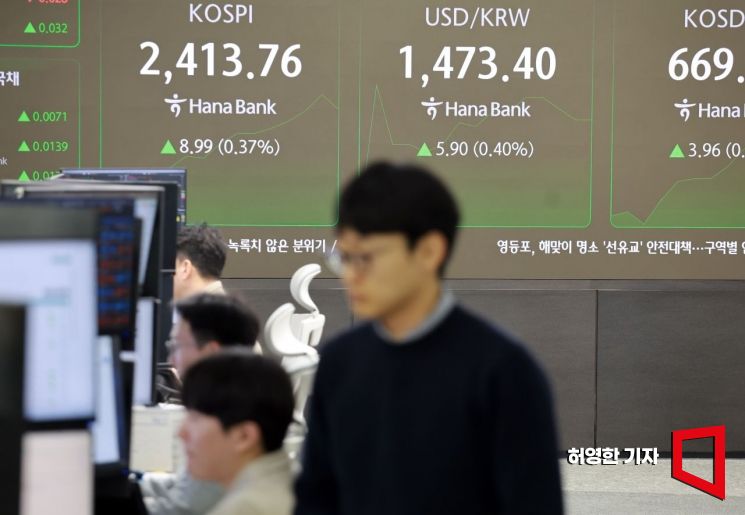 On the 30th, the last trading day of the year, the KOSPI and KOSDAQ started with a slight decline but then turned to a rebound. The won-dollar exchange rate rose again to the mid-1470 won range. Employees are working in the dealing room at the Hana Bank headquarters in Euljiro, Seoul. Photo by Heo Young-han
The won-dollar exchange rate surged to the 1,486 won level during trading on the 27th amid increasing political uncertainty, including the passage of an impeachment motion against Acting President Han Duck-soo, and maintained around 1,470 won on the 30th. Financial institutions are growing increasingly uneasy ahead of the year-end closing.
On the 30th, the won-dollar exchange rate opened at 1,475.0 won, up 7.5 won from the previous trading day, in the Seoul foreign exchange market. As this day is the last trading day of the year, if the closing price records around 1,470 won, this figure will be reflected in this year’s financial closing. The 1,470 won level is about 5% higher compared to the approximately 1,400 won level in early December.
According to the financial sector, commercial banks are closely monitoring the impact since the exchange rate closing price will be reflected in the year-end financial statements of financial companies and corporations. A financial sector official explained, "Even a 1% change in the exchange rate can significantly alter the won-based financial statements depending on the amount of foreign currency net assets (assets minus liabilities). Given the 5% surge in the exchange rate due to political instability such as the martial law situation and impeachment phase, it inevitably has a major impact on the overall financial closing this year."
The surge in the exchange rate to the highest level in 15 years since the financial crisis is likely to negatively affect soundness indicators. For banks, the won-denominated amount of risk-weighted assets (RWA) may increase, causing the total capital ratio to decline. RWA is a revaluation of a bank’s assets by type?such as loans, receivables, and overseas investments?considering the degree of risk. When the exchange rate rises sharply, the won-denominated amount of foreign currency RWA increases, deteriorating bank soundness indicators calculated based on won-denominated RWA, such as the total capital ratio and Common Equity Tier 1 (CET1) ratio.
According to the Bank of Korea, as of the third quarter, the size of foreign currency RWA of domestic banks was 209.5 trillion won, accounting for 22.6% of total RWA. It is estimated that when the won depreciates by 10 won, the RWA of the five major financial holding companies increases by about 1.98 trillion won. Since this is directly linked to various indicators such as the Basel Committee on Banking Supervision (BIS) capital ratio, a soundness indicator, and the liquidity coverage ratio (LCR), a liquidity indicator, concerns inevitably grow. The BIS capital ratio is calculated by dividing capital by RWA, and when the exchange rate rises, the scale of foreign currency asset risk exposure increases, causing the ratio to decline. The foreign currency LCR ratio also falls as the burden of margin payments related to foreign exchange derivative transactions increases with the rising exchange rate.
In response, major domestic financial holding companies have effectively entered an emergency management system, anticipating the possibility of a sustained high exchange rate next year. They are reportedly preparing response plans for next year, considering the inevitable negative impact of the exchange rate rise on banks’ capital ratios and profits and losses.
A Bank of Korea official stated, "Attention should be paid to the possibility that some financial institutions may face difficulties in liquidity management if short-term funding demand coincides with a sharp rise in the exchange rate," adding, "It is also necessary to strengthen policy efforts, such as encouraging longer maturities for foreign exchange swaps, to prevent funding demand from concentrating in the short term during sharp exchange rate increases."
© The Asia Business Daily(www.asiae.co.kr). All rights reserved.