Balloon Effect Seen in Seoul Metropolitan Area
Corporate Housing Sales Also Active
10,397 Cases in Gyeonggi Province by May
4,915 Cases Purchased in Seoul
Capital Gains and Comprehensive Real Estate Taxes to Strengthen Next Year
Possibility of Urgent Sales in Some Areas Within the Year
[Asia Economy Reporter Donghyun Choi] As the government significantly increases transaction and holding tax burdens on corporate-owned housing, there is a forecast that a flood of forced sales from corporations will emerge in the housing markets of the Seoul metropolitan area, including Incheon and Suwon. In particular, in areas where 'gap investment' through corporations is preferred or where prices have surged sharply due to the balloon effect, it is analyzed that this influx of forced sales could trigger a full-scale market correction.
According to industry sources on the 14th, following the government's June 17 and July 10 real estate measures, acquisition tax, holding tax, and capital gains tax that corporations must pay when purchasing, holding, or disposing of housing have been strengthened, leading to an increase in corporate operators considering disposing of their holdings. The acquisition tax rate for housing acquired by corporations has been raised from the previous 1-3% to 12%, and real estate trading or rental corporations are no longer eligible for the 75% acquisition tax reduction benefit for in-kind contributions. From June next year, the 600 million KRW basic deduction for comprehensive real estate tax will no longer apply to corporate-owned housing. Corporations must pay comprehensive real estate tax regardless of housing price, with no cap on tax burden. Additionally, the comprehensive real estate tax rate for corporate housing has increased to 3% for two or fewer houses, and up to the highest rate of 6% for three or more houses or two houses in regulated areas, increasing the burden. Furthermore, from January next year, corporate tax, which functions as capital gains tax on the disposal of corporate-held housing, will also rise significantly. Currently, when a corporation disposes of real estate, a basic tax rate of 10-25% is applied to the capital gains, with an additional 10% tax on housing disposals, making the maximum rate 35%. However, the government plans to raise the tax rate applied to corporate housing disposals to 20%, imposing a maximum tax of 45% on corporate housing capital gains.
Local acquisition tax is expected to be implemented immediately after passing the temporary National Assembly session this month, with some grace periods for contract signing or balance payment. However, national taxes such as capital gains tax and comprehensive real estate tax will be fully applied from January and June next year, respectively, making it likely that some forced sales will appear in certain areas before the laws take effect by the end of this year.
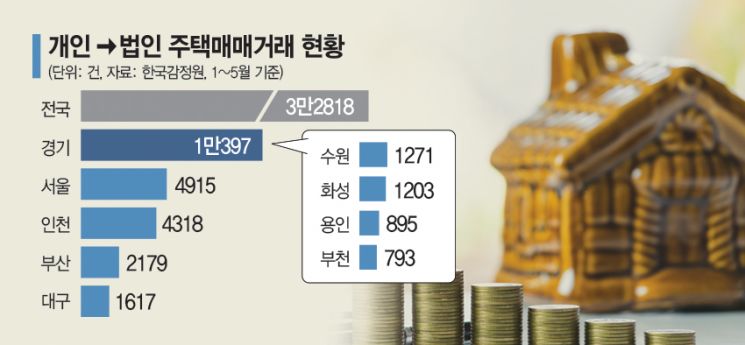
According to the Korea Real Estate Agency's 'Monthly Housing Sales by Transaction Entity Statistics,' corporate housing transactions have been active in the Seoul metropolitan area, where balloon effects have repeatedly appeared after regulatory measures. From January to May this year, corporations purchased 32,818 housing units nationwide from individuals, with Gyeonggi-do leading at 10,397 units. This was followed by Seoul (4,915 units), Incheon (4,318 units), and Busan (2,179 units). Within Gyeonggi-do, Suwon had the highest number at 1,271 units, followed by Hwaseong (1,203 units), Yongin (895 units), and Bucheon (793 units). Suwon and Hwaseong (designated as Dongtan 2 New Town), and Yongin (Suji and Giheung) were designated as speculative overheated districts under the June 17 measures due to rapid house price increases.
In areas like Gimpo, where house prices have recently risen due to the balloon effect, and Ansan, where some areas were designated as speculative overheated districts under the June 17 measures, several corporate sales have already been identified. A representative from A Real Estate in Unyang-dong, Gimpo, said, "As Gimpo has recently attracted attention and house prices have risen significantly, possibly leading to its designation as a regulated area, several forced sales priced about 20 to 30 million KRW cheaper have been traded," adding, "Forced sales of apartments priced between 200 million and 300 million KRW often involve corporate gap investment."
In Seoul's Gangnam 3 districts (Seocho, Gangnam, Songpa), where tax burdens are relatively high, some forced sales centered on high-priced apartments are also likely to appear. However, due to the government's strengthened regulations significantly reducing loan limits, these transactions are expected to be limited to cash-rich individuals.
Park Won-gap, Senior Specialist at KB Kookmin Bank, said, "There is a possibility that a large number of properties will be released at once, especially in areas where corporate transactions have recently surged," adding, "Cases where multiple people form a corporation to pursue low-priced housing gap investments will also largely disappear."
© The Asia Business Daily(www.asiae.co.kr). All rights reserved.