Economic Vitality Expected Through Job Creation, Business Attraction, and Youth Settlement
Sharing the Master Plan for the Vision of Becoming the Capital of AI, Energy, and Culture
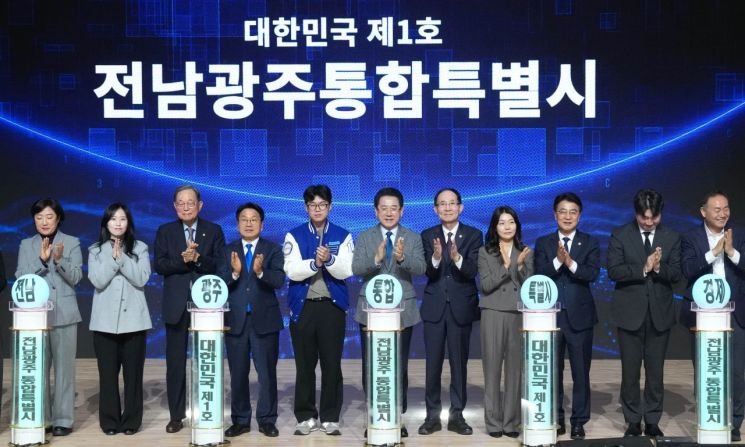 Kim Young-rok, Governor of Jeollanam-do, is performing a future commitment performance with representatives of citizens and key guests at the ‘Jeonnam-Gwangju Integrated Special Act Enactment Citizens’ Report Meeting’ held on the 3rd at Korea Energy Engineering University in Naju. Provided by Jeonnam Province
To commemorate the passage of the Jeonnam-Gwangju Integration Special Act by the National Assembly, South Jeolla Province and Gwangju Metropolitan City held a city and province residents report meeting on March 3 at the main auditorium of Korea Energy Engineering University in Naju, sharing the vision and future plans for the integrated special city, which will be launched on July 1.
The event was attended by approximately 700 people, including Kim Youngrok, Governor of South Jeolla Province, Kang Gijung, Mayor of Gwangju Metropolitan City, the chairs of both city and provincial councils, members of the Pan-Provincial Residents Council, and local residents. The program included a briefing on the Jeonnam-Gwangju Integration Special Act; a QR code poll on “Changes Residents Expect”; the announcement of hopeful messages for the integrated special city by 10 resident representatives; a future pledge performance; and a commemorative photo session.
In the "Changes Residents Expect" segment, conducted via QR code voting, responses indicated the highest expectations for job creation and attracting businesses, followed by mitigation of population decline and youth settlement, improvement of medical and welfare services, and expansion of transportation and living infrastructure. This reflected strong hopes for revitalizing the regional economy.
The 10 resident representatives from various sectors presented their visions for the integrated special city, proposing: a job-creating city where young people can settle; balanced growth through the harmony of advanced and primary industries; and expanded cultural opportunities through the development of a cultural city foundation. These proposals demonstrated that “economy and industry” are the core demands for the future direction of the integrated special city.
The Jeonnam-Gwangju Integration Special Act passed the National Assembly plenary session just 59 days after the announcement of the “Jeonnam-Gwangju Grand Integration Joint Declaration” at the May 18 Democratic Cemetery’s Gate of Democracy on January 2.
Opinions gathered from 27 city, county, and district public hearings, five joint meetings of regional National Assembly members and heads of local governments, and city and provincial council briefings were reflected in the legislation.
Local residents also strongly supported the administrative integration, with an overwhelming approval rating of around 70%. The Lee Jaemyung administration bolstered the integration by offering four major incentives: annual fiscal support of 5 trillion won, up to 20 trillion won over four years, preferential treatment for the second round of public institution relocations, and additional measures.
The integrated special city, launching on July 1, will have a population of 3.2 million (5th largest in Korea) and a regional gross domestic product (GRDP) of 159 trillion won (3rd largest nationwide). It is expected to become a major economic bloc and a historic turning point as a new core growth axis for Korea.
South Jeolla Province and Gwangju Metropolitan City plan to formulate a master plan with a vision of becoming the capital of AI, energy, and culture, pursuing balanced development of advanced industries, key industries, and the agriculture and fisheries sectors.
A South Jeolla Province official stated, "We will concretize the Y4-nomics vision focusing on the four major zones-Gwangju, Western, Eastern, and Southern regions (the 3+1 axes)-and foster balanced growth of advanced industries, agriculture, fisheries and livestock, and cultural tourism industries."
© The Asia Business Daily(www.asiae.co.kr). All rights reserved.