"Same as National Assembly Constituencies"
Easier Access for Minor Parties to Metropolitan Councils
On March 3, Assemblywoman Mi Ae Lim of the Democratic Party (Proportional Representation), Assemblyman Chun Saeng Jung of the Innovation Party (Proportional Representation), and Assemblywoman Hye Kyung Jung of the Progressive Party (Proportional Representation) proposed an amendment to the election law. The core of the bill is to introduce a multi-member district system in administrative integration areas, in which 3 to 5 representatives would be elected per district based on the current National Assembly constituencies, replacing the current single-member districts for metropolitan council elections.
Assemblywoman Mi Ae Lim and the other lawmakers held a press conference on the same day, stating, "In order for the principles of checks and balances to function under the separation of powers, local councils must be empowered. The strength of local councils is realized when they are formed in a way that guarantees the equality of votes, representativeness, and proportionality in accordance with democratic principles. Ultimately, for the Integrated Special City to function properly, its council must be properly constituted."
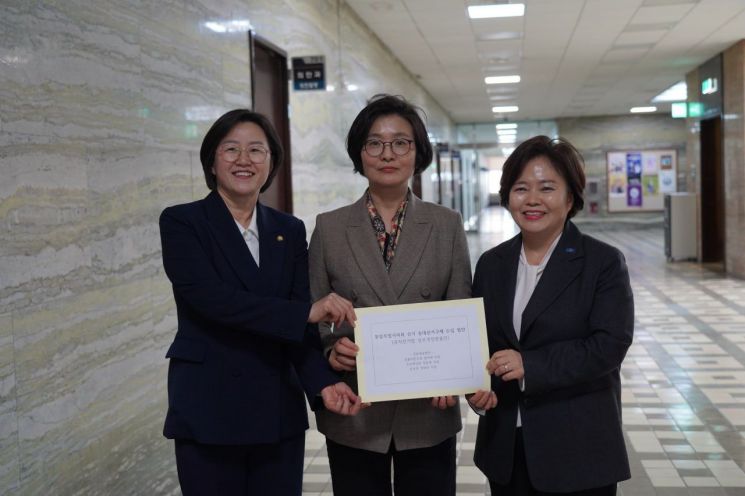 Democratic Party lawmaker Mi-ae Lim (center), Justice Innovation Party lawmaker Chun-sang Jung (right), and Progressive Party lawmaker Hye-kyung Jung are submitting an election law amendment proposing to change the metropolitan council electoral district in the administrative integration area to a multi-member district.
They added, "However, if the Integrated Special City council is formed under the current election system, none of the equality of votes, representativeness, or proportionality can be guaranteed. For example, the population of Gwangju City is about 1.4 million, and that of South Jeolla Province is about 1.78 million-a difference of about 380,000. Yet, the number of constituency seats in the Gwangju City Council is 20, while the South Jeolla Provincial Council has 55, nearly three times more. The number of constituents represented by each Gwangju City Council member is 69,847, while each South Jeolla Provincial Council member represents 32,381-a difference of 37,466."
They continued, "Without improving the electoral system, we would have to either nearly double the number of seats in the Gwangju City Council or reduce the number of seats in the South Jeolla Provincial Council. However, simply doubling the number of seats is not an easy choice due to budget constraints and public opinion, and reducing existing seats is even more difficult. Therefore, an electoral reform that minimizes seat adjustments while guaranteeing the equality of votes and representativeness is necessary."
Assemblywoman Lim, Assemblyman Jung, and Assemblywoman Jung explained, "We have proposed this amendment to the election law to address these issues. The bill stipulates that, within the integrated region, metropolitan council constituency boundaries should match those of the current National Assembly, and that a multi-member district system electing at least 3 and up to 5 representatives per district should be introduced."
They said, "If metropolitan council elections are held under a multi-member district system, it will be possible to improve the equality of votes with only a minimal increase in city council seats, while also maintaining the representativeness of less-populous provincial areas. Furthermore, it could improve the political situation in Gwangju and South Jeolla, where political diversity has disappeared, and although the proportionality of the vote guaranteed by the multi-member district system may be somewhat insufficient, it would allow third parties and smaller parties to enter the integrated city council and provide a channel to reflect the diverse opinions of residents."
They continued, "So far, the only region where administrative integration has been promoted is the Gwangju-South Jeolla Integrated Special City, but with Daejeon-South Chungcheong, Daegu-North Gyeongsang, and even Busan-South Gyeongsang-which is currently being discussed locally-future administrative integration is likely to be pursued in several regions. This bill is not limited to Gwangju and South Jeolla; it is intended to address anticipated issues in any future administrative integration regions, and even in areas without administrative integration, it aims to foster discussions on improving the metropolitan council electoral system."
© The Asia Business Daily(www.asiae.co.kr). All rights reserved.