Yeoncheon County Unites Central and Local Governments with Experts
Seeking Strategies to Realize the "Peace Economy Special Zone"
Pursuing Compensation for the Special Sacrifices of Border Areas
All-Out Effort for Designation of the "Peace Economy Special Zone"
Yeoncheon County held the "Seminar on Fostering Peace Economy in Border Areas and Revitalizing Inter-Korean Cooperation" on February 27 at the Korea National Institute for Peace and Unification Democracy Education's Korean Peninsula Unification Future Center.
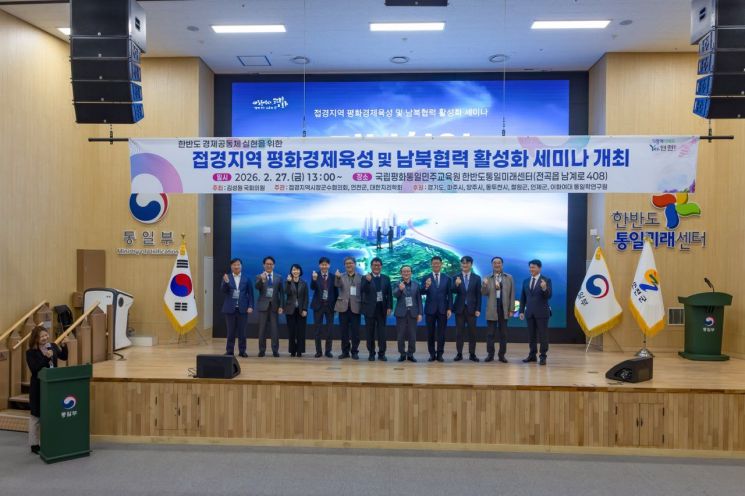 Yeoncheon County held the "Peace Economy Development and Inter-Korean Cooperation Activation Seminar for Border Areas" on February 27 at the Korean Peninsula Unification Future Center of the National Institute for Peace and Unification Education. Provided by Yeoncheon County
The seminar was organized to discuss policy directions for establishing the foundation of a peace economy in border areas and revitalizing inter-Korean exchanges and cooperation for the realization of an economic community on the Korean Peninsula, as well as to explore sustainable development strategies for the region.
The event drew strong interest, with more than 200 participants attending, including officials from the Ministry of Unification and Gyeonggi Province, public officials from cities and counties in border areas, participating local governments, and expert groups such as professors, researchers, and academics.
This seminar took on added significance as it was held after the announcement of the basic plan for the Peace Economy Special Zone in December of last year, marking the official start of preparations for the establishment of development plans by city and province. It served as a venue to discuss inter-Korean cooperation and development strategies for border areas linked to the major national policy tasks of providing fair compensation for the special sacrifices of border regions and laying the groundwork for the development of these areas.
Furthermore, Minister of Unification Chung Dongyoung, National Assembly member Kim Sungwon, and Ham Myeongjun, Chair of the Council of Mayors and Governors of Border Areas (and Mayor of Goseong County), expressed their strong interest in the seminar through video or written congratulatory messages. They emphasized that while border areas have long been on the front line of security, they are now transforming into a unique space in Korea where peace and the economy coexist, holding significant potential to become a key driver of Korea’s future growth.
The seminar began with a keynote speech by Kim Yeoncheol, Chair of the Korea Peninsula Peace Forum and former Minister of Unification, on the topic of "The Challenges of Peace Economy and Border Cooperation on the Korean Peninsula." Kim stated, "Beautiful blossoms of prosperity bloom on truly peaceful land," and stressed that, "To shift from adversarial to cooperative relations, pursuing shared interests is essential for sustainable peace. Peace is not something that simply happens, but something that must be built. No matter how difficult or complex, it is a task of our era that must be continuously pursued with determination and effort."
The first session featured presentations and discussions on the topic of "National Strategies for Fostering Peace Economy and Revitalizing Inter-Korean Cooperation in Border Areas Linked to National Policy Tasks."
Professor Yoon Youngsang of KAIST Graduate School of Future Strategy and Lee Junghoon, Director of the Geography Research Institute at the Korean Geographical Society, emphasized the need for a "co-benefit cooperation model" that could attract North Korea’s interest by promoting a peace economy of coexistence and mutual prosperity and the path toward unification. They suggested that South Korea should prepare independent strategies for restoring and rebuilding inter-Korean relations that do not rely solely on U.S.-North Korea negotiations or sanctions relief.
Notably, Dr. Lee Sungwoo of the Korea Maritime Institute, who participated in the discussion, pointed out the need to develop the concept of the Peace Economy Special Zone into a transnational cooperation initiative, such as establishing twin special zones in North and South Korea and advancing railway (and road) connection projects like the Gyeongwon Line and Donghae Line. He highlighted that connecting the Gyeongwon Line and pioneering the Arctic route could link logistics in the Seoul metropolitan area to Eurasia and the Arctic route via Wonsan, creating a significant opportunity for both Koreas to jointly achieve economic results through logistics innovation and the expansion of industrial infrastructure.
Additionally, he explained that combining North Korea’s rare earth resources with South Korea’s capital and technology could establish a mutually beneficial development model, forming a highly important strategic link for equal cooperation between the two Koreas. In this context, he added that the Arctic route would become a key artery in the national resource supply chain, enabling energy and North Korean rare earths to be supplied quickly and cost-effectively to the Seoul metropolitan area, the heart of Korean industry.
In the second session, presentations and discussions were held on the topic of "Region-Led Implementation Strategies and Institutional Tasks for the Realization of the Peace Economy Special Zone."
Dr. Lee Hyunju of the Korea Research Institute for Human Settlements noted the urgent need for the central government to prepare concrete implementation measures, such as securing funding and supplementing related laws and systems, to promote the Peace Economy Special Zone. She also emphasized the importance of creating innovative incentive schemes, including introducing special provisions for attracting companies and project developers, in order to generate national interest and consensus.
During the presentations by representatives from border area cities and counties, the Future Strategy Officer of Yeoncheon County explained that the purpose of enacting the Peace Economy Special Zone Act is to overcome development delays caused by security restrictions in areas adjacent to North Korea and to improve the quality of life for residents who have suffered from division. He stressed that the objective of the law is to promote the development of areas near North Korea and achieve balanced development in border regions.
The Peace Economy Special Zone team leader from Paju City argued for the swift enactment of relevant legislation to allow the use of inter-Korean cooperation funds to support infrastructure installation costs. He also asserted that expanding local tax benefits, such as reductions in acquisition and property taxes, is necessary to ease the fiscal burden on local governments.
Next, the Business Support Team leader from Gapyeong County demonstrated a strong commitment to promoting the Peace Economy Special Zone, presenting a new strategy that incorporates the use of artificial intelligence (AI) and green transition, despite being a latecomer to the initiative.
A Yeoncheon County official stated, "This seminar, as the first organized by a local government, was a meaningful occasion to once again confirm the potential and role of border areas," adding, "We will continue to cooperate with the central government and actively promote the establishment of a peace economy base at the regional level for the improvement of inter-Korean relations and mutually beneficial regional development."
Additionally, Yeoncheon County plans to ensure that the policy directions derived from this seminar on the designation of the Peace Economy Special Zone are sufficiently shared with and gain broad consensus in the local community. To this end, the county will create forums for communication and work closely with experts and others to thoroughly prepare for the designation of the special zone.
© The Asia Business Daily(www.asiae.co.kr). All rights reserved.