Yangju City and LH Join Forces to Attract Gwacheon Racecourse
All-Out Effort to Host "Let's Run Park" Instead of Residential Development
Immediate Construction Possible on Ready, Compensated Site
Yangju City in Gyeonggi Province is actively pursuing the relocation of Gwacheon Racecourse (Let's Run Park Seoul) as a solution to the prolonged stagnation of development in the Gwangseok District, which has remained idle for over 20 years since its designation in 2004.
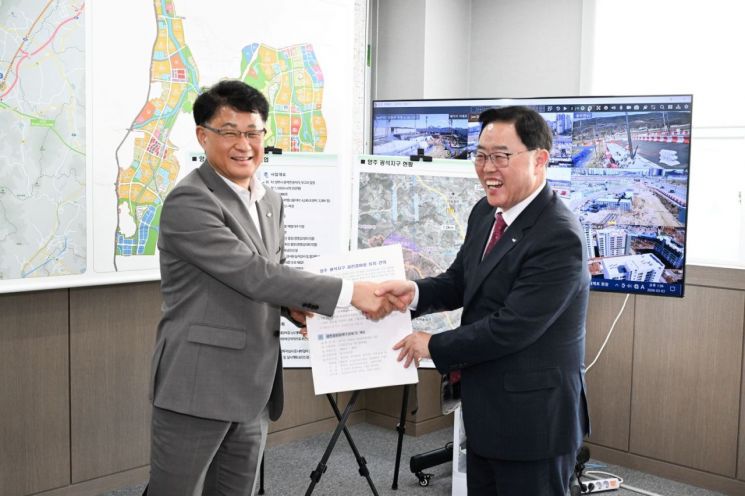 Yang Suhyun, Mayor of Yangju, visited the Korea Land and Housing Corporation (LH) Yangju Business Headquarters on the 3rd and requested cooperation so that the Gwangseok District in Yangju could be considered as an alternative site in relation to the relocation of Gwacheon Racecourse included in the government's "January 29 Housing Supply Plan." Provided by Yangju City
On March 3, the city visited the Yangju Business Headquarters of the Korea Land and Housing Corporation (LH) to request cooperation in considering Gwangseok District in Yangju as an alternative site for the relocation of Gwacheon Racecourse, which is included in the government’s 'January 29 Housing Supply Measures.'
This visit was a response to the Ministry of Land, Infrastructure and Transport's announcement regarding the relocation of Gwacheon Racecourse and Gyeonggi Provincial Government’s move to request the relocation of US military return sites in northeastern Gyeonggi Province. The city emphasized that Gwangseok District is similar in size to the current Gwacheon Racecourse site (approximately 1.16 million square meters), and that LH has already completed land compensation, making it possible to immediately proceed with the project.
Gwangseok District was initially planned for residential land development, but the project has been delayed for a long time as it was excluded from new housing supply plans, leading to decreased profitability. In response, the city has shifted its development strategy from a housing-centered approach to introducing large-scale self-sustaining functions, such as a racecourse park, aiming to find a breakthrough for project normalization.
According to the city, if Let's Run Park Seoul is relocated, it is estimated that about 50 billion won in local tax revenue will be generated annually. The influx of approximately 3,000 permanent staff and the increase in annual visitors are also expected to have a positive impact on local businesses, including restaurants and accommodations.
Transportation conditions are also cited as a strength. Gwangseok District is located about 50 kilometers from Gangnam Station in Seoul and about 30 kilometers from Jonggak Station. With the expansion of major transportation networks such as the Second Metropolitan Area Ring Expressway, National Route 39, and the Seoul-Yangju Expressway, accessibility to downtown Seoul is expected to improve.
An official from Yangju City stated, "Gwangseok District has experienced over 20 years of delayed development, with ongoing calls for project normalization. Attracting Let's Run Park to a ready site owned by LH would create a win-win model, enabling swift policy implementation at the national level and balanced development in the western region for the city."
The city has already organized and is operating a task force team led by the vice mayor to attract the project and plans to continue consultations with related agencies.
© The Asia Business Daily(www.asiae.co.kr). All rights reserved.