Readiness to Release Oil Reserves and Secure Alternative Supply Routes
Close Monitoring of 1,063 Export Companies
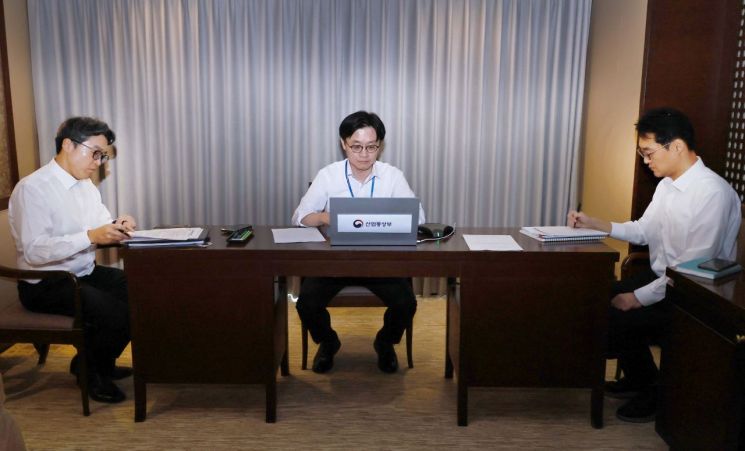 Kim Jeong-gwan, Minister of Trade, Industry and Energy, who is on a visit to the Philippines, is chairing the 3rd Middle East Situation Real Economy Review Meeting via video conference on the 3rd at The Manila Hotel in the Philippines, checking the impact on each industry sector. Ministry of Trade, Industry and Energy.
The South Korean government has launched a comprehensive review in response to the rapidly changing situation in the Middle East, even considering the possibility of a blockade of the Strait of Hormuz. In particular, the Ministry of Trade, Industry and Energy has upgraded its existing "emergency response team" to a "Middle East Situation Response Headquarters," headed by the Vice Minister. The government reaffirmed its readiness to release oil reserves and immediately transitioned to a crisis management system for crude oil and gas supply, raising the emergency response level across the real economy.
On the afternoon of March 3, Kim Jungkwan, Minister of Trade, Industry and Energy, chaired the "3rd Real Economy Review Meeting" via video conference, conducting a comprehensive assessment of resource and energy supply, trade, supply chains, finance, and the impact by industry sector. The meeting was attended by relevant ministries such as the Ministry of Foreign Affairs, the Ministry of Environment, the Ministry of Oceans and Fisheries, and the Financial Services Commission, as well as Korea National Oil Corporation, Korea Gas Corporation, KOTRA (Middle East Headquarters), Korea Energy Economics Institute, the Korea Chamber of Commerce and Industry, the Federation of Korean Industries, the Korea International Trade Association, various associations for petroleum, chemicals, and plants, and commercial counselors from the United States, China, Japan, and the EU.
Previously, the Ministry of Trade, Industry and Energy convened an emergency review meeting at 7 p.m. on February 28, the day the situation began, presided over by Minister Kim. On March 1, Vice Minister Moon Sinhak conducted a follow-up review of the impacts on trade, resources, and security. For the 3rd meeting, given the urgency of recent developments in the Middle East, Minister Kim, who was on a visit to the Philippines, connected via video conference to directly reassess the response measures.
In particular, following the immediate launch of the "emergency response team" led by Yang Kiuk, Director General of the Office of Industrial Resources and Security, the Ministry upgraded its response organization on this day to the "Middle East Situation Response Headquarters," now headed by the Vice Minister. The Ministry has entered a crisis management system for crude oil and gas supply and plans to swiftly implement phased measures as the situation develops.
The meeting focused on reviewing contingency plans based on the scenario of an actual blockade of the Strait of Hormuz. The Ministry explained that it is closely monitoring the movement of oil tankers and the progress of key shipping schedules, and is fully prepared to implement alternatives such as adjusting shipping schedules immediately if a blockade becomes reality.
Regarding oil supply, the government currently maintains sufficient oil reserves, and thus expects the short-term impact to be limited. However, it is keeping a close watch on the situation of oil tankers passing through the Strait of Hormuz, changes in transportation conditions such as insurance and freight rates, and is also reviewing measures to secure alternative sources outside the Middle East.
Minister Kim called on the industry to make additional efforts to secure supplies from outside the Middle East. He stated that if the situation is prolonged and private sector oil inventories fall below a certain level, making a supply crisis visible, the Ministry will decide on the release of reserves after its own situation assessment meeting. He also instructed preparations for the immediate supply of oil stored at nine reserve bases nationwide, including Yeosu and Geoje, to the domestic market.
Additionally, the Ministry explained that emergency manual measures such as the introduction of overseas production by Korea National Oil Corporation, exercising the priority purchase right for joint stockpiles, and confirming the readiness to release reserves-measures that were instructed during the first meeting-are also being prepared for immediate activation should the situation arise.
For gas supply, more than 80% of domestic imports currently come from sources outside the Middle East, and with significant reserves on hand, the Ministry believes the country can cope for a considerable period even if supplies from Qatar are completely halted. Nevertheless, as a precaution, it will simultaneously work to secure alternative suppliers from Southeast Asia, Australia, North America, and other regions.
Maritime logistics have so far not experienced significant disruptions. Major container shipping companies have continued to reroute via the Cape of Good Hope in Africa instead of the Suez Canal since the Red Sea crisis in 2023, which is assessed to limit the direct impact of the current situation. However, the government will conduct close monitoring of 1,063 companies whose export share to seven Middle Eastern countries bordering the Strait of Hormuz exceeds 50%, and will proactively provide emergency export vouchers and liquidity support.
The impact on industrial supply chains is also considered limited at this time. While dependence on the Middle East is high for 14 items, including semiconductor measurement and inspection equipment, bromine, and helium, the Ministry explained that alternative imports of inspection parts and equipment are possible from the United States and other countries, and some precision chemicals can be sourced from domestic production and inventories. However, since 54% of imported naphtha relies on the Strait of Hormuz, there are concerns about supply if the situation is prolonged. Therefore, the government plans to convert export volumes for domestic use and secure alternative supply chains.
In the plant sector, there are currently no direct damages to the construction sites of South Korean companies. The government will continue close communication with companies operating in Saudi Arabia, the UAE, and Qatar, and will keep monitoring site safety and supply chain challenges.
There is also no immediate direct impact on power supply, but Korea Electric Power Corporation and power generation public enterprises are monitoring the situation in preparation for a possible surge in oil prices or disruptions in LNG imports. The Ministry of Trade, Industry and Energy and the Ministry of Environment will strengthen their cooperation system.
During the meeting, Minister Kim stressed, "Since we cannot rule out the possibility of a prolonged situation in the Middle East, make sure there are no gaps in resource and energy supply and support for exporting companies, preparing for all possible scenarios."
© The Asia Business Daily(www.asiae.co.kr). All rights reserved.