"Yojeum Plain" Tops Protein Content at 13.1g
"Kirkland Signature" Offers Lowest Price at 826 Won per 100g
Recently, Greek yogurt products, which have gained significant popularity as a health food, have shown up to a 2.2-fold difference in nutritional content and as much as a fourfold difference in price depending on the brand.
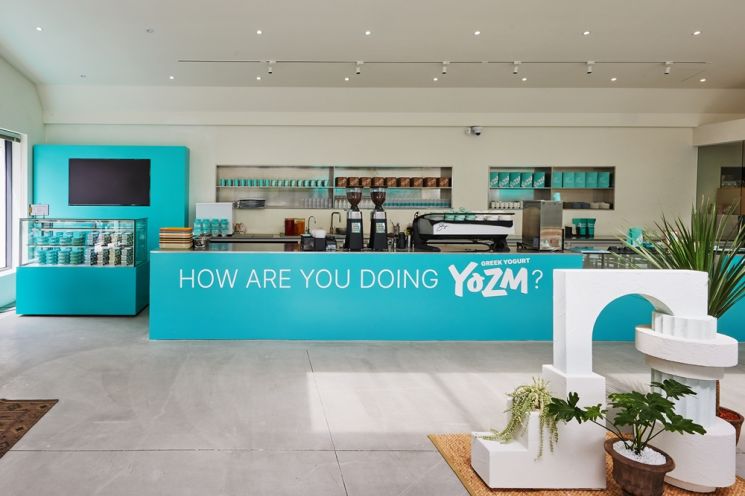 A scene from three years ago at the pop-up cafe of 'Yojeum,' a brand specializing in Greek yogurt. Yojeum.
The Consumers Union of Korea announced on the 3rd that a comparison of 17 products distributed in the market revealed a clear trend: protein content and price increase proportionally according to the degree of moisture removal. Therefore, the organization emphasized the need for consumers to make rational choices based on their consumption purposes.
According to the test results, “Yojeum Plain Greek Yogurt” had the highest protein content at 13.1g per 100g, while “Hoodis Greek Yogurt Plain” and “Hoodis Unsweetened Low-Fat” products had the lowest at 5.9g, resulting in a maximum difference of 2.2 times.
The average protein content of Greek yogurt was 8.3g, which is 1.8 times higher than that of regular yogurt, and the fat content was also 1.9 times higher. In particular, “Yojeum Plain Greek Yogurt” (14.0g) and “Seoul Milk Rich Greek Yogurt” (13.6g) accounted for more than 25% of the daily recommended intake for fat, so caution is advised when consuming these products. In contrast, “Koukakis Greek Yogurt 0%” and “Kirkland Signature Greek Yogurt” had very low fat content at around 0.1g.
As for the solid content, which determines the firmness of the texture, “Yojeum Plain Greek Yogurt” had the highest amount at 33.8g, while “Kirkland Signature Greek Yogurt” had the lowest at 14.4g, resulting in a 2.3-fold difference. The Consumers Union of Korea explained that the more moisture is removed, the more raw milk is needed to produce the same quantity, which raises manufacturing costs, making thicker products relatively more expensive. In fact, the price per 100g was lowest for “Kirkland Signature Greek Yogurt” at 826 won, but “Yojeum Plain Greek Yogurt” was priced at 3,333 won, marking a price gap of more than four times.
All products met the standards for lactic acid bacteria count for fermented milk. However, “Yojeum Plain Greek Yogurt” displayed the lactic acid bacteria count as a maximum value, which could mislead consumers, and the company has decided to remove this labeling. Additionally, it was found that “Koukakis Greek Yogurt 0%” and “Yojeum Plain Greek Yogurt” need improvement because the actual measured values for calories and sodium exceeded the allowable margin of error compared to their labeled amounts.
Yoon Myung, Secretary-General of the Consumers Union of Korea, stated, “The survey results show that Greek yogurt products differ greatly not only in nutritional content and concentration but also in price. Consumers should take into account their personal dietary goals, preferred concentration, and price when choosing a product.” He added, “Even if a product is labeled as ‘plain,’ it may still contain sugar or other sweeteners, so it is important to check the ingredient list and sugar content. Adopting a healthy eating habit, such as reducing sugar by adding nuts, is also recommended.”
© The Asia Business Daily(www.asiae.co.kr). All rights reserved.