Ingredient Analysis of 325 Nutrition Bars Sold in Korea
"Be Cautious of Excessive Consumption," Experts Advise
A significant number of nutrition bars, including "protein bars" and "energy bars" sold in Korea, were found to have fat content ratios exceeding the recommended guidelines.
According to the latest issue of the journal published by the Korean Nutrition Society on March 3, the research team analyzed the composition of 325 products-nutrition bars, energy bars, and protein bars-distributed in the market as of February last year.
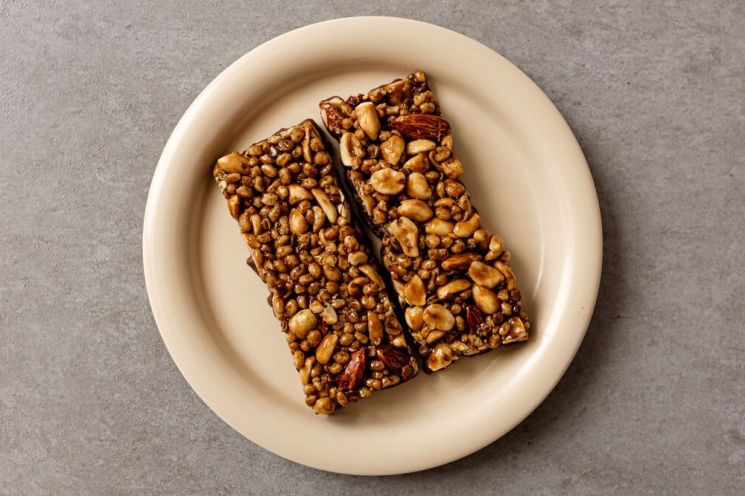
The research team investigated, based on a single serving, the amount and the percentage relative to the daily nutritional reference value for mandatory labeled nutrients such as calories, carbohydrates, sugars, protein, fat, saturated fat, cholesterol, and sodium. Based on this, they calculated the contribution rate compared to the Korean dietary reference intake and the nutritional density index. A nutritional density index exceeding 1 indicates that the nutrient content relative to calories surpasses the reference value.
The results showed that, on average, a single serving of the products surveyed provided 9.6% of daily energy, 6.7% of carbohydrates, 16.8% of protein, and 16.9% of fat compared to the daily nutritional reference value.
In particular, the energy contribution of fat (42.5%) and the nutritional density index for fat (1.8) both exceeded the recommended range for the Korean dietary reference intake (15-30%) and surpassed the reference value relative to calorie content. The nutritional density index for saturated fat was also high at 1.9, and the energy contribution from sugars reached 19.5%, approaching the upper limit of the recommended range (10-20%) for total energy intake with just one serving. For protein, the energy contribution was 19.3%, which is at the upper end of the recommended range (7-20%), and the nutritional density index was also high at 1.7.
However, since the main purpose of nutrition bars is to supplement protein, the research team analyzed that nutrition bars are suitable for fulfilling this role compared to ordinary snacks. The energy contribution from sugars, at 19.5%, was also at the upper limit of the recommended range (10-20%) for total energy intake.
Based on these findings, the research team emphasized, "When consuming more than a single serving of a nutrition bar or obtaining additional nutrients through other meals, it is essential to be cautious to avoid excessive total intake." They added, "While nutrition bars can serve as a convenient snack and contribute to supplementing certain nutrients, the characteristics of each product category can vary significantly, so they should be consumed selectively based on the intended purpose and individual needs."
© The Asia Business Daily(www.asiae.co.kr). All rights reserved.