Construction Period Expected to Be Reduced by 20%
On March 3, DL E&C announced that it has developed and patented a "slipform method specialized for pumped-storage hydroelectric power" that enables efficient construction of ultra-deep vertical tunnels over 100 meters underground, and is now working on its commercialization. As demand for renewable energy increases, the number of pumped-storage power plant projects is rising, and the company plans to strengthen its construction capabilities to support this trend.
The core of this patent is the improvement of the way slipforms (molds that shape concrete as it is poured) are moved inside tunnels. Traditionally, slipforms were pushed upward using hydraulic jacks, but with this technology, the slipform can be suspended from wires and installed as if floating in the air. The movement routes of workers are separated into upper and lower areas based on the slipform, so that the workspace is not limited to just the lower area.
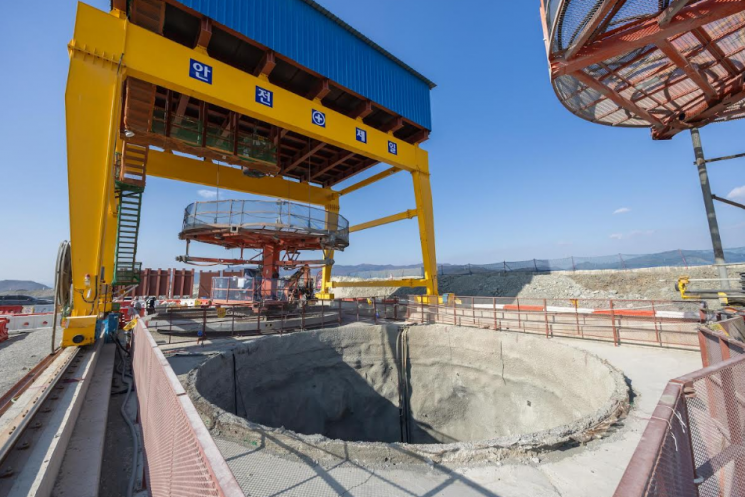 At the construction site of the second phase of the port hinterland complex at the northern container terminal of Busan New Port, the vertical tunnel excavation beneath the gantry crane has been completed. DL E&C
Applying this technology makes it possible to carry out tasks in the upper and lower spaces simultaneously, instead of sequentially as before, which is expected to reduce the construction period by 20% compared to conventional methods.
Given the nature of pumped-storage hydroelectric power, where the height of vertical tunnels can reach several hundred meters, advanced excavation equipment such as the RBM (Raise Boring Machine) is essential. The RBM is a large machine that bores through rock by rotating a head equipped with dozens of blades, requiring highly advanced control technology. Recently, DL E&C completed vertical tunnel excavation through Busan’s Yongmang Mountain using an RBM, boring through a mountain peak equivalent to a 43-story apartment building to create a 120-meter vertical tunnel. The RBM method is also set to be a core technology in the currently under-construction Yeongdong Pumped Storage Power Plant.
In addition, the company successfully completed the underground space construction at Seoul Station for the GTX-A line. This project created the largest single underground space in Korea, 60 meters below ground, including a concourse, platforms, and transfer passages. By employing a divided excavation method, the blast impacts from each section were dispersed into smaller excavated spaces first, minimizing vibrations transmitted to above-ground structures and enhancing the stability of the tunnel.
Park Sangshin, CEO of DL E&C, stated, "With our specialized technology for vertical tunnel processes and extensive experience in special underground space projects such as the GTX-A Seoul Station-the largest urban underground space in Korea-we expect to secure a competitive edge in the pumped-storage hydroelectric market in the future. We will further advance our technology and expertise to accelerate our entry into the pumped-storage hydroelectric market, including the currently bidding Pocheon Pumped Storage Power Plant project."
© The Asia Business Daily(www.asiae.co.kr). All rights reserved.