"Stronger and More Hardline IRGC Resistance, Leadership Ouster Unlikely"
"Even With Dislike for Iran, Firm Monarchies... Public Sentiment in the Middle East Bound to Waver"
"Economic Interests Such as Saudi Vision and UAE Cooperation Projects Also Prevent Escalation"
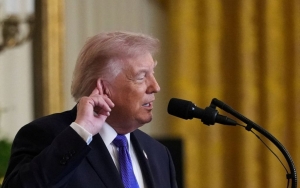
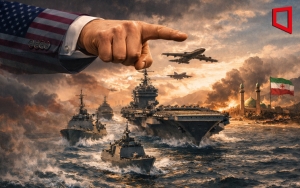
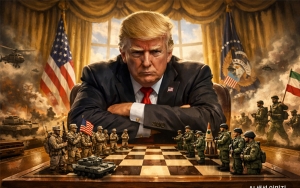
Amid escalating military clashes triggered by US and Israeli airstrikes on Iran, tensions are rising in the Middle East as Iran has also declared its intent to retaliate. In particular, US President Donald Trump stated on March 2 (local time), "We expected this operation to take about four to five weeks, but we are capable of sustaining it for even longer." Experts have suggested that while a prolonged conflict is possible, a full-scale Middle East war is unlikely. Iran's theocratic political system, centered around Supreme Leader Ayatollah Seyyed Ali Khamenei-who was killed in the recent US airstrike-remains deeply rooted in society. Additionally, the Islamic Revolutionary Guard Corps (IRGC), a military organization, continues to wield significant influence within Iran.
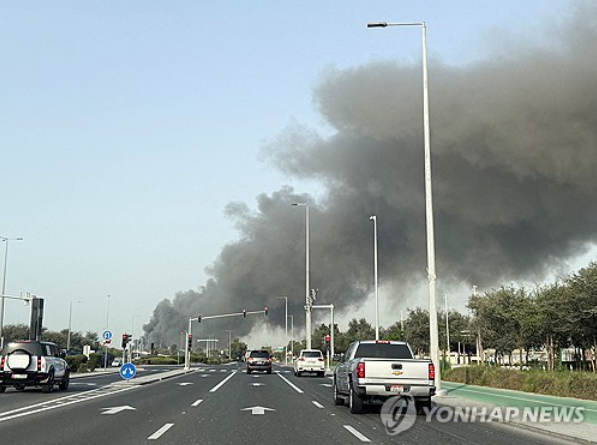 On the 1st, amidst ongoing Iranian retaliation following the US and Israel's attacks on Iran, smoke is rising at Zayed Port in Abu Dhabi, United Arab Emirates. Photo by Yonhap News
Kim Kangseok, Professor of Arabic Studies at Hankuk University of Foreign Studies, said in a phone interview with The Asia Business Daily on March 3, "It will not be easy for the US to oust the Iranian leadership as it wishes," adding, "In fact, after Khamenei, resistance may intensify through a strengthened or even more hardline Revolutionary Guard." He further explained that, similar to the US attempt to oust Venezuelan President Nicolas Maduro in January, Iran's power structure is simply too solid to be toppled in a short period.
In retaliation for the US and Israeli airstrikes that began on February 28, Iran launched missiles at US military bases located in neighboring countries such as Saudi Arabia, Bahrain, Kuwait, and the United Arab Emirates (UAE). Jo Hanbeom, Senior Research Fellow at the Korea Institute for National Unification, analyzed that Iran's strategy goes beyond simple military strikes, amounting to "political psychological warfare." Jo explained, "Iran is maximizing the fatigue of Middle Eastern countries by attacking civilian facilities with weak air defenses under the pretext of targeting US military bases in neighboring countries," and added, "No matter how much they may dislike Iran, if the situation persists where they join forces with the US to attack an Islamic country, public sentiment at home is bound to waver." This is interpreted as Iran using Islamic solidarity to put pressure on the monarchies in the region, as many Middle Eastern countries are ruled by royal families.
Professor Kim further analyzed that the economic interests of neighboring countries could be a variable preventing the conflict from spreading further across the Middle East. He said, "For countries like Saudi Arabia, with its 'Vision 2030,' or the UAE with its economic cooperation projects, economic benefits are extremely important." Park Hyundo, Professor at the EuroMENA Research Institute at Sogang University, also stated, "The losses, such as the destruction of oil facilities due to Iran's counterattacks, would far outweigh any potential gains from participating."
Yoo Dalseung, Professor of Persian at Hankuk University of Foreign Studies, noted, "Although Iran and Saudi Arabia have traditionally been regional rivals and may make official statements expressing their positions, actual military intervention is a different matter," adding, "These countries, which prioritize regime stability, are unlikely to enter the war."
If US military action within Iran is prolonged, there is also speculation that the US could request South Korea, its ally, to send troops or increase its defense cost-sharing contributions. Jo noted, "While economic burdens or demands to boost defense budgets could intensify, the South Korea-US alliance itself is unlikely to be shaken from a security standpoint."
Jo especially predicted, "Watching the Iran situation, North Korean leader Kim Jong Un might become more obsessed with nuclear weapons and deterrence, fearing that without strong deterrence, North Korea could face similar consequences." However, he also noted, "Paradoxically, the likelihood of a North Korea-US summit could increase." From President Trump's perspective, he might seek to showcase diplomatic achievements with North Korea to offset domestic political pressures. Jo added, "Chairman Kim, too, may be more inclined toward dialogue rather than catastrophe after witnessing the overwhelming firepower of the US military, which could rapidly accelerate North Korea-US talks."
© The Asia Business Daily(www.asiae.co.kr). All rights reserved.