Erosion of Full Bench’s Symbolism and Authority
Possibility of Constitutional Review for Judicial Distortion Crime
Concerns over a Four-Instance Trial System with Judicial Appeal
The legal community has been thrown into a state of panic following the passage of the three judicial reform bills by the National Assembly. In particular, with the successor nomination for Supreme Court Justice Noh Taeak, who retires on the 3rd, remaining unresolved for over a month, the “Supreme Court Justice vacancy crisis” continues to lengthen. The aftermath of the passage of the three judicial reform bills, despite strong opposition such as the resignation of Park Youngjae, Chief Justice of the National Court Administration, also appears to be a contributing factor. Some even speculate that, in an extreme scenario, even though the number of Supreme Court Justices has increased to 26, the Supreme Court may opt not to fill the expanded seats immediately by simply delaying the nominations, in effect leaving the seats vacant.
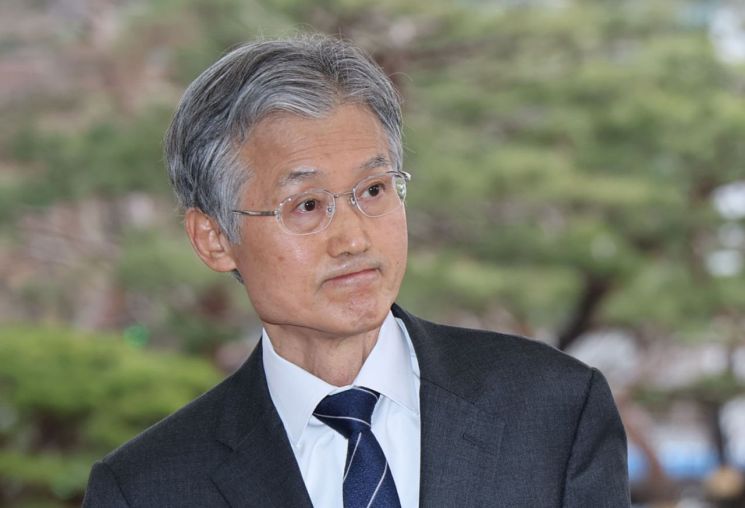
On the morning of the 3rd, Chief Justice Cho Hee-dae told reporters on his way to work that the reason for the delay in nominating new Supreme Court Justices is that “discussions are ongoing,” and added, “I ask the public to carefully consider until the very end whether these sudden reforms and changes truly benefit the people or if there may be any harmful aspects.” On February 28, the National Assembly passed an amendment to the Court Organization Act in a plenary session, increasing the number of Supreme Court Justices to 26. Prior to this, the Assembly also passed back-to-back amendments to the Criminal Act to introduce the crime of judicial distortion, and to the Constitutional Court Act to implement the system of judicial appeals.
As a result, the “14-Justice Supreme Court” system, which has been in place for 39 years since the 1987 constitutional amendment, is now inevitably set to change. Within the judiciary, confusion is mounting, especially regarding how to operate the full bench with the expanded number of justices. Even under the current 14-member system, coordinating the full bench is not easy, and having 26 justices deliberate and reach consensus together is physically challenging. Consequently, there is discussion about operating the bench in separate groups according to case type, such as civil or criminal cases, in a “split full bench” format.
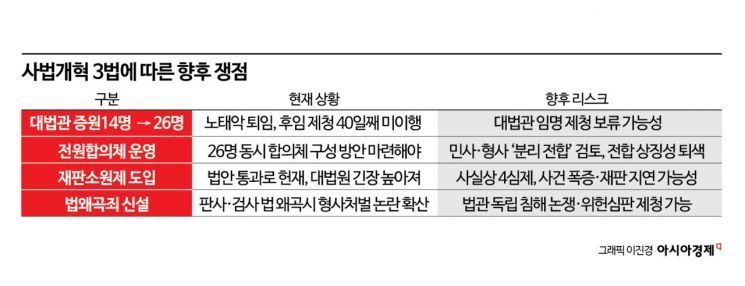
The problem with this approach is that it could undermine the symbolism and authority of the full bench. The full bench has functioned as the Supreme Court’s highest decision-making body, unifying final legal interpretations and revising precedents. However, if it is effectively divided into “large-scale panels,” its function of unifying precedents could become fragmented, diluting the significance of full bench decisions. There is analysis that the increase in the number of justices may not necessarily result in greater efficiency in deliberations.
There is also growing controversy over the constitutionality of the crime of judicial distortion and the judicial appeal system. The crime of judicial distortion stipulates criminal punishment for judges, prosecutors, and others who deliberately distort and apply the law. Critics point out that the elements of the offense are abstract and that allowing retrospective criminal evaluation of trial content could infringe on judicial independence. Many suggest that if actual cases arise, lower courts should consider requesting a constitutional review. The judicial appeal system is also raising concerns that, by including final court rulings as subjects of constitutional complaint, it could effectively create a “four-instance trial system.”
Chief Justice Cho made his opposition public on February 23, stating that these reforms would “harm the public,” and expressed regret over the lack of deliberation in system changes at the National Court Presidents’ Meeting. Nevertheless, the National Assembly pressed ahead with the legislation. At the regular National Court Presidents’ Meeting scheduled for March 12-13, follow-up responses to the implementation of the three judicial reform bills are expected to be discussed.
Meanwhile, the Supreme Court Justice Candidate Recommendation Committee narrowed down the candidates to four on January 21: Kim Min-gi (26th class, Judicial Research and Training Institute), Suh Park-soon-young (25th class, Seoul High Court Judge), Son Bong-gi (22nd class, Chief Judge at Daegu District Court), and Yoon Sung-sik (24th class, Chief Judge at Seoul High Court). However, even after 40 days, Chief Justice Cho has yet to submit an official nomination for appointment.
© The Asia Business Daily(www.asiae.co.kr). All rights reserved.