Ruling Party: "You Must Also Support Daejeon?South Chungcheong Integration"
Opposition: "Just an Excuse"
The political parties continue to play a game of ping-pong over the special bill for the administrative integration of Daegu and Gyeongbuk (TK). The People Power Party adopted the TK integration as an official party policy and passed the responsibility to the ruling party, but the Democratic Party of Korea has once again shifted the responsibility back by linking the push for integration of Daejeon and South Chungcheong-which the People Power Party opposes.
On the morning of March 3, Song Eonseok, floor leader of the People Power Party, stated at a party strategy meeting, "Today is the last day of the February extraordinary session of the National Assembly, which the government had presented as the deadline for administrative integration before the June 3 local elections," and urged, "The ruling party should immediately convene the full session of the Legislation and Judiciary Committee and a plenary session to pass the special bill."
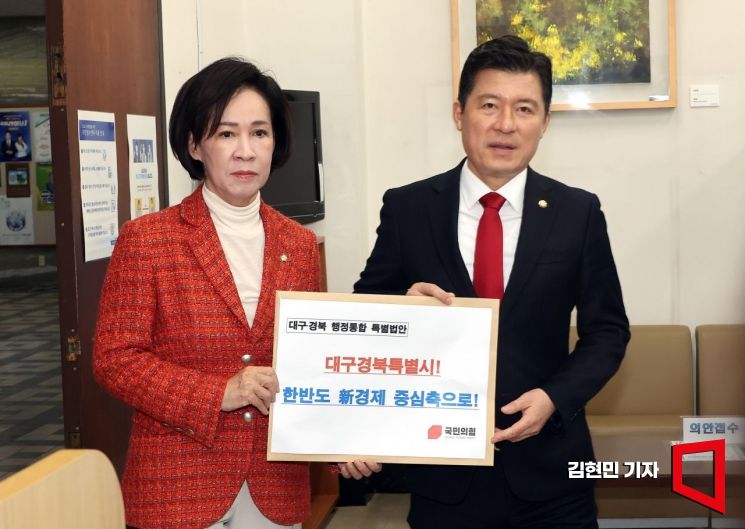 Lee Inseon and Gu Jageun, members of the People Power Party, submitted the Special Act on Administrative Integration of Daegu and Gyeongbuk to the National Assembly Secretariat in Yeouido, Seoul, on January 30, 2026. Photo by Kim Hyunmin
The People Power Party, after holding a general assembly during the holiday, decided as its official position to halt the unlimited debate (filibuster) against the three judicial reform bills and to proceed with the TK special bill. The Democratic Party demanded "consensus" within the People Power Party regarding TK integration. The People Power Party plans to hold a press conference later in the afternoon, attended by TK lawmakers, metropolitan mayors, and provincial council chairs, to increase pressure on the ruling party to process the special bill.
However, the Democratic Party, now in possession of the initiative, is demanding that the special bills for Daejeon and South Chungcheong also be adopted as official party policies and that all the bills be processed together. Han Byungdo, floor leader of the Democratic Party, stated at a morning meeting, "It was the People Power Party that flip-flopped and blocked the bill from being put on the agenda for a plenary session," and insisted, "TK and Daejeon-South Chungcheong must move toward integration together. If this opportunity is missed, all responsibility lies with the People Power Party."
The internal situation within the People Power Party is complicated. In the case of TK, the basic councils of eight northern Gyeongbuk cities and counties-including Andong-have expressed opposition to the integration. For Daejeon and South Chungcheong, not only the city and provincial councils but also Lee Jangwoo, the People Power Party-affiliated mayor of Daejeon, and Kim Taeheum, the governor of South Chungcheong, oppose the integration. Choi Eunseok, chief spokesperson for the People Power Party, told reporters, "After the passage of the special bill for Gwangju and Jeonnam, demanding the simultaneous processing of TK, Daejeon, and South Chungcheong means they have no intention of allowing the bill to pass."
There are also criticisms that the People Power Party leadership has failed to demonstrate political leadership over the issue of administrative integration, which has led to internal strife. It is a matter of great interest in each region, and could change the landscape of the 9th nationwide local elections scheduled for June 3, but the party is criticized for lacking a strategic response.
Starting today, the People Power Party will launch street protests to block the ruling party's so-called "three judicial reform bills" (Constitutional Complaint Act, Judicial Distortion Crime Act, and Supreme Court Justice Expansion Act). In the afternoon, they plan to hold a rally titled "National Appeal and Protest March for Judicial Independence and Protection of Constitutional Order," and will march on foot from the National Assembly to the Presidential Office.
© The Asia Business Daily(www.asiae.co.kr). All rights reserved.