"Spread of Performance-Based Wage Systems"
"Retirement Age Extension Requires Careful Consideration"
Experts have advised that, in a situation where an aging workforce has become the norm, it is more important to promote re-employment rather than simply extending the retirement age without improving the human resources system.
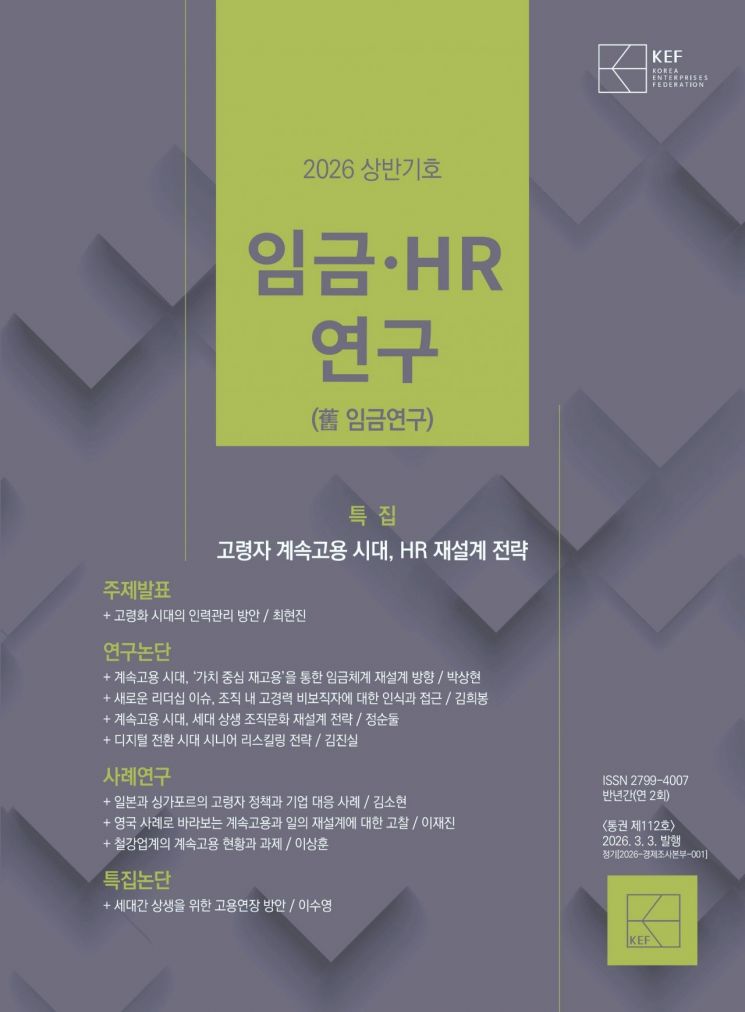
The Korea Employers Federation (KEF) announced on the 3rd that it has published the first half 2026 issue of its periodical “Wage and HR Research,” which contains these findings. “Wage and HR Research” is a biannual publication that selects recent issues related to HR, organizational, and wage systems in domestic and international companies as special topics, and supports rational HR management for companies by delivering the opinions of academic and field experts, as well as case studies from leading companies.
Choi Hyunjin, Senior Partner at Korn Ferry, who gave the keynote presentation, said, “In a situation where rigid employment structures, multi-tiered job grade systems and regular promotion processes unrelated to job roles, and seniority-based compensation systems are undermining corporate productivity, extending the retirement age without fundamentally improving HR practices could become an even greater disaster in an era of population aging. In an era where an aging workforce is the norm, there needs to be an overhaul of the overall HR system, including performance-based compensation, stringent promotion evaluations, and the development and assessment of talent suitable for the AI era.”
Kim Sohyun, Executive Director at PERSOL Korea, who was in charge of the case study, explained, “The reason the re-employment model has become mainstream in both Japan and Singapore, despite differences in the labor market, is that the model simultaneously fulfills three key requirements: flexibility in managing labor costs, the possibility of job redesign, and intergenerational role distribution.”
Lee Jaejin, Research Professor at Oxford University, pointed out, “The reason continued employment for older workers often fails is that organizations still require tasks designed with younger employees in mind,” and introduced examples from UK companies on how to reassign and utilize older workers.
The publication also introduced cases where most domestic steel companies maintain the retirement age at 60 and rehire employees for one year as contract or advisory staff.
Ha Sangwoo, Director of Economic Research at KEF, stated, “There is an urgent need to rapidly redesign HR systems to improve seniority-based HR and wage practices and rigid role allocation structures. As in Japan and Singapore, it is necessary to establish an institutional foundation that allows companies to adjust wages and job roles rationally and flexibly and to have a variety of options.” He added, “The extension of the retirement age should be carefully reviewed while monitoring developments such as the spread of job- and performance-based wage systems and other comprehensive labor market conditions.”
© The Asia Business Daily(www.asiae.co.kr). All rights reserved.