Province Announces 90 Billion Won Forest Policy for 2026
Systematic Management of Half of Province's Area as Forests
Seven Key Policy Initiatives to Be Implemented
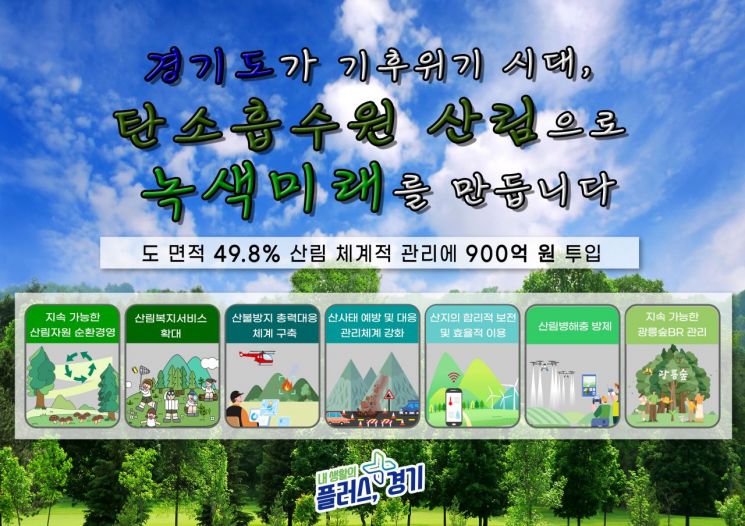
Gyeonggi Province will implement forest projects totaling 90 billion won this year to realize the vision of “Providing a Green Future through Forests as Carbon Sinks in the Era of Climate Crisis.”
Gyeonggi Province announced on March 3 that it has established the 2026 Forest and Greenery Policy based on these plans.
To systematically manage its 5,078.66 km² (507,866 ha) of forests, which accounts for 49.8% of the province’s total area, Gyeonggi Province will focus on seven key policy tasks: 1) Sustainable circulation-based management of forest resources, 2) Expansion of forest-based welfare services, 3) Establishment of a comprehensive wildfire prevention and response system, 4) Reinforcement of landslide prevention and response management, 5) Rational conservation and efficient use of mountainous areas, 6) Forest pest and disease control for resource protection, and 7) Sustainable management of the Gwangneung Forest Biosphere Reserve (BR).
The province will first pursue sustainable, circular management of forest resources. Through afforestation projects covering 5.49 km², it will restore public functions of forests, and through forest tending projects on 37.66 km², it will provide tailored management by function.
To ensure stable income for forestry workers and enhance the external competitiveness of forestry products, the province will support 76 facilities for the production, processing, and distribution of short-term income forest products to build a stable distribution system. Additionally, 221 production infrastructure modernization and expansion projects will improve the productivity and quality competitiveness of forestry products.
To expand forest-based welfare services, one new natural recreation forest will be created, and 28 projects will upgrade existing natural recreation forests, arboretums, forest bathing parks, and forest experience centers for children. A total of 198 personnel-including forest interpreters, children’s forest instructors, forest healing instructors, and forest service assistants-will be deployed to operate forest education and healing programs, creating job opportunities in the sector. By supporting events such as “Children’s Forest Day” and expanding forest welfare programs for all life stages, the province aims to help residents enjoy forests in their daily lives.
To strengthen wildfire prevention and preparedness, 33 wildfire prevention headquarters will be operated at the provincial and city/county levels during the spring and autumn wildfire prevention periods, and an emergency contact system will be maintained year-round. Surveillance personnel will be concentrated in vulnerable areas such as hiking trails, around cemeteries, and at recreation facilities. Prevention activities will be reinforced through tailored public campaigns by season and region. For rapid wildfire response, 19 helicopters leased by cities and counties will be stationed to implement a “golden time” system, aiming for arrival within 30 minutes.
To prevent landslides and related damage, 28 check dams and four forest watershed management facilities will be installed, and 506 existing erosion control facilities will be inspected. Field inspections and repairs or reinforcements will be carried out at 2,547 landslide-prone areas and 881 evacuation sites. In addition, a survey will be conducted at 1,436 locations to expand the management of landslide-prone areas near residential zones and prevent casualties. During the summer disaster response period, a 24-hour emergency duty system will be maintained, centered around the landslide response situation room.
For the rational conservation and efficient use of mountainous areas, the province will use an integrated information system to digitalize permit procedures and systematically manage fees for alternative forest resource creation and restoration. To prevent disasters at forest conversion sites, quarry complexes, and soil and rock extraction sites, deficiencies identified during preliminary field inspections will be addressed, and monitoring support will be provided to nine environmental NGOs.
To prevent the spread of pine wilt disease in severely affected areas and restore mildly affected areas to a healthy state, 41,673 dead or damaged trees will be removed, and preventative measures such as tree injections will be carried out over an area of 11.87 km². For 14 types of forest pests and diseases, including oak wilt disease, control measures will be implemented over 87.42 km².
The “Gwangneung Forest Forum” and contests for photos and short-form videos will be held to promote the value of the Gwangneung Forest UNESCO Biosphere Reserve (BR). Community participation and capacity-building projects will support local community vitalization and future generation education, while expanding cooperation for the conservation of the Gwangneung Forest BR.
Kim Ilgon, Head of the Forest and Greenery Division at Gyeonggi Province, stated, “Forests are core carbon sinks in responding to the climate crisis and are closely connected to residents’ lives. We will steadily implement the 2026 Forest and Greenery Policy to cultivate healthy forests and establish a disaster-resilient forest management system. The province and local governments will work closely together to maintain forest policies that residents can truly feel.”
© The Asia Business Daily(www.asiae.co.kr). All rights reserved.