A stretchable organic light-emitting diode (OLED) that maintains its clarity (brightness) even when stretched like a rubber band has been developed. This breakthrough overcomes the limitations of conventional displays, which dim when their size is increased. The technology has also demonstrated performance stability in repeated stretching environments, further raising the potential for commercialization.
KAIST announced on March 3 that a research team led by Professor Jo Himchan from the Department of Materials Science and Engineering, in collaboration with the University of Chicago and Soochow University in China, has developed a new electrode technology that does not lose electrical connectivity even when stretched.
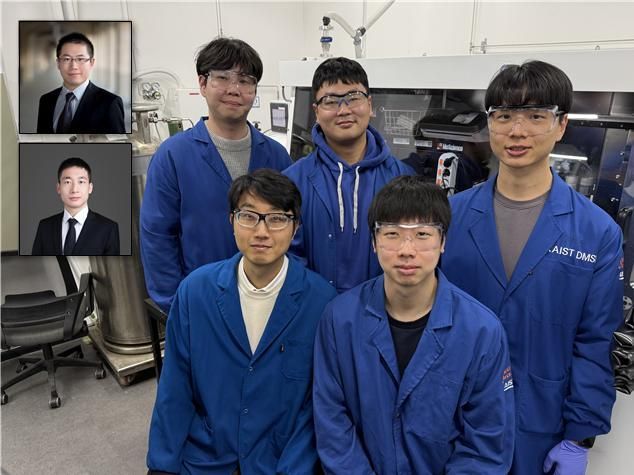 (Front row, from left) Professor Hoim Chan Jo, PhD candidate Wonbeom Lee, (Back row, from left) Master's candidate Jaejun Lee, PhD candidate Seungmin Shin, Dr. Jaedong Jang, (Top left box, from top) Professor Sihong Wang, Professor Wei Liu. KAIST
The electrode is a core component required to supply electricity so that the OLED can emit light. In conventional stretchable OLEDs, it has been difficult for the cathode to satisfy both efficient electron supply and excellent mechanical stretchability at the same time.
However, the joint research team applied a "hybrid liquid metal cathode" (an electrode that supplies electrons) to realize a next-generation stretchable OLED with no performance degradation, thereby enhancing its commercial viability.
The solution lies in "liquid metal." The joint research team densely stacked liquid metal particles and then ruptured only the particles on the surface, creating a smooth, continuous metal layer.
A layer of small particles still remains below, allowing electricity to flow stably along the upper metal layer while the lower layer absorbs shocks when stretched like rubber. This structure results in an electrode that conducts electricity like metal while stretching freely like rubber. This is why the brightness does not decrease even when the display is stretched.
The stretchable OLED utilizing this technology was able to light up at a low voltage of 3.0V (volts), and when operated at 9.5V, it achieved a maximum brightness of 17,670 cd/m². Cd/m² is an international standard unit indicating how bright a screen appears-the larger the number, the brighter the display.
At 9.5V, the brightness achieved by the joint research team exceeds the maximum brightness of standard smartphone displays. The "current efficiency," which indicates the brightness produced per unit current supplied, is also the highest ever reported for stretchable OLEDs worldwide (10.35 cd/A). This means that brighter light can be produced with the same current.
Previously, stretchable OLEDs suffered from decreased brightness due to electrode damage when the display was stretched. However, the technology developed by the joint research team maintained the initial brightness even in the stretched state. This addresses the "brightness decrease when stretched," which has been the most significant weakness of existing technologies.
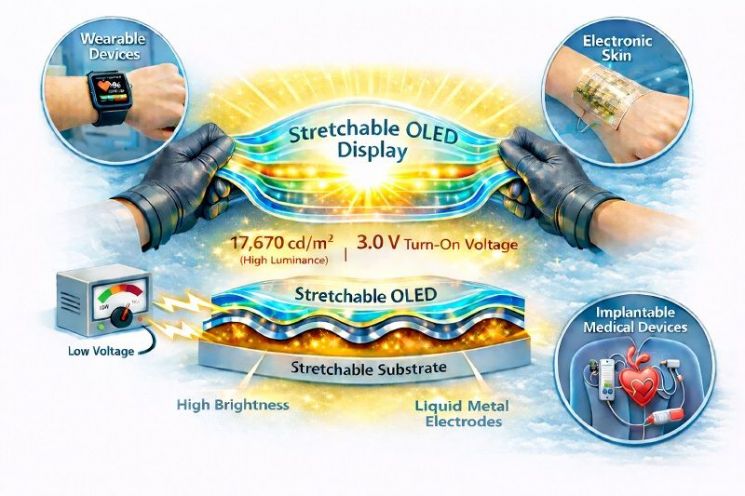
In particular, even after repeated stretching and contraction experiments, both brightness and electrical performance remained stable. This demonstrates durability essential for commercialization, suggesting the device can be used reliably in scenarios such as wearing it like clothing or attaching it to skin without malfunction.
This technology is expected to be widely applied in next-generation flexible electronics, including wearable displays, soft robotics, electronic skin, and implantable medical devices.
Professor Jo stated, "With this research, we have solved fundamental issues of electrode materials, allowing us to overcome performance limitations of stretchable displays. The hybrid liquid metal cathode technology will become a key foundation for next-generation flexible electronic devices."
Meanwhile, Lee Wonbeom, a PhD candidate in the Department of Materials Science and Engineering at KAIST, participated as the first author of this research. The results (paper) were recently published in the international journal 'Advanced Materials' and were also selected as an Inside Back Cover paper for that journal.
© The Asia Business Daily(www.asiae.co.kr). All rights reserved.