All Eyes on US Patent Trial Outcome... Alteogen Secures Major Technology Transfer Deals Ahead
Enzyme-Based "Space Expansion" vs. Concentrated "Compression" Formulations: Full-Fledged Competition Begins
Beyond Legal Watershed, Technological P
The UK Patent Court did not recognize Halozyme's infringement claims in the patent dispute between Merck (MSD) and Halozyme, bolstering Alteogen's global momentum. As this ruling is anticipated to influence lawsuits in Germany and the United States, expectations are rising that Alteogen may accelerate its business expansion in the subcutaneous (SC) formulation market.
Accordingly, attention is focused on whether Alteogen can gain an early lead in the competitive race among domestic and global companies to switch to SC formulations. Analysts point out that, following the alleviation of patent risks, the direction of technological competition is emerging as a more significant factor.
According to the bio industry on March 3, the results of the U.S. patent invalidation trial for Alteogen are expected within the first half of this year. Despite ongoing patent issues, Alteogen has continued to secure large-scale contracts. The company signed technology transfer agreements with AstraZeneca worth up to approximately 2.2 trillion won and with Tesaro, a subsidiary of GSK, worth up to approximately 421 billion won. Alteogen also secured exclusive rights with MSD for the SC formulation of the blockbuster anticancer drug Keytruda.
Alteogen's core technology is the human recombinant hyaluronidase "ALT-B4." This platform temporarily breaks down hyaluronic acid to expand subcutaneous tissue and converts intravenous (IV) antibody drugs to subcutaneous (SC) injections. Its strength lies in enabling the administration of high-dose antibodies in a relatively short period of time.
There is growing interest in whether Alteogen, which has successfully concluded a series of large-scale technology transfer deals, can maintain its edge in the SC formulation platform market. However, experts are divided on whether the SC formulation market will become dominated by a single platform for an extended period. Currently, the market features multi-faceted competition between enzyme-based hyaluronidase technologies like Alteogen's and "ultra-high concentration formulation technologies." In addition, strategies that combine formulation and devices are further complicating the competitive landscape.
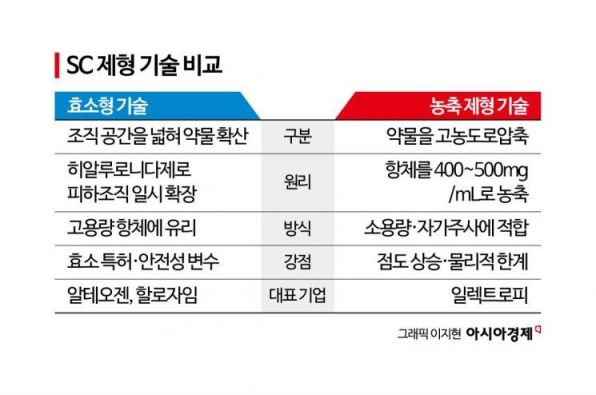
Enzyme-based formulation switching technologies work by temporarily breaking down hyaluronic acid in subcutaneous tissue to create space for drug dispersion. Their advantage is in allowing the administration of high-dose antibodies in relatively large volumes. Halozyme and Alteogen are the leading companies in this enzyme-based technology. Halozyme has collaborated with numerous global pharmaceutical companies based on its recombinant human hyaluronidase "rHuPH20." Both companies temporarily alter the extracellular matrix to expand the space for drug diffusion. This approach is considered particularly competitive for high-dose antibodies, such as immune-oncology drugs that require large administration volumes.
Ultra-high concentration formulation technology works by concentrating the antibody itself to a level of 400-500 mg per 1 mL, thereby reducing the injection volume. This method "compresses" the drug to allow for small-volume injections without altering tissue. In the next-generation SC formulation field based on ultra-high concentration technology, U.S. biotech company Elecrofi is considered a front-runner. Elecrofi's core platform is "Hypercon," which micronizes antibody drugs to enable concentrations of 400-500 mg per 1 mL while suppressing protein aggregation. This technology controls protein-protein interactions that are likely to occur in high-concentration environments, ensuring long-term stability and keeping viscosity low enough for administration via devices such as autoinjectors. Because it does not use enzymes, its dependency on specific patents is considered low, but as concentration increases, viscosity rises sharply, posing physical limitations for ultra-high-dose antibodies.
Previously, Halozyme, which focused on ultra-high concentration formulation technology, acquired Elecrofi for approximately 1.26 trillion won. The strategy is to combine the existing hyaluronidase-based "ENHANZE" platform with Hypercon technology, targeting both the hospital and clinic high-dose administration market and the self-injection, ultra-high concentration, small-volume market. An industry insider commented, "Enzyme-based platforms have strengths in high-volume antibody administration, but the scope of enzyme patents and long-term safety validation remain key variables," and added, "Beyond legal disputes, stability and scalability at the commercialization stage will ultimately determine competitiveness."
© The Asia Business Daily(www.asiae.co.kr). All rights reserved.