Four New Unicorns Last Year: AI Semiconductor Firms Lead the Way
Consumer Goods and Distribution Account for 46% of Korean Unicorns
"Unicorns Face Limits Without Long-Term Capital and Global Expansion"
As deep tech companies such as artificial intelligence (AI) semiconductor firms have newly joined the list of domestic unicorns (unlisted companies valued at over KRW 1 trillion), which has previously been dominated by distribution and platform companies, industry expectations are rising for a stronger presence of "technology unicorns." However, there are also concerns about whether long-term capital that bets on technological competitiveness will follow, as investment practices remain focused on short-term results centered on "revenue growth."
Share of AI/IT Solutions Among Unicorns: 36% Overseas vs. 15% in Korea
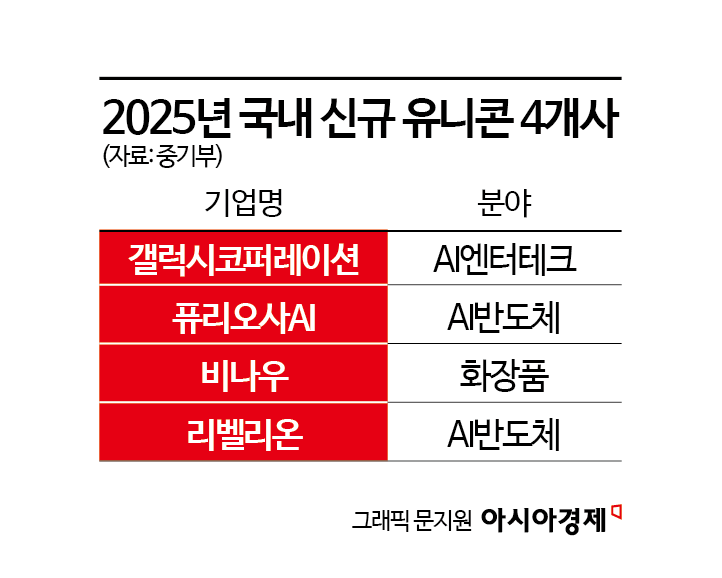
According to the Ministry of SMEs and Startups on March 3, as of December last year, four companies were newly added to the unicorn list: FuriosaAI and Rebellions (both AI semiconductor firms), Vinaw (cosmetics), and Galaxy Corporation (AI entertainment technology). Looking only at these new additions, the industry composition shows a trend of diversification, moving away from a commerce and platform-centric focus.
Nevertheless, the overall landscape is still considered to be heavily weighted toward platform businesses. Among the 27 domestic unicorns, at least 11 are in distribution or platform sectors. This figure only reflects companies clearly categorized as e-commerce, or as platforms in fields such as real estate, travel, or accommodation. While the inclusion of AI semiconductor companies signals "the beginning of change," the platform-centric structure remains dominant and has not yet shifted significantly.
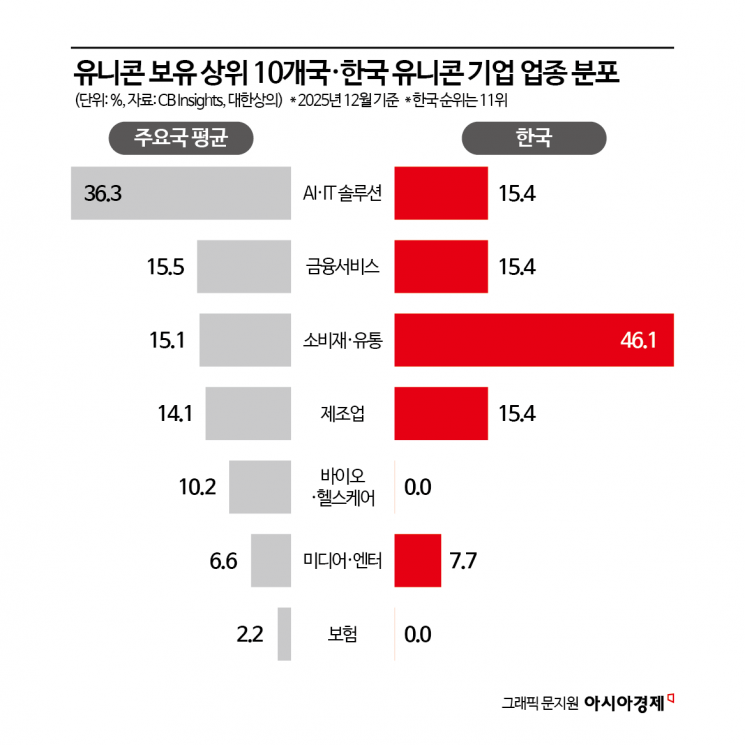
The Korean Chamber of Commerce and Industry also recently compared and analyzed the industry distribution of unicorn companies in major countries versus Korea, highlighting that "Korean unicorns are heavily concentrated in consumer goods and distribution." According to their data, the average industry distribution in major countries showed AI and IT solutions accounted for the largest share at 36.3%, whereas the same sector in Korea was only 15.4%. In contrast, Korea's largest sector-consumer goods and distribution (46.1%)-far exceeded the major country average of 15.1%. The Chamber noted, "It appears urgent to foster promising startups in the 'AI and IT solutions' field, where global competition in advanced strategic industries is fierce."
"Rushed to Meet Revenue Targets... Structural Shift Remains a Challenge"
The venture investment industry believes that both the source of capital and the characteristics of certain industries have contributed to this concentration. An executive at a domestic venture capital firm said, "Distribution and service fields are relatively accessible to foreign investors with abundant capital. This is because distribution and service businesses in Korea are operated on an ICT basis with flagship stores, attracting significant foreign investment."
He continued, "On the other hand, deep tech industries require significant technological capabilities and large-scale, long-term capital. The distribution and consumer goods markets can scale up relatively quickly, which is another reason for their prevalence."
There is also analysis that the evaluation and exit structure, which is skewed toward "revenue-based" metrics, has further reinforced the platform-centric landscape. Another venture capital CEO commented, "Korean venture investors are often focused on meeting revenue benchmarks required for listing on the stock exchange. Even during the IPO process, there is ongoing rigorous screening centered on external growth and profitability."
He added, "By contrast, in the United States and other advanced countries, qualitative aspects are often valued just as highly as quantitative indicators like size. The global standard is to emphasize value from a technological perspective, enabling companies to grow beyond unicorn status and attract capital. There are limits to growing a company solely on domestic revenue. Companies must gradually improve their fundamentals by expanding their client base and market dominance in the global market."
© The Asia Business Daily(www.asiae.co.kr). All rights reserved.