"Chip Design, Fabrication, and AI Software: Korean Talent, Join Tesla"
Elon Musk, CEO of Tesla, has personally stepped up efforts to secure semiconductor talent in South Korea. As competition intensifies in autonomous driving and artificial intelligence (AI) semiconductors, Musk's public call for Korean engineers to join Tesla is drawing keen attention from both the automotive and semiconductor industries.
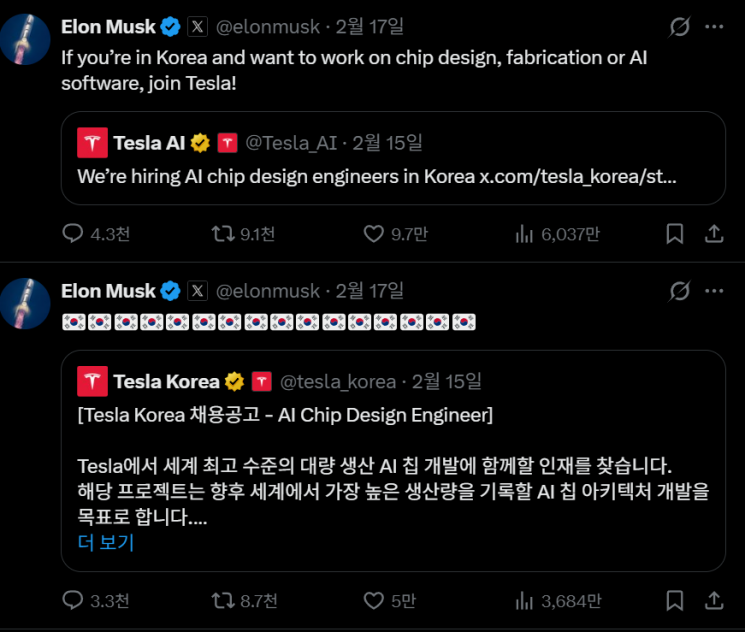 Elon Musk, Tesla CEO, directly reposted Tesla Korea's job posting for AI chip personnel in Korea and encouraged people to join Tesla. X screenshot
On the 17th (local time), CEO Musk posted on his X (formerly Twitter) account, "If you're in Korea and want to work on chip design, fabrication or AI software, join Tesla!"
Earlier, he retweeted a job posting from Tesla's Korea account, posted on the 15th, that read "We're hiring AI chip design engineers in Korea," adding multiple Taegeukgi (Korean flag) emojis to signal his interest in South Korea.
In its job posting for AI chip design engineers, Tesla Korea stated that it is "looking for talent to join the development of world-class, high-volume production AI chips," specifying that the project aims to develop an AI chip architecture that will "achieve the highest production volume in the world" in the future.
Applicants will be evaluated mainly on the three most difficult technical problems they have solved. This is interpreted as an intention to prioritize hands-on experience in high-difficulty design and verification.
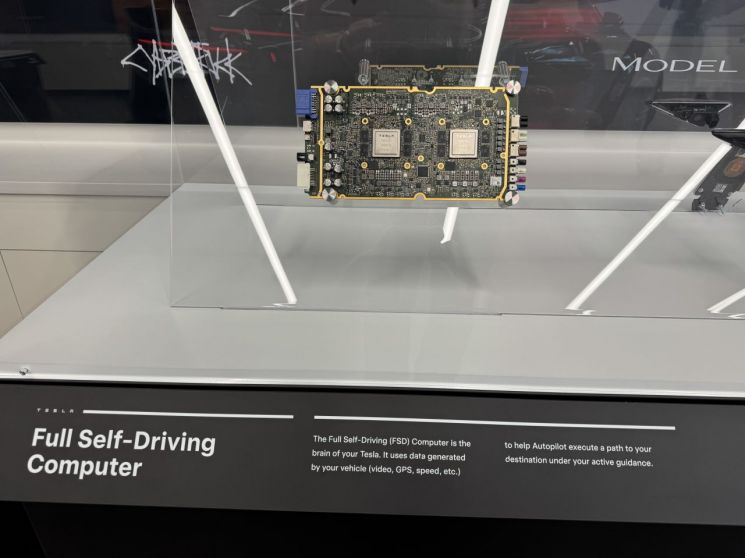 A semiconductor chip used in Tesla vehicles is on display at the Tesla showroom in New Jersey, USA. Photo by Paek Jongmin, Tech Specialist
Industry observers say it is unusual for the head of a global big tech company to single out a specific country and openly recruit semiconductor talent there. This move is seen as a strong vote of confidence in South Korea's semiconductor capabilities.
Tesla already designs its own FSD chips for autonomous driving and installs them in its vehicles, and is pushing ahead with the advancement of next-generation AI chips. According to industry sources, some of Tesla's AI semiconductors are produced through Samsung's foundry processes in Texas, USA.
Last year, Tesla signed a contract with Samsung Electronics to outsource production of its A16 chips, worth about 16.5 billion dollars. Since then, Musk has continued to show interest in semiconductors, including expressing his intention to be actively involved in production within the United States. Tesla's AI chips are installed in autonomous vehicles and the humanoid robot "Optimus," among other platforms.
In a recent earnings call, CEO Musk said, "We need to build a 'Tesla Tera Fab' to remove constraints over the next 3 to 4 years." This reflects a plan to build a large-scale manufacturing facility in the United States that encompasses logic, memory, and packaging at a time when supplies of memory and GPUs are limited. The strategy is interpreted as aiming to reduce reliance on external foundries while simultaneously expanding cooperation with the global semiconductor ecosystem.
As Tesla has now set its sights on semiconductor talent within South Korea, the likelihood of a talent drain from related domestic companies has significantly increased.
© The Asia Business Daily(www.asiae.co.kr). All rights reserved.