Key Tasks of the Climate and Energy Policy Office Work Plan
Targeting a 40% Share of New Electric and Hydrogen Vehicles by 2030
The Ministry of Climate, Energy and Environment has designated this year as the inaugural year for the full-scale implementation of the "2035 National Greenhouse Gas Reduction Target (NDC)" and will accelerate the annual and sector-specific reduction roadmaps. The ministry also plans to establish the Second Basic Plan for Carbon Neutrality and Green Growth (2026-2045) and, in the first half of the year, introduce the "Korea Green Transformation (K-GX) Strategy" to concretize fiscal, tax, and financial support systems.
On January 29, the ministry released the "Key Tasks of the Climate and Energy Policy Office Work Plan," which includes these initiatives. The policy direction for this year is structured around three pillars: completing the national carbon neutrality system, driving the green transformation and growth of the economy and society, and responding to the climate crisis together with the public.
First, the ministry will develop annual and sector-specific reduction roadmaps reflecting the 2035 NDC, pursue the establishment of the Second Basic Plan for Carbon Neutrality and Green Growth, and amend the Basic Act to include the 2050 reduction pathway. The "Korea Green Transformation (K-GX) Task Force," a pan-government and private sector consultative body, will be launched to present the K-GX strategy, including fiscal, tax, and financial support, within the first half of the year.
The implementation foundation will also be strengthened. The Greenhouse Gas Information Center will be reorganized into the "National Climate Science Institute," and sector-specific climate policy research councils will be established to reinforce the scientific basis of policies. At the local level, the ministry will introduce a plan to designate hub centers supporting three to four basic local governments and develop an annual implementation plan for the Jeju Carbon Neutrality Model through 2035. Internationally, the ministry will lead discussions at the 31st Conference of the Parties to the United Nations Framework Convention on Climate Change (COP31) and the G20 Energy Ministers' Meeting, and will launch the K-Initiative in April to share Korea's policy experience.
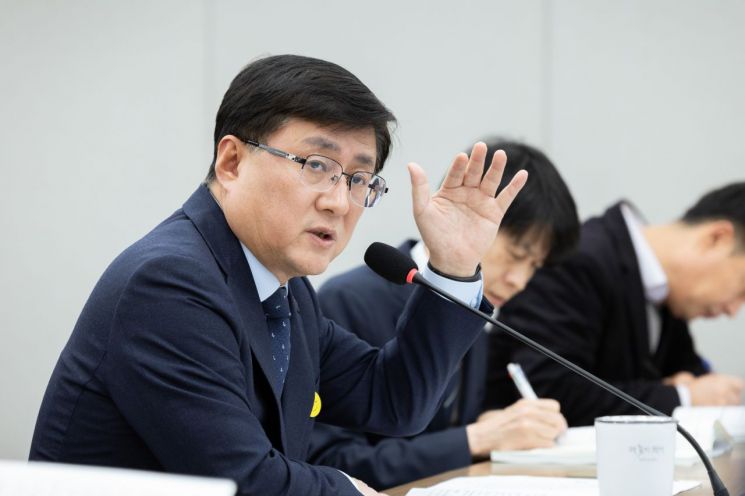 Ministry of Climate, Energy and Environment Subordinate Agencies Work Report in the Environmental Sector
(Seoul=Yonhap News) Kim Seonghwan, Minister of Climate, Energy and Environment, is speaking at the work report meeting of subordinate agencies in the environmental sector held at the Government Sejong Complex on January 14, 2026. [Provided by the Ministry of Climate, Energy and Environment. Resale and database prohibited]
Photo by Yonhap News (End)
In the industrial sector, the ministry will support the transition of hard-to-abate industries through green hydrogen plant demonstration projects (preliminary feasibility study of about 600 billion won), the enactment of the Hydrogen Business Act, and accelerated demonstration of carbon capture, utilization, and storage (CCUS) technologies. The ministry will also pursue the establishment of Korea's own Market Stability Reserve (K-MSR) operating standards and market activation measures for the normalization of the emissions trading market, restructure green finance to focus on reduction effects, link transition finance, and enact the Carbon Neutral Industry Act. To respond to the European Union Carbon Border Adjustment Mechanism (EU CBAM), the ministry will build a lifecycle inventory database (LCI DB), provide consulting for companies, and support the accreditation of domestic verification agencies.
In the transportation sector, the ministry aims to achieve a 40% share of new electric and hydrogen vehicles by 2030 by expanding the subsidy system and promoting the "EV100 Campaign." Infrastructure will be enhanced through the distribution of customized chargers, implementation of vehicle-to-grid (V2G) solutions, and introduction of plug-and-charge (PnC) services for easy payment and charging. The ministry will also promote the electrification of construction and agricultural machinery and the conversion of public vessels to electric ships.
For buildings, the ministry will promote the spread of heat pumps, establish a clean heat system, and strengthen support for the utilization of unused heat sources. Efficiency policies will be pursued in parallel, such as raising the standards for high-efficiency appliances and discovering new models for energy service companies (ESCOs). Overseas expansion of green industries will be broadened through full-cycle management and customized and joint entry support totaling 8.38 billion won.
Public participation will also be expanded. The ministry will promote climate action in daily life through the top 10 nationwide climate action tasks and consultative bodies, and improve the carbon neutrality points system. Welfare measures will be strengthened by expanding the nationwide survey of climate-vulnerable groups, supporting energy vouchers and efficiency improvements, and reviewing climate insurance. Oh Ilyoung, Director General of the Climate and Energy Policy Office, emphasized, "This year is about turning plans into tangible change," and highlighted the importance of balanced reduction and growth.
© The Asia Business Daily(www.asiae.co.kr). All rights reserved.