The Day to Welcome the Deity Who Oversees the Year
Pine Decorations Placed at Every Door
Sharing "Ozoni" Rice Cake Soup and New Year's Money
Just as Koreans start the year with tteokguk (rice cake soup), the Japanese also eat a soup dish with rice cakes called "Ozoni" on January 1. There is also a custom of giving children New Year's money. Since both countries have long histories as agricultural societies, it is natural that their New Year's traditions share many similarities.
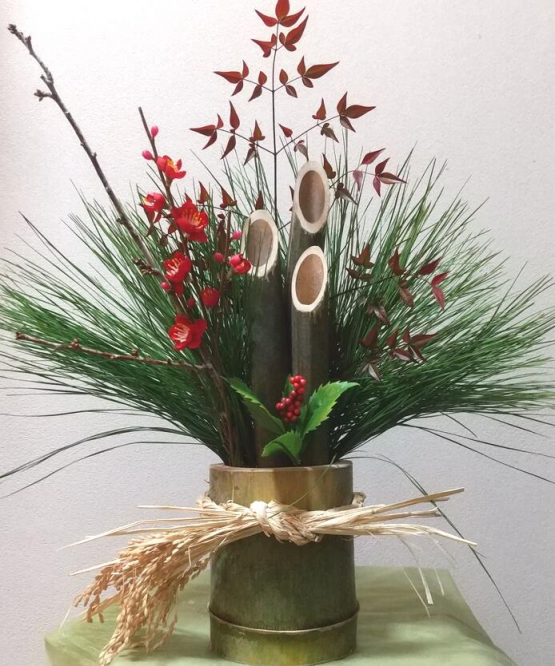
In Japan, it is believed that on the first day of the New Year, "Toshigami" (the Year God) visits each household. Toshigami is a deity who oversees health and well-being for the year. Strictly speaking, Toshigami is the god of grain, and as civilization developed in agricultural societies, the beginning of the year became a time to pray for a good harvest. The ritual of welcoming Toshigami has thus become rooted as a Japanese New Year's tradition. It is said that Toshigami arrives by riding on pine trees. In consideration of this, from the first day of the New Year until the seventh, each household places a decoration called "Kadomatsu"-made by binding pine and bamboo-at the entrance so that Toshigami can stay.
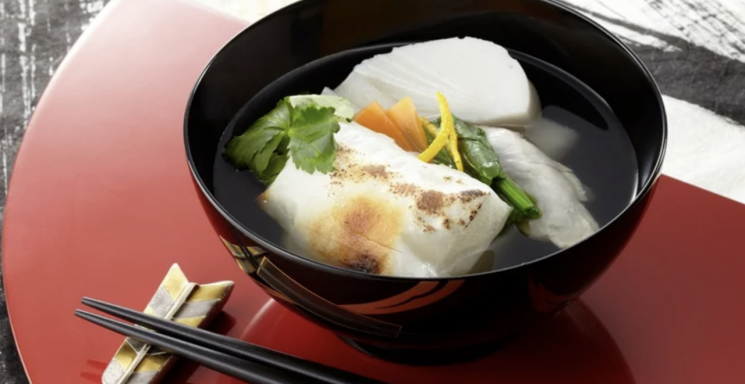
In Japan, people have eaten Ozoni as a New Year's dish since the late 8th-century Heian period. The origin of Ozoni lies in offering rice cakes, taro, carrots, and daikon radish in clean water to Toshigami, then boiling them over the first fire of the year and eating them. The stretching rice cakes symbolize longevity, the sprouting taro represents the prosperity of descendants, the smoothly rounded daikon radish signifies family harmony, and the red carrots are believed to ward off evil. Since rice cakes were once a luxury, it is said that commoners who could not afford them would use taro instead.
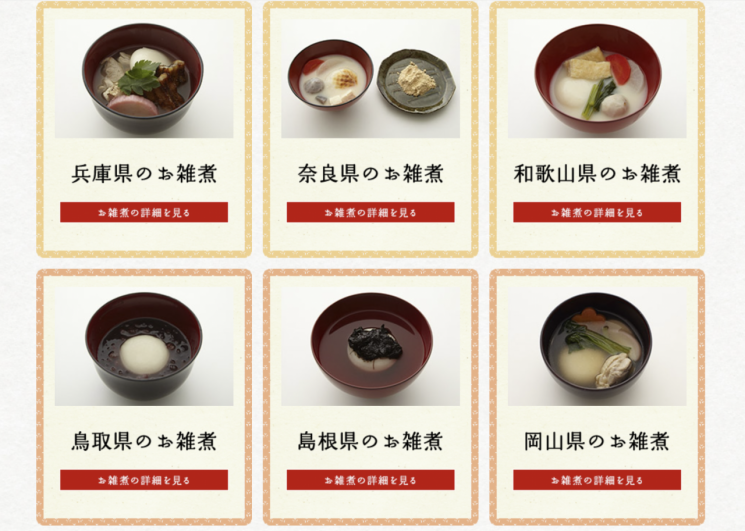
Just as the shape and ingredients of the rice cakes in Korean tteokguk vary by region, Japan also has many regional varieties of Ozoni. The differences are so great that some types of Ozoni are unfamiliar even to Japanese people. The biggest difference is the shape of the rice cakes. In the Kanto region, rectangular rice cakes with sharp edges are used, while in the Kansai region, round rice cakes are preferred. The reason for using rectangular rice cakes in Kanto is that during the Edo period, the population was concentrated there, and cutting rice cakes was a faster and more efficient way to produce them than shaping each one by hand, which led to this tradition.
The method of making the broth also differs. Typically, a broth is made by simmering katsuobushi (dried bonito flakes) and kombu (kelp), then seasoning it with soy sauce or salt. However, in some regions such as Fukui Prefecture, a miso-based broth is used. In Tottori and Shimane prefectures, the broth is made by mashing red beans for a sweet flavor. Local specialties are sometimes added as well. For example, in Hyogo Prefecture, which was once a whaling base, whale meat is added to Ozoni, while in Hiroshima Prefecture, oysters are used. There are many other unique forms of Ozoni. For instance, in Kagawa Prefecture, Ozoni is made by boiling rice cakes filled with sweet red bean paste in miso broth, and some people visit Kagawa just to try this dish. In Nara Prefecture, it is customary to dip the rice cakes in soybean flour before eating.
In addition, there is a culture of giving money to children on New Year's, similar to Korea's New Year's money. This is called "Otoshidama." Like Ozoni, this custom originated from the tradition of sharing rice cakes offered to Toshigami among family members. The act of distributing the rice cakes was performed by the head of the household, who served as Toshigami's representative, which led to the custom of elders giving money to younger family members. As in Korea, it is considered polite to give crisp new bills in envelopes.
© The Asia Business Daily(www.asiae.co.kr). All rights reserved.