[Time on the AI Battlefield: Trapped by the 52-Hour Rule]
⑤ Countries Where Immersive Development Is Possible Without Time Limits
US Implements the White-Collar Exemption System
UK Allows Over 48 Hours of Work Through the Opt-Out System
Japan'
#. "I am looking for someone who wants to work more than 100 hours a week with me, beat all American companies, and develop a world-leading product. The annual salary is 200 million won in cash, plus stock options."
 A job posting seeking an executive-level developer to work locally in New York, USA has shaken the Korean artificial intelligence (AI) startup industry. ChatGPT generated image.
A job posting seeking an executive-level developer to work locally in New York, USA, has shaken the Korean artificial intelligence (AI) startup industry. Last year, Hong Hyun, CEO of Project Pluto, posted the job on the social networking service LinkedIn, describing a position unimaginable in Korea, where the 52-hour workweek must be observed. Just one year after posting the job, Project Pluto has grown into a startup providing AI agents to Wall Street. Its major clients include Millennium, a large US hedge fund, and analysts from Morgan Stanley.
Working 100 hours a week is possible if you subtract only meal and sleep time (about 9.7 hours per day on average) from the 168 hours available in a week (7 days x 24 hours). Hong believes that if executives and employees immerse themselves together, they can achieve results through short-term research and development. He strongly criticized, "Labor standards laws in Korea, such as the 52-hour workweek regulation, are backward systems that promote self-destruction in the era of global competition."

Major countries, in order to advance their AI industries, do not impose uniform working hours; instead, they have systems that allow exemptions from working hour limits or permit work without additional pay under certain conditions.
In the United States, the "white-collar exemption" system exempts high-income workers from working hour restrictions. The target group is high-income earners with annual incomes of about $107,000 (approximately 150 million won) or more. Under the Fair Labor Standards Act (FLSA), this applies to fields where it is difficult to measure working hours or where performance-based compensation is required, such as IT, finance, and research and development, including developers. The key feature is that companies can deploy personnel whenever needed, maximizing production efficiency.
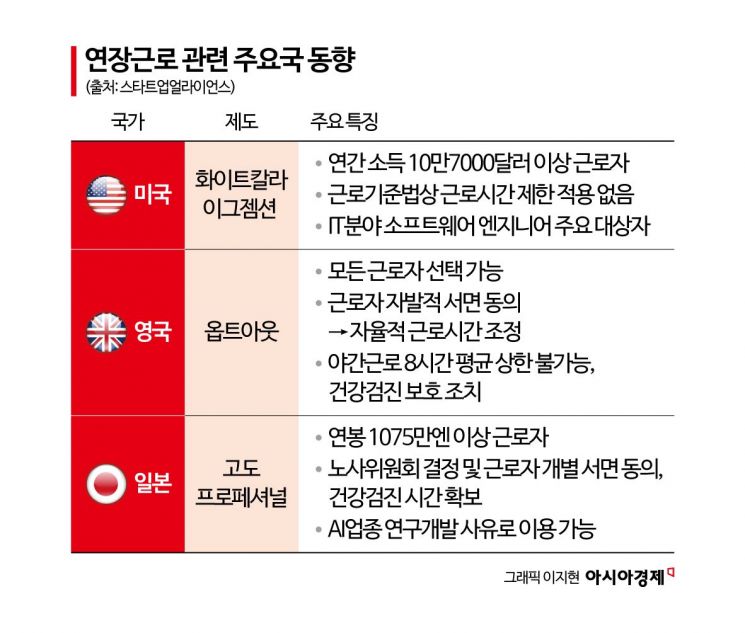
The United Kingdom, a leader in the AI field in Europe, operates a system where employees can voluntarily choose to work overtime, unlike other countries. The UK has introduced the "opt-out" system, which allows employees to work more than 48 hours per week. Unlike the US, where the system is limited to high-income workers, the UK imposes few restrictions on eligibility. Any employee aged 18 or older can choose to opt out, regardless of income, and there is no set duration. However, the choice must be voluntary and documented in writing; verbal agreements are not valid. Night work, however, is capped at 8 hours, and health protection measures such as mandatory health checks must be provided. If an employer penalizes or dismisses an employee for refusing to opt out, legal action can be taken.
Japan guarantees overtime through the "highly professional system." This system targets high-income earners with annual salaries of 10.75 million yen (about 10 million won) or more. According to the Ministry of Health, Labour and Welfare, as of the end of March this year, 1,390 people at 36 companies were using the highly professional system. The system includes decisions by labor-management committees, individual written consent from employees, and measures to ensure health management. It is applied across various occupations and job types. In the AI field, research and development is included under the highly professional system, making overtime possible. Other eligible areas include financial product development, the work of fund managers, traders, and dealers, as well as securities analysts and consultants.
 Lee Jae-myung, the presidential candidate of the Democratic Party of Korea, participated in the 'K-Innovation' brown bag meeting at an officetel in Pangyo, Seongnam, Gyeonggi Province on the 12th, holding a discussion with IT developers and office workers in their 20s and 30s from Pangyo. 2025.5.12 Photo by Kim Hyunmin
Kwon Hyukwook, Professor of Economics at Nihon University, explained, "This system was introduced as part of a 'work style reform' to evaluate employees based on performance rather than working hours." He added, "The highly professional system can also be used for AI development." He continued, "Recently, the Japanese government has included AI as a key area for development and is actively supporting it, and companies and universities are also making efforts in line with this."
However, it is known that the system's use is somewhat limited because salaries in Japan's AI industry are not particularly high. Lee Changmin, Professor at the Department of Japanese Studies Convergence at Hankuk University of Foreign Studies and Director of the Korea-Japan Policy Research Center, said, "Although, in theory, AI researchers and advanced technology personnel can use the system since research and development of new technologies and products are included as eligible duties, the complex administrative procedures-such as establishing labor-management committees and recording health management hours-are a hurdle for AI companies and startups."
© The Asia Business Daily(www.asiae.co.kr). All rights reserved.
![Clutching a Stolen Dior Bag, Saying "I Hate Being Poor but Real"... The Grotesque Con of a "Human Knockoff" [Slate]](https://cwcontent.asiae.co.kr/asiaresize/183/2026021902243444107_1771435474.jpg)

















