Rising Demand for Basics and Functional Apparel Over Trends
Strong Performance by Uniqlo, Topten, and Musinsa Standard
Failure of Fast-Fashion Giants to Respond
Although the global fashion industry has entered a phase of slowing growth, SPA (Specialty store retailer of Private-label Apparel) brands that integrate manufacturing and distribution are enjoying a boom thanks to a rebound in performance. As the period of high inflation has been prolonged, consumers have shifted toward spending that prioritizes "value for money" above all else. With demand rising for basic apparel that can be worn across all four seasons rather than trend-driven items that simply follow the latest fashions, the SPA model, which is based on mass production and strong price competitiveness, is drawing attention.
However, unlike the expansion in overall market size, the brands leading this segment are changing rapidly. ZARA and H&M, once symbols of global fast fashion, still maintain their status as major players, but many say they no longer display the overwhelming presence in the Korean market that they once did.
According to the industry on the 23rd, global SPA brand Uniqlo surpassed 1 trillion won in sales in the Korean market for the second consecutive year. Its sales for the 2025 fiscal year (September 2024 to August 2025) reached 1.3524 trillion won, up 27.5% from a year earlier. This is the highest sales figure among SPA brands in Korea.
Industry watchers analyze that Uniqlo’s rebound in performance is largely the result of a strategy focused on strengthening its functional innerwear and basic product lines. Instead of trend-leading items, the company pushed seasonal essentials such as Heattech and AIRism to the forefront, thereby raising average transaction value and repeat purchase rates. Many assess that it has built a portfolio optimized for consumer sentiment in an economic downturn.
The rapid rise of homegrown SPA brands is also notable. Topten, operated by Shinsegae International, recorded sales of around 900 billion won in 2025, ranking second in the industry. This is similar in scale to the 970 billion won in annual sales it disclosed for 2024. Its strength is seen as lying in securing accessibility by building a dense offline store network centered on major commercial districts. With price points similar to those of Uniqlo, it has added the identity of being a "domestic brand" and, according to analysts, has secured a stable customer base.
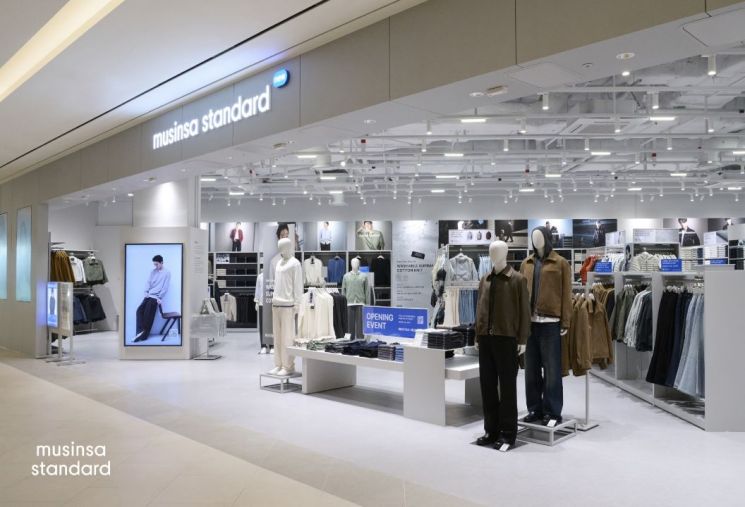
Brands based on online platforms are also showing striking growth. Musinsa Standard is reported to have recorded annual sales of 470 billion won, combining online and offline channels. This represents an increase of more than 40% from the previous year. Product planning based on platform data and rapid inventory turnover are cited as its growth drivers.
As competition among top-tier brands has intensified, the domestic SPA market is rapidly being reshaped into a "domestic demand-centered structure." Strategies that strengthen functional and basic products, while fine-tuning prices and fits to local preferences, are emerging as the key determinants of success or failure.
In contrast, global SPA brands ZARA and H&M are showing limited growth in the Korean market. Inditex, which operates ZARA, posted sales of over 35 billion euros (about 60 trillion won) in 2024, and the H&M Group also maintained sales of around 23 billion euros (about 40 trillion won), demonstrating solid competitiveness in the global market. However, in Korea, the number of their stores has decreased, and their sales growth has been limited. In the case of Zara Retail Korea, sales in 2024 came to 460 billion won, up only 3.49% from the previous year, and it is known that last year’s figure was at a similar level. During the same period, sales at H&M’s Korean subsidiary grew 4.75% to 370 billion won.
Industry insiders point to insufficient product localization by these brands as the main reason. One industry official said, "H&M produces mainly based on global standard sizes, whereas brands like Uniqlo are launching separately planned products that take Korean body types into account," adding, "Korean consumers are sensitive to fit and size suitability, and this seems to have worked as a weakness for them."
Differences in distribution strategies have also had an impact. In Korea, as consumption has rapidly spread around fashion platforms such as Musinsa, price comparison, review checking, and fast delivery have become basic competitive factors. ZARA and H&M, on the other hand, have stuck to strategies centered on their own online malls and offline stores. While this has allowed them to maintain control over their brands, many evaluate that they have been conservative in expansion strategies that leverage platform traffic.
An industry source said, "Korean consumers simultaneously consider price, fit, and delivery speed," and added, "ZARA and H&M still retain their symbolism as global brands, but in the Korean market they no longer offer as distinct an appeal as they once did."
© The Asia Business Daily(www.asiae.co.kr). All rights reserved.
![Clutching a Stolen Dior Bag, Saying "I Hate Being Poor but Real"... The Grotesque Con of a "Human Knockoff" [Slate]](https://cwcontent.asiae.co.kr/asiaresize/183/2026021902243444107_1771435474.jpg)

















