[Time on the AI Battlefield: Trapped by the 52-Hour Rule]
④ The Limits of the 52-Hour Workweek According to AI Startups
Interview with Lee Gidae, Head of Startup Alliance Center
"Only industries with low added value that can survive on a 52-hour workweek will remain in Korea."
Lee Gidae, Head of Startup Alliance Center, responded with this prediction when asked by The Asia Business Daily what the future would look like if there were no changes to the current 52-hour workweek system. The Startup Alliance is a private, non-profit organization launched in 2014 through the participation of the Ministry of Science, ICT and Future Planning (now the Ministry of Science and ICT), along with IT companies such as Naver and Kakao. The organization publishes a report titled "The Reality Faced by AI Startups," based on surveys conducted within the AI industry.
 Lee Gidae, Head of Startup Alliance Center, is giving an interview to The Asia Business Daily on the 26th of last month. Photo by Dongju Yoon
Lee believes that the 52-hour workweek is an obstacle to the growth of the AI industry. He stated, "This is not about indiscriminately increasing working hours for all employees," emphasizing, "At the very least, we should remove time restrictions for core personnel in the AI field so that they can secure enough time for development." According to a recent survey by the Startup Alliance of 1,000 employees at AI startups, 64.6% of respondents said, "If properly compensated, I am willing to work more than 52 hours per week." Only 19.3% gave a negative answer, saying they would not work overtime.
He continued, "The AI sector is so competitive that every advanced country must jump in as if it were a war. It makes no sense for only Korea to be shackled by the 52-hour rule," adding, "There is an aspect of overprotecting workers. We should not hinder the process by which AI startups pursue their dreams." He further warned, "Those who are truly committed to their work do not want to be restricted by working hours. Ultimately, the outflow of key talent will become inevitable."
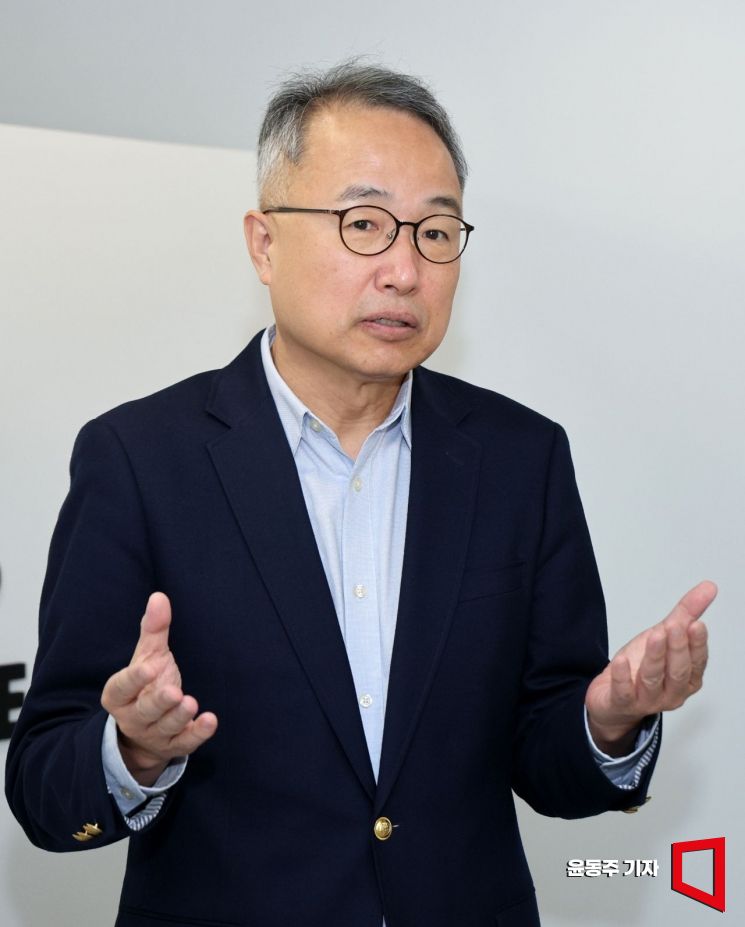 Lee Gidae, Head of Startup Alliance Center, is being interviewed by The Asia Business Daily. Photo by Dongju Yoon
The regulation stipulating up to two years in prison or a fine of up to 20 million won for violating the 52-hour workweek is a significant burden for the AI industry. Lee pointed out, "If people who want to grow their companies are subject to criminal and civil penalties for working overtime, who would want to work?"
Lee suggested that if the 52-hour workweek were applied more flexibly, working hours could be managed at the discretion of employees rather than enforced by employers. He explained, "In the AI era, it is impossible to produce high-quality results without autonomy. Trying to control work by the clock, as in a manufacturing plant, is meaningless in this age." He reiterated, "Developers do not just sit in front of a computer all day. They attend meetings, think on their own, and sometimes come up with development ideas unexpectedly. Therefore, when they need to focus, we must remove time restrictions so they can work intensively."
Lee also said, "The rapid growth of China's AI industry was possible because of the 996 work system (9 a.m. to 9 p.m., six days a week), which fostered a culture where people worked extremely hard." He added, "Korea must also encourage people to immerse themselves in their work when they want to. If we continue to manage talent merely by counting hours spent at a desk, there will be no future."
About Lee Gidae
© The Asia Business Daily(www.asiae.co.kr). All rights reserved.
![Clutching a Stolen Dior Bag, Saying "I Hate Being Poor but Real"... The Grotesque Con of a "Human Knockoff" [Slate]](https://cwcontent.asiae.co.kr/asiaresize/183/2026021902243444107_1771435474.jpg)

















