[Time in the AI Battlefield, Trapped by the 52-Hour Rule]
③Special Extended Work System Fails to Reflect AI Industry's Unique Needs
"Impossible to Get Approval for Every Project"
Although the special extended work system-which allows for overtime beyond the 52-hour workweek with employee consent and approval from the Minister of Employment and Labor-is currently in place, the AI industry has been unable to take full advantage of it. The utilization rate of this special extended work system has been declining for three consecutive years.
According to data submitted by the office of Kim Sohee, a member of the National Assembly's Climate, Energy, Environment and Labor Committee, from the Ministry of Employment and Labor on December 21, the number of special extended work approvals dropped from 9,119 in 2022 to 6,424 in 2023, and to 6,389 last year. As of October this year, there have been 5,979 cases, and considering that the year-end season is typically less busy, it is likely that this year's total will be similar to or even lower than last year's figure. The number of companies utilizing the special extended work system has also declined each year, from 2,938 in 2022 to 1,745 this year. Only 0.3% of all companies have applied for special extended work approval.
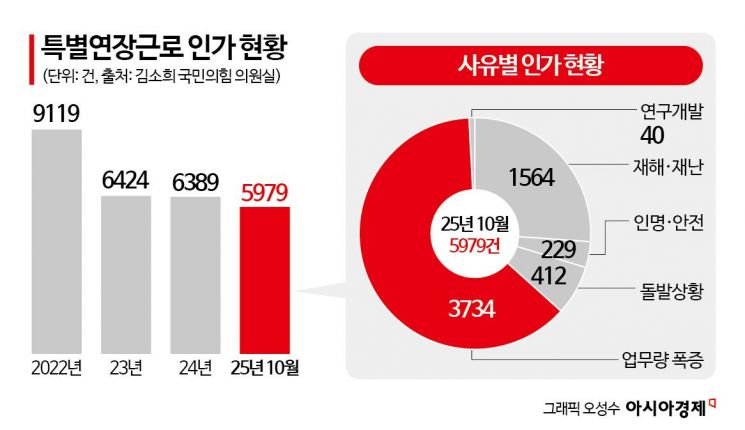
The special extended work system can be applied for under five specific circumstances: ▲ disaster/calamity, ▲ life/safety, ▲ unexpected situations, ▲ surge in workload, and ▲ research and development. By industry, manufacturing accounts for the largest share of special extended work approvals at 41.8%, followed by public administration (22.3%), other sectors (16.1%), and transportation and warehousing (11.2%).
The most common reasons companies apply for special extended work are ▲ surge in workload and ▲ research and development. However, there have been almost no cases of companies engaged in AI development and research utilizing this system.
If a company receives approval for a surge in workload under the special extended work system, overtime can be extended for up to four weeks. However, AI startups point out that this system does not reflect the realities of their work, as their projects typically run on three- or six-month cycles with small teams. Furthermore, startups often face urgent situations where projects must be completed within three to five days, leaving no time to wait for government approval. One startup industry insider lamented, "Does it make sense to have to get approval from the Minister of Employment and Labor every time we work on a project? This is only possible in very exceptional cases, so in reality, it's almost as if we're being told not to do it at all."
The most suitable reason for the AI industry to apply for special extended work appears to be research and development. Under this category, the maximum approval period is three months per application, and extensions are possible upon review if the period exceeds three months. However, under current law, AI development work is not included among the eligible research and development activities for special extended work approval. Only semiconductor, materials, components, equipment, and items subject to Japanese export restrictions are permitted. This is a major source of frustration in the industry.
The Korea Employers Federation (KEF) recently recommended that the government allow special extended work for research and development in the AI sector, just as it does for semiconductors. The reason is that it is difficult to quickly train and secure talent in the AI field, so trained workers must be allowed to work overtime flexibly in order to compete globally. A KEF official said, "Korea is not a leading country in AI technology but a latecomer, so we need to immerse ourselves in research as soon as possible. If we do not make working hours more flexible, it will be extremely difficult to catch up with leading companies."
 President Lee Jae-myung participated in the 'K-Innovation' brown bag meeting at an officetel in Pangyo, Seongnam, Gyeonggi Province, on May 12, when he was the Democratic Party presidential candidate, holding a discussion with IT developers and office workers in their 20s and 30s in Pangyo. 2025.5.12 Photo by Kim Hyun-min
Major countries around the world are more flexible in allowing overtime in the AI sector. According to the KEF, in Japan, overtime is allowed simply by reporting to the Ministry of Labor if both labor and management agree. In Germany, overtime can be implemented without additional requirements in the event of sudden emergencies. In France, special extended work is permitted with labor inspector approval for time-limited tasks or temporary increases in workload. In the United States, there are no time restrictions on special extended work at all.
In contrast, the Ministry of Employment and Labor maintains a negative stance on expanding special extended work. While acknowledging the industry's demands and concerns, the ministry continues to prioritize the principle of protecting workers' health in line with the current government's policy. A ministry official said, "If there is a surge in workload, companies should first apply for the special extended work approval system. If that is not feasible, we recommend utilizing flexible work arrangements such as the selective working hour system, which allows employees to adjust their start and end times freely. We also offer workplace innovation consulting, so companies can seek alternative solutions through consultations."
Assemblywoman Kim stated, "The AI industry is ready to go beyond the 52-hour workweek, but the system is not keeping up. The current system does not reflect this reality at all," she criticized.
© The Asia Business Daily(www.asiae.co.kr). All rights reserved.
![Clutching a Stolen Dior Bag, Saying "I Hate Being Poor but Real"... The Grotesque Con of a "Human Knockoff" [Slate]](https://cwcontent.asiae.co.kr/asiaresize/183/2026021902243444107_1771435474.jpg)
















