[Time in the AI Battlefield: Trapped by the 52-Hour Rule]
⑥ What Is Needed to Make the 52-Hour Workweek More Flexible
Protecting Health Rights with Clear Job and Wage Standards
Compensation Linked to Stock Options and RSUs Is Essential
There are calls for the introduction of a "Korean-style white-collar exemption" system to compete with leading AI nations such as the United States and China. Experts agree that the current 52-hour workweek should be made more flexible to allow for extended working hours, while institutionalizing health protections and economic compensation. As research into improving the 52-hour workweek system has begun, led by the Ministry of SMEs and Startups, attention is focused on whether institutional reforms will accelerate in the future.

The Current State of Korea's AI Industry
South Korea, aiming to become one of the top three AI powers, is currently facing a shortage of developers and field experts in the AI sector. According to the "Global AI Index 2025" released by Tortoise Media in the UK on December 26, Korea ranked fifth overall in AI capabilities. Although Korea's overall ranking was high among 93 countries surveyed, it ranked only 13th in talent and 17th in the industrial ecosystem. This indicates not only a shortage of developers and AI professionals, but also that the scale and scope of private investment and the dynamism of the industrial ecosystem are relatively lacking.

In particular, Korea lags far behind the United States and China in terms of talent. According to the "National Strategic Technology R&D Workforce Survey" published by the Ministry of Science and ICT and the Korea Institute of Science and Technology Evaluation and Planning, Korea has only 21,000 core AI researchers, ranking ninth in the world. In the same survey, China ranked first with 410,000, followed by India with 195,000, and the United States with 120,000. In a report by the Australian Strategic Policy Institute, which analyzed the number of citations for advanced data analytics technologies such as AI, the top 25% of cited researchers were concentrated in China and the United States. China accounted for 22.5% of undergraduate degrees, while the United States had the highest rates for graduate degrees and employment at 27.8% and 25.3%, respectively. In Korea, all these rates were only in the 3% range.
Given these circumstances, there are also limits to the growth of AI companies in Korea. An analysis by the Korean Chamber of Commerce and Industry of the global unicorn (privately held startups valued at over $1 billion) list from CB Insights found that, as of October this year, 36.3% of unicorns in the top 10 countries, including the United States and China, were in the AI and IT solutions sector. In contrast, in Korea, only 15.4% were in these sectors.
The Need to Introduce a Korean-Style White-Collar Exemption System
There is growing support for revising the 52-hour workweek system to allow highly skilled workers in the AI industry to immerse themselves in their work for longer periods. Professor Yoon Dongyeol of Konkuk University's Department of Business Administration has argued for the introduction of a Korean-style white-collar exemption system, setting conditions such as clear standards for duties, wages, and roles; autonomy through written consent, the right to withdraw, and prohibition of disadvantages; and minimum continuous rest to protect health. Professor Yoon explained, "If the side effects of unofficial long working hours outside the formal system are added, both the sustainability of the industry and social trust could be undermined," emphasizing the urgency of institutional reform. He also warned, "Because top talent prefers a flexible, performance-oriented work environment, there is a high risk that they will move to Japan or the United States rather than remain at rigidly regulated Korean companies."
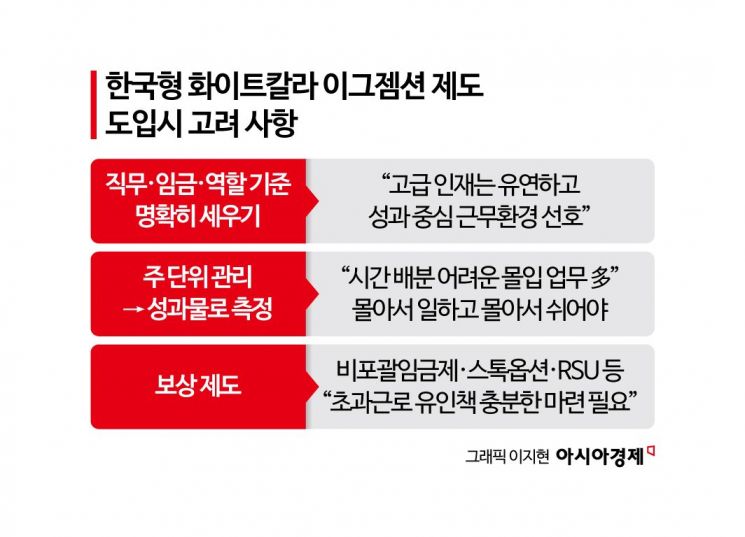
AI research and development does not have clearly defined work methods or time allocation. Therefore, measuring performance rather than total weekly working hours is more conducive to focused work. Sufficient rest must also be guaranteed. For example, employees could work unlimited overtime for three months, then take a concentrated three-month break. Yoo Ilho, Head of Employment and Labor Policy at the Korean Chamber of Commerce and Industry and author of the report "International Comparison and Implications of Working Hour Exemption Systems," said, "The goal is not simply to allow long working hours, but to provide autonomy so that employees can choose to work overtime," adding, "At the same time, sufficient vacation and compensation should be provided for periods of intensive work."
There are also calls for financial compensation measures to be discussed alongside improvements to the 52-hour workweek system. By switching to a non-inclusive wage system, additional work hours can be properly compensated, and mechanisms such as stock options and restricted stock units (RSUs) are needed to attract highly skilled workers to the AI sector. Recently, Naver has implemented stock grants, and SK Telecom has introduced performance-based stock units (PSUs). By actively providing incentives to employees, companies can secure top talent.
Government's Conservative Position: "Social Consensus Needed"
The government is currently conducting research on relaxing the 52-hour workweek regulations, but only in the venture (startup) sector. The Ministry of SMEs and Startups is promoting research into a "venture-type working hours system." The aim is to develop a suitable working hours system for certain employees who have received stock options.
The Ministry of SMEs and Startups stated, "We understand that employees in the field have an open attitude toward extended work hours," and added, "More than 70% of employees at venture companies have said that they would accept working beyond the 52-hour limit if sufficient compensation is provided, so we believe further research is needed into working hours suitable for startups."
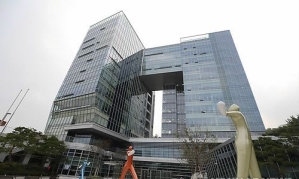
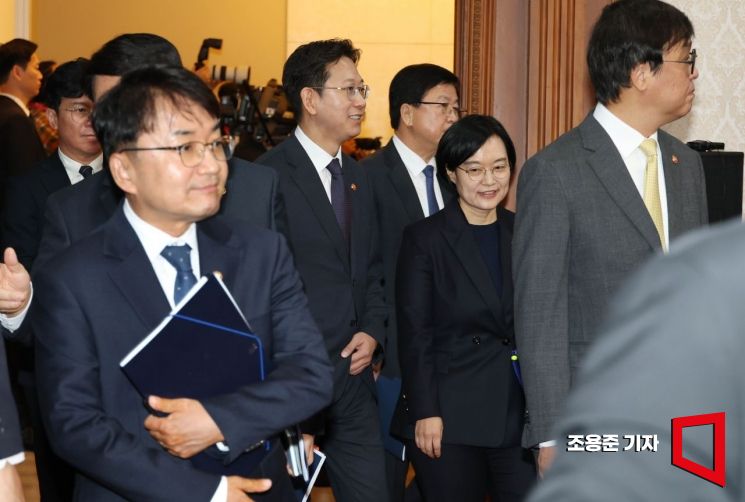 Baek Kyunghun, Deputy Prime Minister for Science and Technology, Han Seongsuk, Minister of SMEs and Startups, and other cabinet members are entering the Cabinet Meeting held at the Government Seoul Office in Jongno-gu, Seoul on November 25. 2025.11.25 Photo by Jo Yongjun
However, the Ministry of Science and ICT and the Ministry of Employment and Labor, which are responsible for AI and the Labor Standards Act, are reluctant to pursue institutional reforms, citing a lack of social consensus. The Ministry of Science and ICT said, "Improvements to the 52-hour workweek system require social consensus, so we will consider various opinions from the industry and other stakeholders." An official from the Ministry of Employment and Labor expressed a somewhat negative stance, stating, "Working hours have a significant impact not only on corporate productivity but also on workers' health and work-life balance, so social dialogue involving both labor and management is necessary."
Discussions in the National Assembly are also progressing slowly. The amendment to the Labor Standards Act, which would allow exceptions to the 52-hour workweek regulation, has not passed the relevant standing committee, the Climate, Energy, Environment, and Labor Committee, and remains pending. Discussions on the amendment are expected to continue into next year.
© The Asia Business Daily(www.asiae.co.kr). All rights reserved.