[Time on the AI Battlefield: Trapped by the 52-Hour Workweek]
② Survey of 30 AI Companies
83.3% Say "Uniform 52-Hour Workweek Needs Improvement"
Eight out of ten domestic AI companies believe that the 52-hour workweek is hindering AI development work. The AI industry points out that managing work hours on a uniform weekly basis makes it difficult to respond to rapidly changing situations, which in turn undermines the competitiveness of AI technology. There are growing calls to first reform the 52-hour workweek, which slows down research and development, in order to become one of the top three AI powerhouses.
According to a survey conducted by The Asia Business Daily from December 8 to 12 among companies located in the Yangjae AI Special Zone in Seoul, 24 out of 30 respondents (80%) said that the current 52-hour workweek is causing disruptions to their work. Only 6 companies (20%) responded that there were no disruptions.
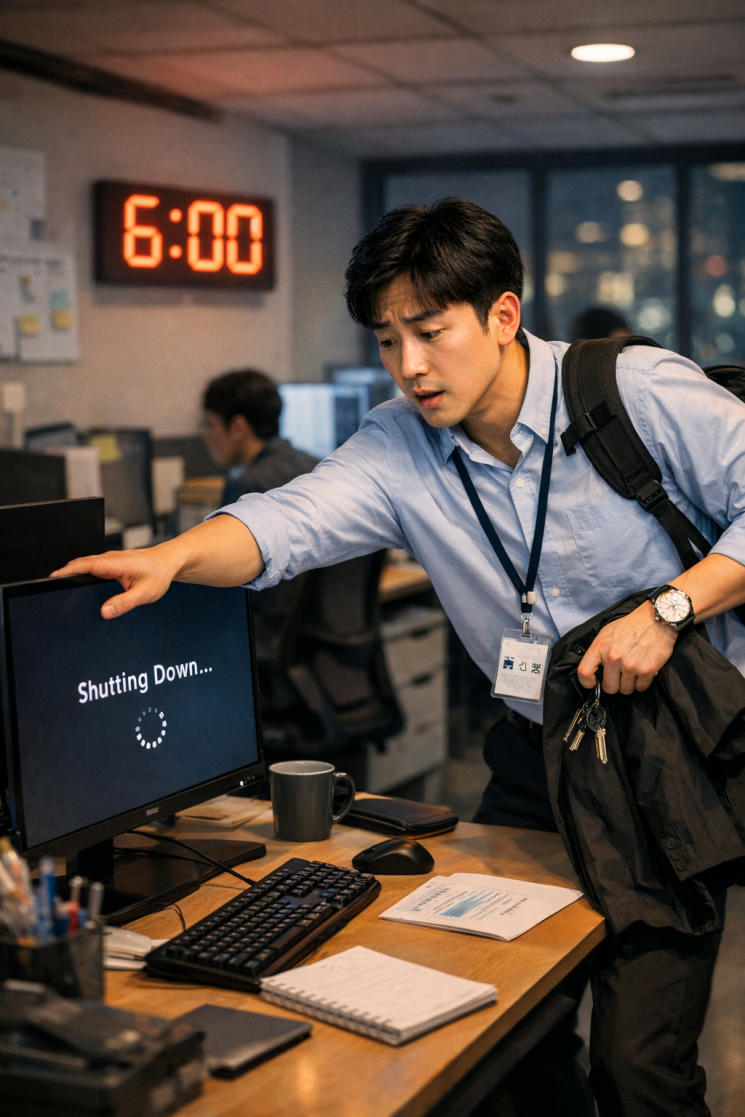
An AI industry insider commented, "In innovative industries, workloads are not consistent, and the level of immersion varies greatly depending on the project. When developing a new service, intensive work is required at certain times, followed by periods of relative downtime. However, the 52-hour workweek fails to account for this nonlinearity in work, ultimately resulting in missed opportunities and negative side effects."
According to the survey, 63.3% of responding companies admitted to working overtime, unable to comply with the 52-hour rule. Park Jooyoung (37, pseudonym), who has been running an AI startup for three years, said, "Trying to find ways around the system often leads to working from home after hours. In reality, we are working, but it is frustrating not to be able to openly acknowledge it."
The main reason for overtime was "immersion in technology development work to survive in the competition," cited by 56.7% of respondents. This was followed by "meeting project deadlines" (36.7%) and "collaborating with countries in different time zones, such as the United States and Europe" (6.7%). Not a single respondent cited overtime due to a supervisor's directive. Another AI industry insider noted, "Imposing daily, weekly, or monthly work hour limits does not suit performance-oriented employees. Forcing people to leave while they are immersed in their work reduces work efficiency and causes companies to fall behind."
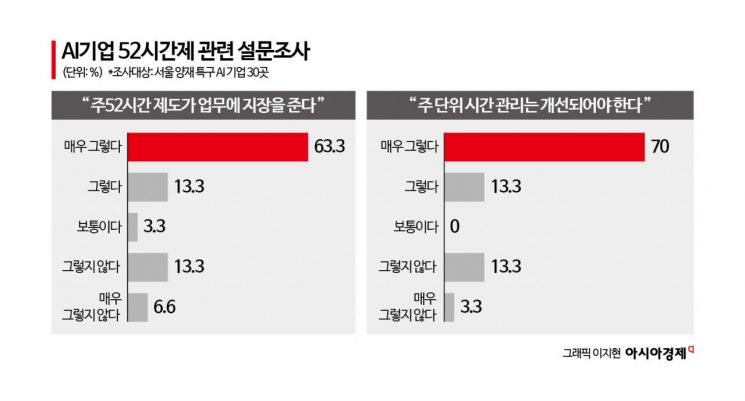
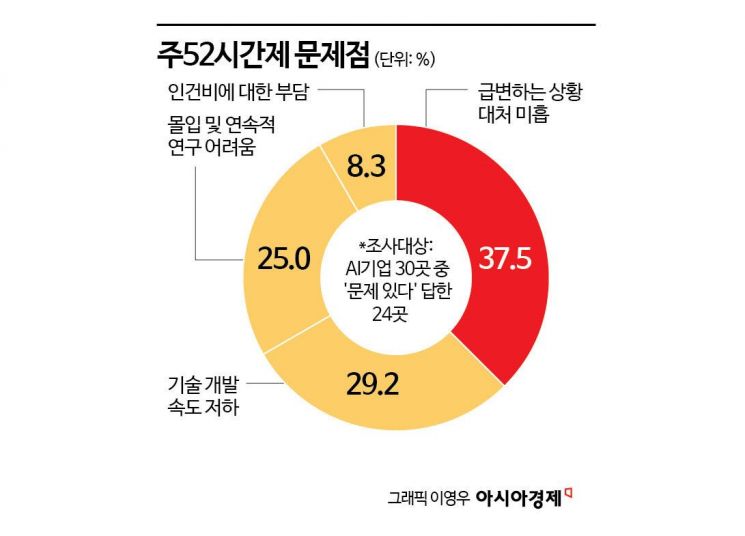
Among the AI companies surveyed, 83.3% said the 52-hour workweek needs to be improved. The main issues cited were: ▲inadequate response to rapidly changing situations (37.5%), ▲slower pace of technology development (29.2%), and ▲difficulty in maintaining immersion and continuous research (25.0%). Some companies (8.3%) also cited the burden of labor costs.
On the other hand, companies that said the 52-hour rule was not a major issue most frequently cited "having sufficient staff" (50%) as the reason. An anonymous AI industry insider said, "Even though we pay extra wages for overtime, startups where technological capability is vital for survival feel a significant burden and sense of responsibility." Another insider explained, "I've seen many cases where team members who want to immerse themselves in research without worrying about work hours lose motivation due to the legal work hour limits."
Recently, more AI startups have been relocating their headquarters overseas. Domestic AI startup leaders expressed their envy. One startup CEO said, "There are many job postings in Silicon Valley looking for people to work with me to change the world and to work 80 hours a week. I feel that intensive work is necessary for innovation, but as a CEO, I am very cautious about saying such things."
Kim, who has run an AI startup for nearly 10 years, said, "Even remote workers abroad are subject to the domestic legal entity, so overtime issues arise due to the 52-hour workweek. Even though we pay annual salaries in the hundreds of millions of won, potential lawsuits and other issues may arise, so I ask employees not to work on weekends."
Large corporations operate various welfare programs to manage AI talent. A representative from an AI research institute run by a major company said, "Since the 52-hour workweek limits how much we can increase salaries, the company provides separate health management programs and other support. For research and development roles, we apply an expanded flexible work system, such as allowing evening shifts."
The AI industry believes that even if overtime beyond the 52-hour workweek is permitted, employee voluntariness should be prioritized, and the right to refuse overtime must be fully guaranteed. They want decisions about work arrangements to be left as much as possible to the autonomy of companies. The most frequently cited prerequisite for allowing overtime was "guaranteeing employees the right to refuse overtime for voluntary agreement and choice" (40%). This was followed by "adopting a non-inclusive wage system that compensates for actual hours worked" (20%), "mandatory health checkups after a certain number of working hours to guarantee health rights" (20%), and "thorough supervision by the Ministry of Employment and Labor to prevent abuse" (10%). Other suggestions included "allowing it as long as there is an agreement between employer and employee" and "leaving it up to autonomy."
An HR manager in the AI industry said, "Overseas companies offer clear performance-based rewards, so only those who want to work harder remain, which leads to the company's growth. In contrast, in Korea, conflicts over overtime frequently occur between field workers and management."
© The Asia Business Daily(www.asiae.co.kr). All rights reserved.