Aliexpress and Temu's Growth Stalls
C-commerce Security Risks Resurface... Multiple Fines Imposed
In the wake of Coupang's large-scale personal data breach, concerns over e-commerce security have heightened, leading to growing distrust among consumers toward Chinese e-commerce (c-commerce) platforms. As c-commerce companies have repeatedly been fined for violating personal information protection laws during the process of transferring customer data overseas, there are projections that the Coupang incident could hinder their growth in South Korea.

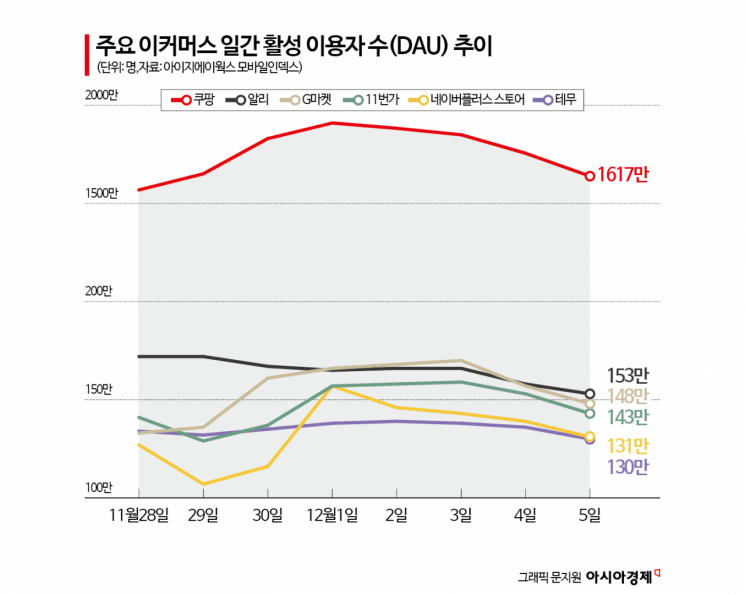
According to the retail industry on December 9, data from IGAWorks Mobile Index shows that Aliexpress's daily active users (DAU) decreased from 1.72 million on November 29 to 1.68 million on December 1. During the same period, Temu saw only a slight increase from 1.33 million to 1.36 million. In contrast, domestic e-commerce platforms saw notable growth: Naver Plus Store's DAU rose from 1.07 million to 1.58 million, and Gmarket's DAU increased from around 1.3 million to 1.6 million.
Industry sources believe that the Coupang incident has once again highlighted the security risks associated with c-commerce. Previously, Aliexpress was fined approximately 2 billion won by the Personal Information Protection Commission in July last year for transferring personal data to a Chinese company without customer consent. The commission also imposed a 1.4 billion won fine on Temu in May for unauthorized overseas transfer of personal data and the collection of resident registration numbers. Chinese fashion platform Shein was fined 150 million euros by the French data protection authority (CNIL) for unauthorized collection of personal information and other violations.
These c-commerce companies have repeatedly faced criticism for their vulnerability in managing personal information, as customer data is transferred through overseas servers and third-party companies. According to Aliexpress's "Personal Information Processing Policy," a purchaser's name, address, contact information, payment details, personal customs clearance code, shared entrance access code, and delivery location information may be provided to overseas sellers during order, payment, delivery, and customs clearance processes. Temu states in its "Personal Information Processing Policy" that users may refuse to consent to the provision of personal data, but if they do, the range of services provided by the company may be limited.
However, most analysts believe that this incident is unlikely to lead to a "Quit Coupang" movement. In fact, following the data breach, Coupang's DAU reached a record high of 18 million on December 1. While Coupang's DAU fell from 16.25 million on November 29 to about 16.17 million on December 5, indicating a gradual increase in user departures, many still expect a significant number of customers to continue using Coupang due to its delivery convenience.
Naver has strengthened its membership benefits this year and launched "Kurly N Mart" in partnership with Kurly to compete with Coupang. However, many point out that its logistics service competitiveness is weak due to reliance on multiple courier companies. In addition, offline retailers such as large supermarkets and Super Supermarkets (SSMs) are expected to find it difficult to break Coupang's strong customer lock-in effect, as late-night operating bans have been in place for over a decade. Lee Jongwoo, professor of business administration at Ajou University, commented, "Naver's service expansion is accelerating, but the limited product selection due to a lack of proprietary logistics centers remains a drawback. For domestic platforms to grow further, the key will be how quickly they can build logistics, data, and security infrastructure."
© The Asia Business Daily(www.asiae.co.kr). All rights reserved.