4.71 Billion KRW Invested Since 2023 for Network Reconstruction
Tenfold Increase in Internet Speed, IP Mobility, and Full Redundancy
Keimyung University (President Shin Ilhee) recently announced on December 3 that it held a 'Completion Report Meeting for IT Network Advancement Project' at the Seongseo Campus, officially concluding the SDN (Software Defined Network)-based network reconstruction project that had been underway since December 2023.
This project marks the first case among Korean universities to fully transition the entire campus network to an SDN-based structure, significantly enhancing the stability and performance of the university's information infrastructure and establishing a core foundation for building a next-generation smart educational environment.
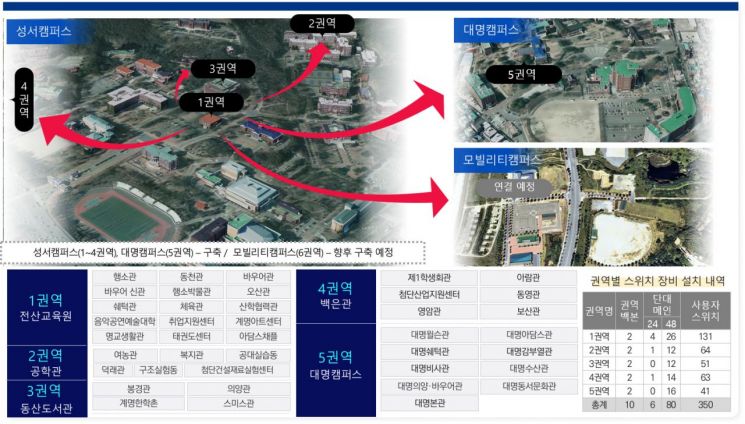 Keimyung University has completed the construction of an end-to-end SDN network, the first among domestic universities (equipment installed by region). Provided by Keimyung University
Keimyung University invested a total of 4.71 billion KRW to completely replace its existing network, which was originally built in 2004.
The project was carried out according to a regional transition plan aligned with the academic calendar, ensuring there was no service interruption. Notably, it was completed over two years without a single major failure.
The core of this advancement is the implementation of a full-scale SDN fabric using a Spine-Leaf-based Full-Mesh architecture.
This has enabled the complete redundancy of main equipment in each building, IP Mobility that maintains the same network environment even when users move locations, logical network separation among students, faculty, and staff, the establishment of a 40G main backbone with a foundation for future expansion to 100G, and more. The internet speed for end-user devices has improved about tenfold, from the previous 100M to 1G, greatly enhancing perceived quality.
Students can now attend online lectures and reliably upload large content or work on team projects without reconnecting as they move between classrooms, libraries, and club rooms.
Faculty members can seamlessly use experimental equipment, smart devices, and lecture platforms without interruptions, ensuring smooth class flow and a stable network environment even during exam periods.
Administrative staff benefit from improved security due to the separation between the student network and the work network, and with main equipment in each building being redundant, administrative services are maintained even in the event of unexpected failures. Furthermore, the logical network separation system fundamentally blocks the risk of exam question leaks through faculty PC hacking, which had previously been a concern.
Yoon Kwangyeol, Executive Vice President for Administration at Keimyung University, stated, "We redesigned the complex infrastructure into a simple and visible structure, increasing both the speed and reliability of incident response," adding, "As the first Korean university to successfully build an SDN-based network, we will continue to advance security and expand the mobility campus."
Operational efficiency has also been greatly improved.
Keimyung University adopted the network automation management solution 'CloudVision,' automating the entire process from initial installation to operation and monitoring.
Authentication, policy, and DHCP were designed with a triple-redundancy structure to enhance service stability and security, and each network is linked to a dedicated firewall to completely block mutual intrusion risks.
The university expects synergy between its policy of 'full adoption of generative AI services for all faculty and students' and this network advancement.
It provides eight paid AI services, including ChatGPT and Gemini, for free, and is expanding AI education across all majors and faculty fields in cooperation with KT and Microsoft. In order to reliably implement generative AI-based education, a high-performance, high-availability network is essential, and this advancement is expected to have a significant impact.
President Shin Ilhee of Keimyung University said, "The advancement of our IT network is a key foundation that determines university competitiveness in the digital era," adding, "We will continue to upgrade our infrastructure to the latest security standards and ultra-high-speed networks so that students can study and conduct research seamlessly anywhere."
© The Asia Business Daily(www.asiae.co.kr). All rights reserved.