Apartment Scaffolding Netting Fails Fire Safety Standards
Contractor Used "Half-Price" Materials to Cut Costs
Illegal Practices Rampant in the Renovation Industry
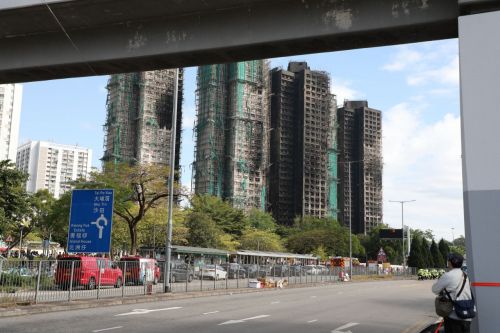 A resident is looking at the disaster site in front of the 'Wong Fuk Court' apartment complex in Tai Po, northern Hong Kong, where a large fire broke out on the 29th of last month (local time). Photo by Yonhap News Agency
There are growing calls pointing to corruption in Hong Kong's aging apartment renovation market-rife with bid-rigging and inflated construction costs-as the root cause behind the deadly apartment fire disaster that claimed at least 156 lives.
On December 3 (local time), the South China Morning Post (SCMP) cited former industry insiders and experts, reporting that this fire has exposed the open secret of greed within Hong Kong's renovation industry.
In Hong Kong, it is mandatory to renovate aging buildings. Authorities annually hire professional consultants to inspect and contract repairs for around 600 buildings over 30 years old. For contractors, it is considered a gold mine. As of the end of 2022, about 9,600 buildings-over 20% of all private buildings-were reportedly over 50 years old.
The fire in question broke out in seven buildings of the 32-story Wong Fuk Court apartment complex while renovation work was underway. Authorities revealed that some of the netting used on scaffolding (temporary structures at high-rise construction sites) did not meet fire-retardant standards. The contractor had replaced some of the netting with cheaper, non-fire-retardant products-costing half as much-after typhoon damage, in an effort to save on expenses.
According to internal documents, the renovation budget for the apartment where the fire occurred was 152 million Hong Kong dollars (about 28.7 billion won) at the initial bid analysis in September 2023. However, SCMP explained that the final amount last year surged to 336 million Hong Kong dollars (about 63.4 billion won) due to the addition of premium options and other factors.
A representative from the Anti-Bid-Rigging Property Owners’ Alliance explained that it is a common illegal practice in the renovation industry for consulting firms to secure contracts at low prices and then collude with contractors to carry out the project at much higher costs than the actual expenses. Some contractors intentionally increase costs by adding unnecessary work and using expensive techniques.
He pointed out that although an agency to prevent bid-rigging was established in 2016, its role is limited. He also highlighted the problem that final contract approvals are made at owners’ association meetings, where results can be manipulated through proxy voting and other means. He stated, "It has become a structural problem. Bad money drives out good," and added, "The challenge is how to restore public trust and bring reputable contractors back to the market."
Ricky Wong, a real estate investment consultant at King Value, explained that the practice of contractors setting up multiple companies to bid has been ongoing for 10 to 20 years. In effect, the transparency and fairness of the bidding process have been undermined.
A representative from the Hong Kong Construction Workers’ Union criticized, "Contractors bid at low prices and then add costs here and there." He pointed out that since contracts are awarded to the lowest bidder, safety and quality issues arise. He said, "Everyone is fighting for the lowest price, so the entire market has become rotten. If a job worth 10,000 Hong Kong dollars is awarded for 8,500, what do you think will happen? They will use substandard materials or ignore procedures."
In response, a representative from the Hong Kong Society of Building Safety urged the government to take action, such as establishing an agency to oversee the renovation process.
© The Asia Business Daily(www.asiae.co.kr). All rights reserved.